
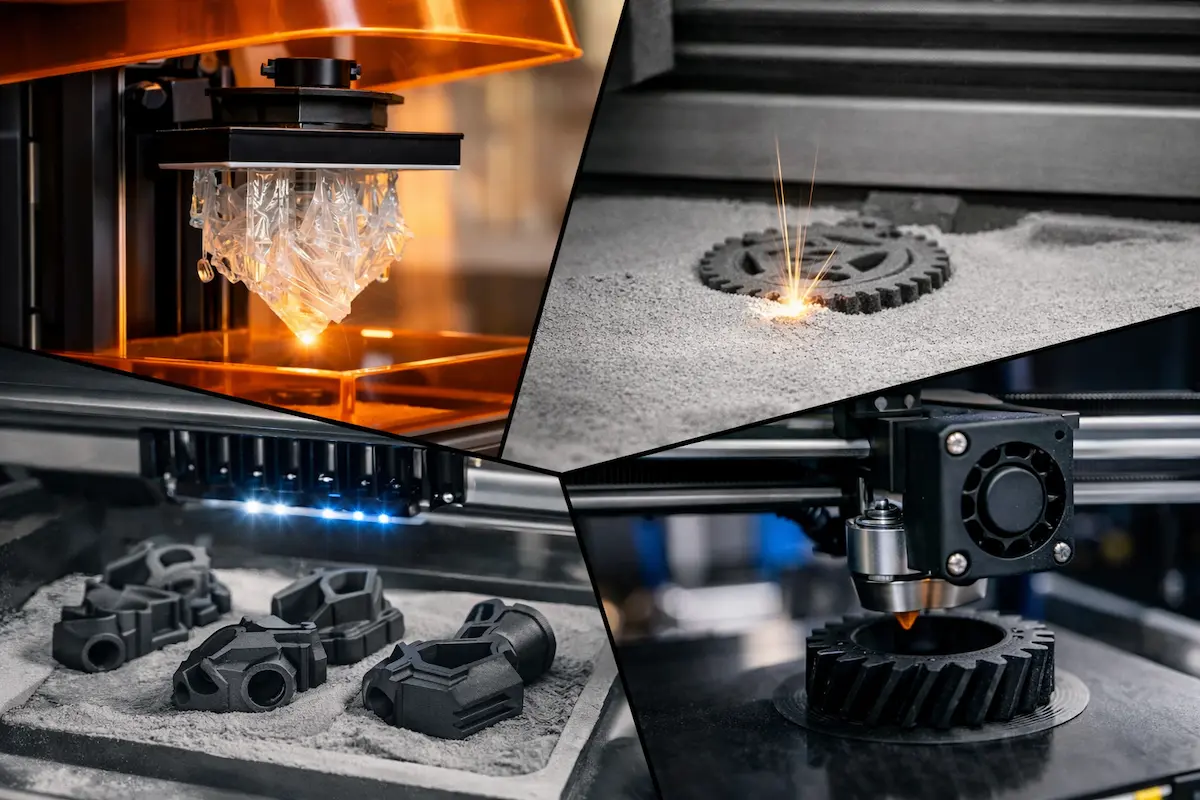
When a project is still in the stages of concept verification, structural iteration, appearance confirmation or low-volume pilot production, 3D printing is often one of the fastest-moving manufacturing methods. But "3D printing" is not a single process, but a set of very different manufacturing routes. The reason why the prototype results of many projects are not ideal is not that 3D printing itself is not suitable. But the process was wrong: FDM was used for the project that should have chosen SLA, but resin parts were used for small-batch functional parts that should have been MJF. In the end, the appearance, strength, delivery time or cost were not ideal.
For the engineering team, the real problem that needs to be solved is not "whether to use 3D printing", but "which one is more suitable for the goals of the current stage among SLA, SLS, MJF and FDM". This article will start from the process principles, material systems, surface effects, dimensional accuracy, mechanical properties, cost structure, post-processing methods and typical application scenarios. Help you establish a more practical 3D printing selection idea.
1. What is 3D printing
3D printing is a typical additive manufacturing process that directly transforms digital models into physical parts by stacking materials layer by layer. Compared with subtractive manufacturing such as CNC, 3D printing does not require cutting off excess parts from the entire material, but forms it layer by layer according to the slicing path. This gives it clear advantages in complex structures, rapid iteration, low mold costs and personalized manufacturing.
- Suitable for rapid prototyping:Design changes faster, no mold opening is required, and it is suitable for frequent iterations.
- Suitable for complex structures:Hollow, grid, complex curved surfaces and partially integrated structures are easier to realize.
- Low starting costs:It is usually more flexible than mold opening for single pieces and small batches.
- Materials and processes vary greatly:The differences in appearance, strength, precision and price of different processes are very obvious.
Precisely because different processes vary greatly, when selecting a project, you can’t just look at “whether it can be printed”, but you must also consider whether the parts need to be inspected for appearance, assembly, and Issues such as load-bearing strength, temperature resistance, wear resistance, batch consistency, and whether it will be converted to injection molding or CNC in the future.
2. Why are SLA/SLS/MJF/FDM always compared together?
These four processes are all very common, and they are all in the demand range of "prototype to small batch", so they often become candidate routes for the same project. But their forming principles are completely different: some are liquid resin light-curing, some are powder sintering, some are powder melting and fusion, and some are thermoplastic wire extrusion and stacking.
A practical judgment:If you care most about appearance and details, SLA is usually your priority; If what you care about most is the durability of nylon functional parts, usually look at SLS or MJF; If what you care about most is low cost and fast structural verification, usually look at FDM.
Truly efficient selection is not about memorizing process definitions, but first clarifying the project goals: whether the current part "looks like the final product" or "uses close to the final product." The former is more focused on appearance verification, while the latter is more focused on functional verification and trial production preparation.
3. Detailed explanation of SLA process
SLA (stereolithography) is a process that uses an ultraviolet laser or light source to solidify liquid SLA resin layer by layer. Its biggest advantage is Good detail performance, high surface quality and clear edge contours, so it is very common in high-appearance prototypes, display models, early stages of structural verification, and transparent part prototyping.
1. Advantages of SLA
- The surface is relatively delicate and suitable for subsequent appearance treatments such as painting, electroplating, and silkscreen printing.
- Good detail restoration ability, suitable for small features, thin walls and complex appearance parts
- Wide selection of transparent resin, ABS-like resin, tough resin and other materials
- Suitable for appearance prototypes, assembly confirmation, design reviews and market display samples
2. Limitations of SLA
- The long-term mechanical stability of resin parts is usually not as good as that of nylon powder technology
- Some materials are brittle and unfriendly to long-term stress, buckling and falling scenarios.
- Outdoor weather resistance, heat resistance and long-term functionality are evaluated in conjunction with the specific resin
- Support, cleaning and secondary curing are required, and the post-processing process is relatively clear.
3. Common applications of SLA
Industrial design models, consumer electronics appearance parts, medical appearance verification parts, transparent covers, lampshades, prototype models, assembly inspection parts, and high-value samples that require better spraying effects.
4. Detailed explanation of SLS process
SLS (selective laser sintering) is a process that uses laser to sinter nylon powder and other materials layer by layer. Since the powder bed provides support for the part, SLS usually does not require additional support structures like SLA, so it is more friendly to complex structures, inner cavity structures and multi-piece nested arrangements.
1. Advantages of SLS
- Common nylon materials have relatively balanced comprehensive properties and are suitable for functional verification.
- No additional support required, suitable for complex structures and batch typesetting
- Durability is generally better than ordinary resin appearance parts
- Suitable for structural parts, small batch functional prototypes and assembly test parts
2. Limitations of SLS
- The surface is usually pink or slightly rough, not as delicate as SLA
- If the appearance parts require high gloss, mirror surface or spray consistency, post-processing is often required.
- The unit price of small batch appearance parts is not necessarily better than other processes
- The performance of small text and extremely small sharp edges is usually not as good as SLA
3. Common applications of SLS
Nylon shells, air ducts, clamps, functional brackets, wearable structural parts, robot parts, complex assembly verification parts, and projects that are inconvenient to open molds but require good durability.
5. Detailed explanation of MJF process
MJF (multi-jet fusion) also belongs to the powder bed nylon process, but the forming mechanism is different from SLS. It is sprayed with melting agent and detailing agent and then heated as a whole. Therefore, in terms of dimensional consistency, batch stability and production efficiency, it is often regarded as one of the most efficient solutions for small batches of functional parts.
1. Advantages of MJF
- Suitable for small and medium-sized batches of nylon parts, batch consistency performance is usually good
- The comprehensive mechanical properties of the parts are balanced and suitable for functional testing and terminal use scenarios.
- Complex structures are highly adaptable and do not require traditional supports
- Staining, sandblasting, and surface treatment for a more uniform engineered appearance
2. Limitations of MJF
- The materials are mainly concentrated in nylon system, and transparent parts and high-gloss appearance parts are not strong points.
- The surface is usually fine sandy, not the original delicate surface of SLA.
- When a single piece is produced in extremely small batches, it may not always be the cheapest.
- If the project is only for display models, MJF may not be the first choice.
3. Common applications of MJF
Low-volume casings, structural brackets, connectors, fasteners, clamps, nylon parts for drones and robots, consumer product pilot parts, and functional parts that require a certain end-use strength.
6. Detailed explanation of FDM process
FDM (Fused Deposition Modeling) is one of the most popular 3D printing processes, in which thermoplastic filaments are extruded by heating and stacked layer by layer. Its core advantages lie in the popularization of equipment, common materials, and relatively low cost. It is especially suitable for early structural verification, large-scale models, and cost-sensitive projects.
1. Advantages of FDM
- The cost is relatively friendly and suitable for quick verification in the early stage of the solution.
- ABS, PLA, PETG, PA, PC, carbon fiber reinforced materials, etc. have a wide range of options
- Suitable for larger size prototypes and fixtures
- Flexible delivery, suitable for internal engineering iterations and low-budget trial and error
2. Limitations of FDM
- The layer texture is relatively obvious, and the native surface texture is usually not as good as SLA.
- Z-direction strength and interlayer bonding performance need to be evaluated in conjunction with the printing direction.
- The ability to restore complex thin-walled details and small features is generally not as good as SLA
- Parts with high requirements for appearance often require more polishing, soil filling and spraying.
3. Common applications of FDM
Structural volume verification, large-scale concept models, jigs and fixtures, in-house functional verification parts, packaging test parts, and projects that are more sensitive to unit cost and iteration speed.
7. Summary table of core differences between the four processes
| Contrast Dimensions | SLA | SLS | MJF | FDM |
|---|---|---|---|---|
| Forming principle | Light curing resin is cured layer by layer | Laser sintering powder | After spraying the melting agent, the whole body is fused. | Thermoplastic wire extrusion layer by layer |
| surface effect | Delicate and suitable for high appearance | Pinky, slightly rough | Fine sand feel, more engineering appearance | The layering is obvious |
| Detailed performance | excellent | better | better | Average to better, depending on equipment and layer thickness |
| functional strength | Medium, depending on resin type | better | better to excellent | The difference is large and is obviously affected by material and direction. |
| Typical materials | Ordinary resin, tough resin, transparent resin | PA12, PA11, glass fiber reinforced nylon | PA12, PA12 GB, etc. | PLA, ABS, PETG, PA, PC, CF enhanced |
| suitable quantity | Single piece to small batch | Single piece to small and medium batch | Small to medium batches are more advantageous | Single piece to small batch |
| Suitable for projects | Appearance samples, display samples | Functional prototypes, complex nylon parts | Small batch functional parts and trial production parts | Rapid verification, low-cost prototypes, large-scale models |
| Not very suitable | Long-term reload function | High-gloss, high-looking display pieces | Transparent parts and mirror appearance parts | High-definition appearance parts |
8. How to understand precision, surface and strength
Many projects will say "I want high precision" when communicating, but in the manufacturing context, precision can be broken down into at least three levels: Dimensional accuracy、Detail accuracy、Assembly accuracy. For example, SLA usually has advantages in detail restoration and surface texture, but the durability of functional parts is not necessarily stronger than MJF or SLS nylon parts.
1. Surface quality
If the project needs to be painted, photographed, displayed, and reviewed by customers, surface quality is usually more important than ultimate strength, and SLA usually takes precedence.
2. Mechanical properties
If the project needs to be fastened, stressed, repeatedly assembled and disassembled, and subjected to durability testing, nylon parts such as SLS and MJF are usually more reliable.
3. Directional influence
The difference in direction between layers of FDM parts is more obvious, and the design and placement direction will directly affect the strength and appearance of the parts.
4. Post-processing effects
Post-processing such as grinding, sandblasting, staining, painting, and steam polishing will significantly change the final look and size of the part.
9. How to choose common materials
When selecting a process, you should not just look at the name of the equipment, but also whether the material matches the project goals. For most projects, material selection can be prioritized by appearance first or function first.
1. Partial appearance verification
- Ordinary white/grey resin:Suitable for initial appearance prototype, prototype display and basic assembly.
- Tough resin:Suitable for structural samples that require certain impact resistance.
- Transparent resin:Suitable for lampshades, viewing windows, liquid viewing parts and transparent housing verification.
2. Partial functional verification
- PA12 nylon:The comprehensive performance is balanced and suitable for structural parts, shells and functional prototypes.
- PA11 nylon:Better toughness, suitable for impact and repeated deformation scenarios.
- Glass fiber/mineral reinforced nylon:Suitable for higher rigidity and dimensional stability requirements.
3. Low cost and fast verification
- PLA:Suitable for concept models and demonstrations, not recommended for long-term functional load.
- ABS / PETG:Suitable for structural verification and general engineering use.
- PC/PA/CF reinforced material:Suitable for FDM scenarios with higher strength or higher rigidity.
10. How are costs and delivery times affected?
3D printing quotations are not calculated solely by volume. Common influencing factors also include part outer dimensions, solid volume, hollow structure, nesting typesetting efficiency, support and post-processing hours, material type, Surface requirements, quantity and whether piece numbering, staining, sanding, painting, assembly and testing are required.
- SLA:It is more obviously affected by support, cleaning, sanding and appearance post-processing.
- SLS / MJF:It is greatly affected by layout density, powder utilization rate and post-processing methods.
- FDM:It is greatly affected by printing time, support, layer thickness settings and surface requirements.
In the small batch stage,Same geometryPrinting with different processes, the unit price difference may be very large. Therefore, it is best to clarify before quoting: Is it the "lowest unit price" or the "highest overall development efficiency".
11. Which application scenarios are suitable for
Scenarios suitable for SLA
- High-quality appearance prototype
- Transparencies and display models
- Customer review samples and photograph samples
- Product shell prototypes that require painting, electroplating, and silkscreen printing
Scenarios suitable for SLS/MJF
- Verification of functional structural parts
- Low-volume production of housings and brackets
- Fasteners, connectors, wearables, ducts and clamps
- Complex hollow structures and integrated assemblies
Scenarios suitable for FDM
- Internal quick verification
- Large size structural model
- Cost-sensitive solution iteration
- Fixtures, jigs and non-display engineering parts
12. How to avoid overturning of 3D printing prototyping
- Don’t just say “make a 3D print”, explain whether it is an appearance part or a functional part
- Determine whether you want to paint, stain, polish, silkscreen or clear the effect
- It is best to synchronize key dimensions, tolerances, and coordination relationships with 2D drawings
- If there are buckles, thin walls, threads, or buckles, do a DFM assessment in advance.
- When there is a force direction, especially for FDM parts, confirm the printing direction.
- For small batch projects, you should check the consistency in advance and don’t just focus on the effect of a single piece.
- When planning to switch to injection molding in the future, it is recommended to consider the cost of design migration at the same time.
Experience suggestions:It is best not to force the same process to take into account all objectives for appearance verification parts and functional verification parts. Many mature projects will use SLA for appearance confirmation, and then use MJF or SLS for functional verification, so the overall efficiency is often higher.
13. How to choose reliable suppliers
- Can we give process suggestions based on usage, rather than just taking orders for printing?
- Can you provide material substitution suggestions, post-processing suggestions and DFM feedback?
- Whether it has multi-process collaboration capabilities such as SLA, SLS, MJF, FDM, etc.
- Whether it supports the transition from single-piece prototyping and small batch production to subsequent transfer to mass production
- Whether it has unified quality inspection, packaging and delivery management capabilities
- Is there real industrial customer project experience, not just model printing experience?
14. XPartsLab 3D printing service capabilities
XPartsLab is oriented to custom manufacturing scenarios of industrial-grade parts and supports multiple 3D printing processes such as SLA, SLS, MJF, and FDM. We can provide more matching process selection suggestions based on part usage, appearance requirements, material properties, quantity and budget.
- Support appearance prototypes, functional samples and low-volume pilot production parts
- Supports printing solutions for resin, nylon and various engineering plastics
- Supports post-processing collaboration such as polishing, painting, dyeing, and silkscreen printing
- Support DFM evaluation, assembly verification and multi-process combination delivery
- Can be connected with CNC, sheet metal, injection molding, vacuum casting and other processes
Need 3D printing prototyping or small-batch trial production?
Upload 3D drawings to get process suggestions, material recommendations, DFM feedback and quotation plans.
FAQ
How to quickly judge SLA, SLS, MJF, and FDM?
You can choose based on your goals first: give priority to appearance and details, look at SLA first; give priority to functional strength and nylon parts, look at SLS or MJF first; For cost-sensitive, rapid structural verification or large-size prototypes, look to FDM first.
Can 3D printing be used directly for small batch production?
Can. For non-molding projects ranging from dozens to hundreds of pieces, SLS and MJF are usually very advantageous in small batches of functional parts. If subsequent demand continues to increase, we will then evaluate whether to turn to injection molding, vacuum casting or other mass production processes.
Why does an SLA that looks good on the outside not necessarily be suitable for functional testing?
Because "good surface effect" does not mean "best long-term mechanical properties." SLA is stronger in details and appearance, Many projects with higher requirements on repeated assembly, stress, and durability will prefer SLS or MJF nylon parts.
Does FDM have to be rough?
uncertain. The effect of FDM is related to equipment accuracy, nozzles, layer thickness, materials and post-processing. But from the original surface, FDM layering will typically be more pronounced than SLA, making it more suitable for structural verification rather than demanding presentation appearances.
What information do I need to prepare before quoting?
It is recommended to provide at least 3D files (STEP, STP, OBJ, STL, etc.), quantity, usage description, material tendency, surface requirements and delivery time requirements. If there are critical assembly dimensions, tolerances, threads or color requirements, it is best to provide 2D drawings or notes at the same time.