
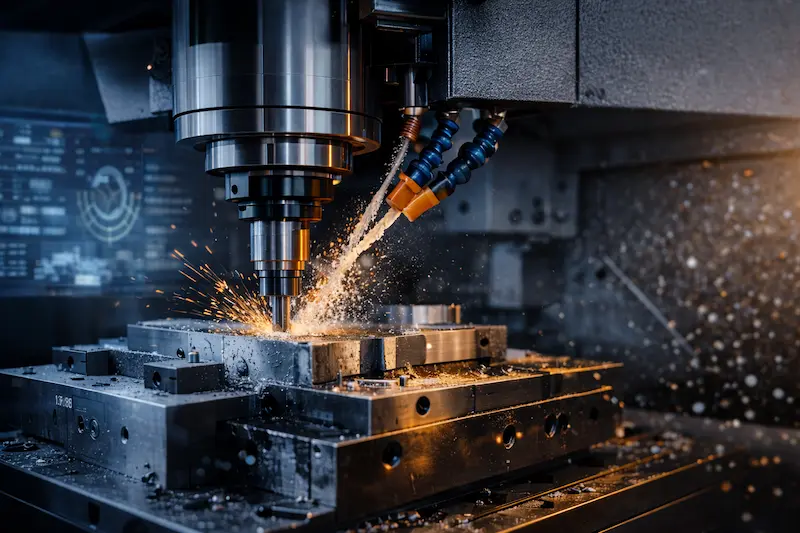
CNC machining has always been one of the most commonly used and reliable manufacturing methods during product development, engineering verification and low-volume production. Whether it is aluminum alloy structural parts, stainless steel functional parts, or engineering plastic parts such as POM, ABS, and PC, CNC machining can achieve a good balance between precision, strength, surface quality and delivery efficiency.
This article will systematically introduce the basic principles of CNC machining, main process types, common materials, accuracy range, surface treatment, Application scenarios, cost influencing factors, and design optimization suggestions help you fully understand CNC machining and promote component development and manufacturing more efficiently.
1. What is CNC machining?
CNC machining uses a computer numerical control system to control the machine tool motion trajectory, spindle speed, feed speed and tool path. Cut metal or plastic materials to create parts that meet design requirements.
Compared with traditional machining, CNC machining has a higher degree of automation, more stable precision control capabilities, and better batch consistency. Widely used in aerospace, robotics, Automotive, medical equipment, automation equipment and consumer electronics industries.
- High precision
- High repeatability
- Suitable for complex structural parts
- Suitable for prototypes and low-volume production
- Supports a variety of metal and plastic materials
2. Basic principles of CNC machining
CNC machining is a subtractive manufacturing process, that is, starting from plates, bars or blocks, excess material is removed with a tool. Finally get the target part. After the engineer provides the 3D model, the process engineer will program, formulate the tool path, select the clamping plan and processing parameters, The machining is then performed by the machine tool.
- Receive 3D models and drawings
- Conduct DFM and process assessment
- CAM programming to generate tool paths
- Prepare fixtures, materials and tools
- Roughing, semi-finishing, finishing
- Inspection, deburring and surface treatment
3. Main process types of CNC machining
1. CNC milling
CNC milling is the most common processing method and is suitable for flat surfaces, steps, grooves, cavities, contours, curved surfaces and multi-faceted structural parts.
2. CNC turning
It is mainly suitable for cylindrical, shaft and rotary parts, and can complete the processing of outer circles, inner holes, end faces and threads.
3. Drilling, tapping and boring
It is often used for assembling structures and precision connectors and has high requirements on hole position, hole diameter, thread quality and coaxiality.
4. Three-axis, four-axis and five-axis machining
Three-axis is suitable for most conventional parts, while four-axis and five-axis are more suitable for complex multi-faceted structures, special-shaped surfaces and high-precision complex parts.
4. Analysis of common materials for CNC machining
Common metal materials
- Aluminum alloy:Lightweight, easy to process, widely used, common 6061, 7075
- Stainless steel:High strength, corrosion resistance, common 304, 316
- Carbon steel/alloy steel:Suitable for functional parts with higher strength requirements
- Copper/Brass:Good electrical and thermal conductivity, suitable for connectors and heat sinks
- Titanium alloy:High strength, lightweight, corrosion-resistant, but difficult to process
Common plastic materials
- ABS:Balanced comprehensive performance, suitable for general functional prototypes
- PC:Good toughness, suitable for protective parts and transparent parts
- POM:Good wear resistance, suitable for mechanical functional parts
- PA (nylon):Suitable for wear-resistant functional structural parts
- PMMA:Good transparency, suitable for transparent parts
- PEEK:High-performance engineering plastics, suitable for high-demand industrial scenarios
5. How high can CNC machining accuracy be?
CNC machining accuracy is greatly affected by machine tool capabilities, material properties, tool status, clamping methods and structural complexity. Under normal circumstances, conventional machining accuracy can be controlled at around ±0.1 mm. Higher requirements can reach ±0.05 mm, and some precision structures can be further controlled to ±0.02 mm or even higher.
For assembly dimensions, shaft hole matching dimensions, sealing surfaces and functional key dimensions, it is recommended to focus on marking tolerance requirements; For non-critical dimensions, it is not recommended to uniformly use tight tolerances to avoid significant increases in manufacturing costs.
6. Surface roughness and surface treatment
After the basic cutting of CNC parts is completed, surface treatment is usually performed based on appearance, corrosion resistance, wear resistance and functional requirements.
- Anodizing:Often used in aluminum alloys to improve corrosion resistance and appearance.
- Sandblasting:Improve surface uniformity and enhance matte texture
- polishing:Improve surface finish
- plating:For corrosion resistance, conductive or decorative needs
- Blackening/paintinging/drawing:Meet different functions and visual effects
7. Which application scenarios are suitable for CNC machining?
- Product prototype validation
- Functional test sample
- Low-volume production
- High-precision customized parts
- Components for robotics, automation, medical, consumer electronics and other industries
CNC machining is often the preferred choice when a project requires real materials, higher strength, higher precision and better assembly consistency.
8. The difference between CNC machining, 3D printing and injection molding
CNC machining vs 3D printing
3D printing is suitable for rapid prototyping, complex internal structures and partial appearance verification; CNC machining is more suitable for real materials, High-strength functional parts and precision assembly structures.
CNC machining vs injection molding
Injection molding is suitable for medium and large batch production, but requires mold investment; CNC is suitable for early prototyping and low-volume pilot production, There is no need to open a mold and it is more flexible to modify the design.
9. Core factors affecting CNC machining quotations
- Material cost
- processing time
- Number of clamping
- structural complexity
- Tolerance requirements
- Surface treatment requirements
- Testing and packaging requirements
- Quantity and delivery time
The parts quotation does not only depend on the size, but also depends on the process complexity, precision requirements and post-processing requirements.
10. How to reduce CNC machining costs through DFM
- Avoid deep cavities and deep hole structures
- Reduce ultra-thin wall and long cantilever designs
- Try to consider the tool fillet radius for internal corners.
- Prioritize standardization of hole diameter and thread
- Tolerances are marked separately for critical dimensions and ordinary dimensions.
- Minimize multiple turning processes as much as possible
- Prioritize conventional material specifications
11. What information do you need to prepare before placing an order?
- 3D files: STEP/STP/IGES/X_T
- 2D drawings: tolerances, threads, roughness, etc. requirements
- Material requirements
- Surface treatment requirements
- Quantity and delivery requirements
- Application scenario description
12. How to choose a reliable CNC machining supplier
- Whether to support DFM evaluation and engineering feedback
- Whether it has multi-material and multi-process collaboration capabilities
- Do you have quality inspection and delivery management capabilities?
- Whether to support prototype, trial production and batch connection
- Do you have experience in complex parts and industry projects?
13. XPartsLabCNC machining service capabilities
XPartsLab focuses on custom manufacturing of industrial-grade parts and supports process collaboration such as CNC machining, 3D printing, sheet metal fabrication, injection molding, and vacuum casting. For CNC machining projects, we can provide material selection, DFM evaluation, structural optimization suggestions, sample validation and low-volume pilot production support.
- Supports a variety of metal and engineering plastic materials
- Support functional prototypes and low-volume pilot production
- Support surface treatment and assembly parts collaborative delivery
- Suitable for robotics, medical, automation, consumer electronics and other industries
Need CNC machining for prototyping or small-batch trial production?
Upload 3D drawings and obtain engineer DFM assessment, material suggestions and quotation plans.
FAQ
What quantity of parts is suitable for CNC machining?
CNC machining is usually suitable for single-piece prototyping, functional samples and low-volume pilot production. For projects of 10 pieces, 50 pieces, 100 pieces to hundreds of pieces, CNC machining generally still offers high flexibility. If the quantity continues to increase and the structure is stable, you can re-evaluate whether to switch to injection molding or other processes.
What file formats are commonly used in CNC machining?
Common 3D file formats include STEP, STP, IGES, IGS, X_T, etc. If there are critical dimensions, tolerances, threads or surface roughness requirements, It is recommended to provide 2D drawings at the same time.
What is the general accuracy of CNC machining?
Conventional machining accuracy is usually around ±0.1 mm, and higher requirements can achieve ±0.05 mm. Some precision structures can achieve ±0.02 mm or higher, depending on the material, structure and process solution.
How to choose between CNC machining and 3D printing?
If the focus is on appearance verification, rapid prototyping or complex internal structures, 3D printing can be given priority; If the focus is on real materials, strength, precision and assembly capabilities, CNC machining is usually more suitable.
Can I quote first without complete drawings?
Can. If you already have a 3D model and basic usage description, you can usually make a preliminary assessment and pre-quote first. If critical tolerances, threads or assembly relationships are involved, it will be more accurate to add 2D drawings later.