
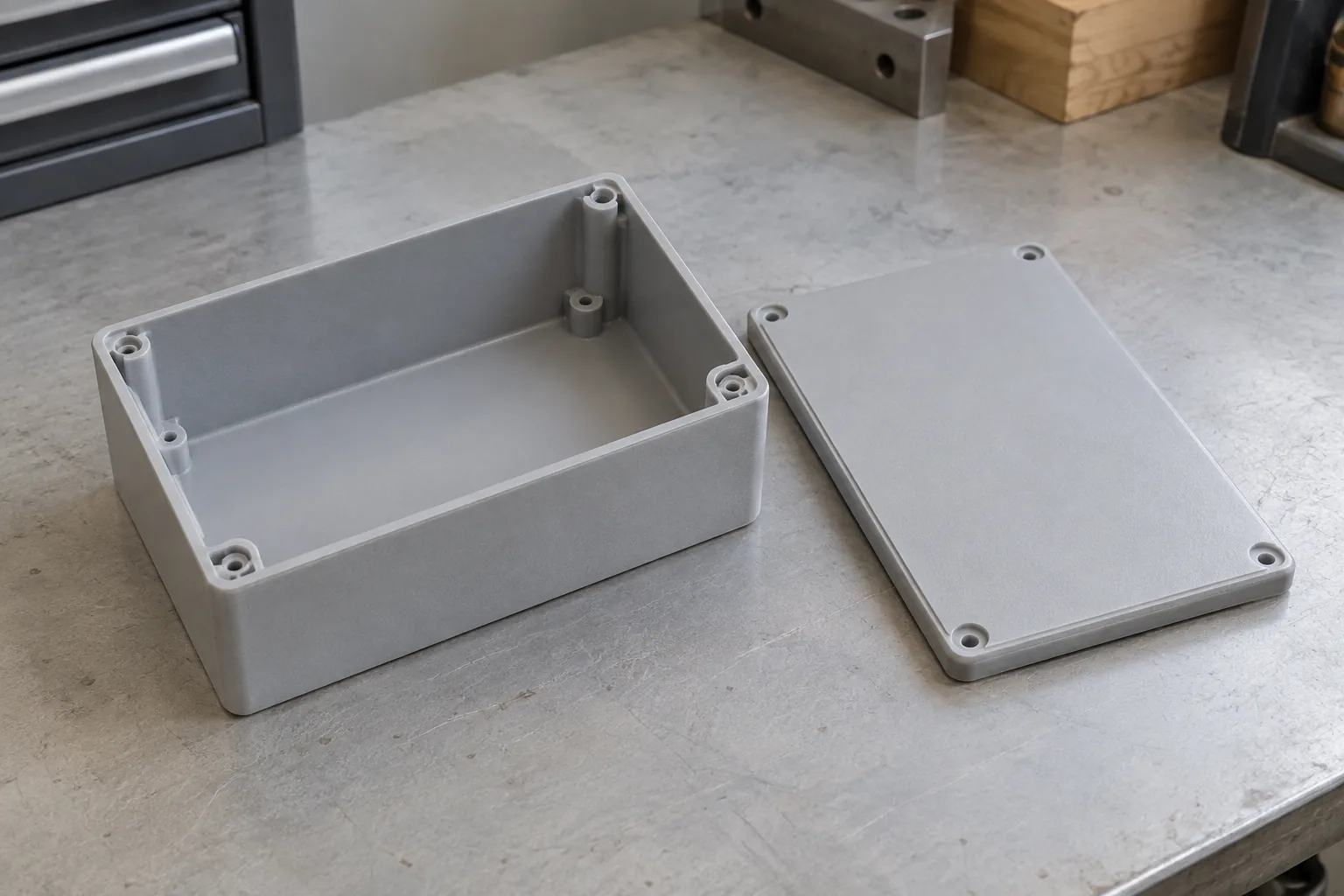
Start with what the housing must prove
A functional housing may need to hold mating parts, retain threaded fasteners or maintain a seal during a trial. A visual prototype can answer shape and appearance questions without proving those duties.
For CNC machining vs 3D printing for functional prototypes, identify what would invalidate the trial. Leakage or misalignment makes working faces and reference features priorities. Inaccessible geometry or changing component packaging favors investigating printing, followed by assembly qualification.
Material form and build direction can change the test
Machining starts with engineering-plastic stock, useful when the trial needs that grade and stock condition. Material removal can release residual stress and change shape, especially in thin sections; a smooth finish does not prove dimensional stability.
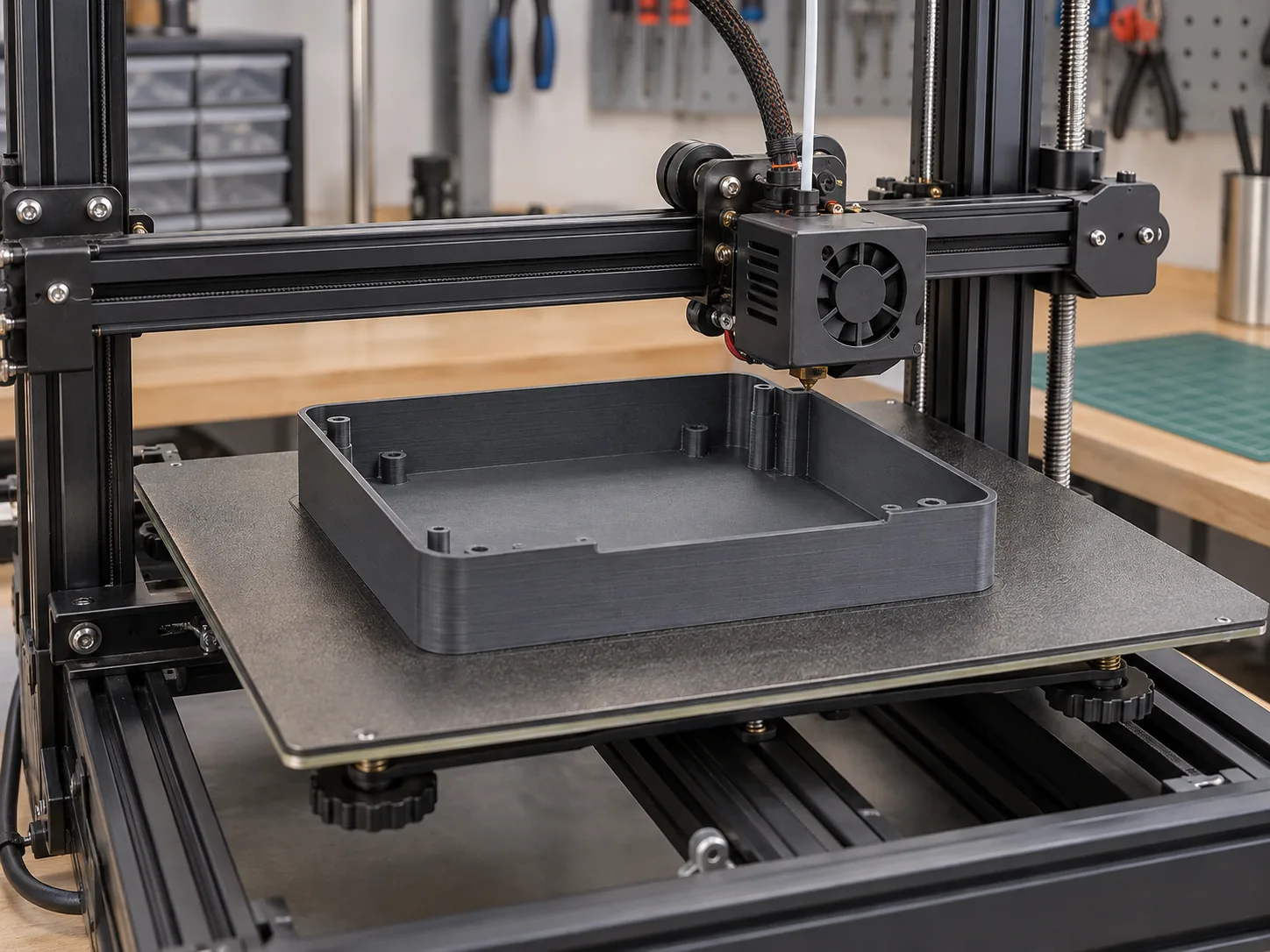
Printing builds in layers. In extrusion-based processes, loading along deposited paths or across their bonds can produce direction-dependent behavior, called anisotropy. Changing build direction may therefore change a fastening boss's response. This does not make every printed polymer weak.
Review orientation against loaded bosses, support-contact areas and sealing faces. Evaluate representative parts after intended conditioning and finishing. Similar polymer names do not establish equivalence: grade, manufacturing route and test method matter when predicting production behavior.
Let tool access, sealing and fasteners shape the design
Cutters need surface access. Deep pockets, undercuts and enclosed channels may require redesign or a split housing. Printing can preserve useful internal geometry, provided supports or trapped material have a removal route.
Accessible sealing faces and related datums—the reference features locating measurements—can favor machining. Printed interfaces may need secondary finishing. An appearance-improving coating does not itself demonstrate leak resistance.
Review insert installation, boss geometry and surrounding material with the supplier. Try mating hardware under the intended assembly procedure. Cracking, poor seating or inadequate clamp support calls for changes to geometry, orientation or process before batch ordering.
Choose a route, then challenge its critical features
Use the same intended duty, mating parts, environmental exposure and acceptance criteria to evaluate both candidates. Inspect functional dimensions and sealing-face flatness from the agreed references and check the assembled sealing interface; nominal machine accuracy or a material datasheet cannot substitute for finished-housing evidence.
| Dominant requirement | Initial preference and reason | Evidence that could change the choice |
|---|---|---|
| Stock-grade behavior and accessible mating faces | CNC: preserve stock form and cut working interfaces. | Shape drift, unavailable stock or failed assembly. |
| Internal features and evolving packaging | Printing: reduce cutter-access constraints and dedicated setups. | Trapped supports, unsuitable load direction or excessive finishing. |
| Complex body with demanding local interfaces | Printed body with machined features: combine shape freedom and local finishing. | Insufficient allowance, unreliable fixturing or assembly failure. |
Revision frequency changes the delivery calculation
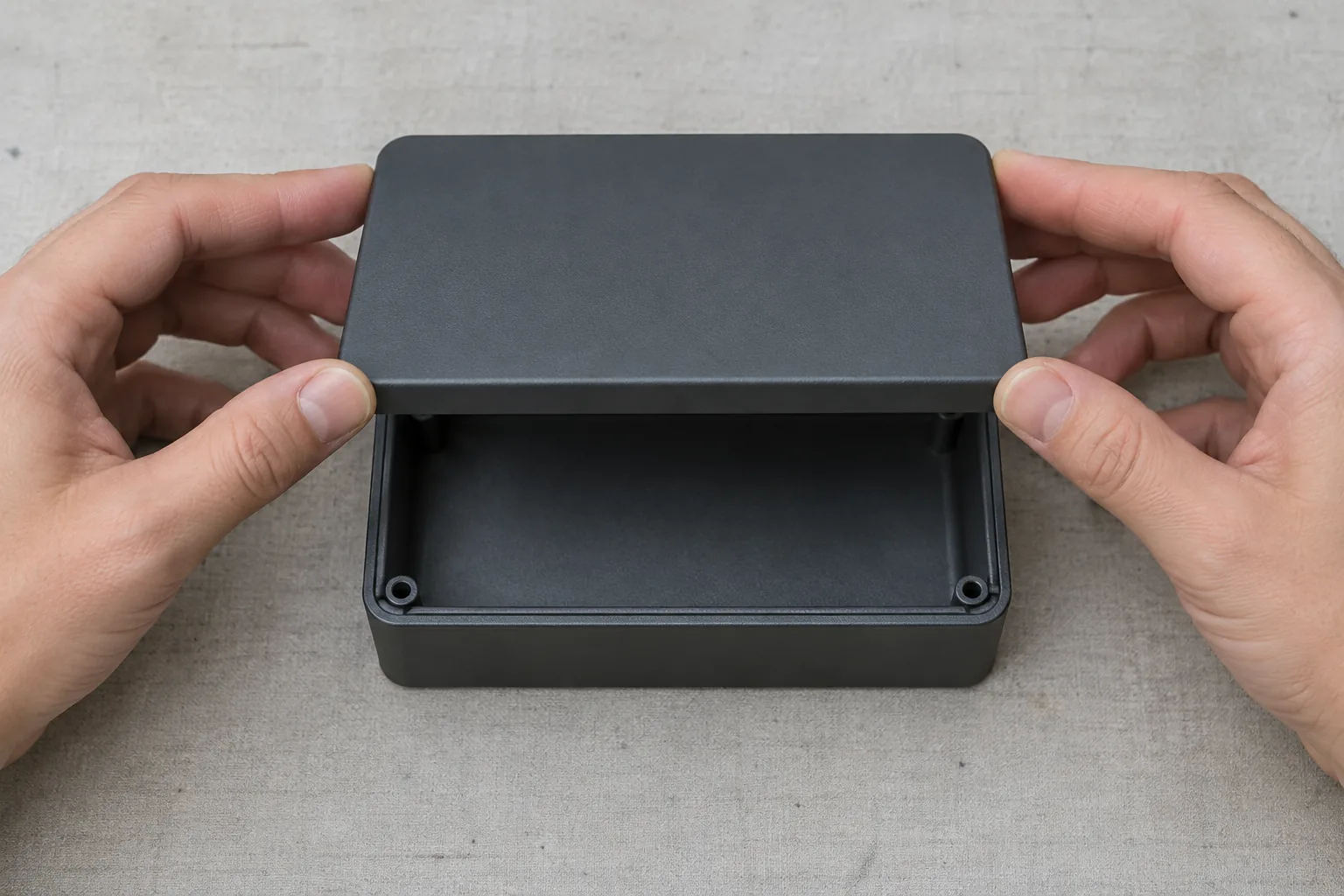
Design changes can require new CNC programming and fixtures. Printing also incurs preparation, build occupancy, cleaning, curing where applicable and inspection. Stable batches can spread setup effort; unfinished printed parts may add substantial downstream work.
When a candidate fails, adjust the responsible feature and retest; switch routes if adaptation defeats its original advantage. After qualification, compare quotations including samples, inserts, finishing, inspection, maintenance needs and delivery commitments. No universal quantity determines the switch.
Move from exploration to a supplier-ready request
Explore uncertain packaging with the more adaptable route. As loads, seals and interfaces settle, qualify the material-process combination. Before repeat supply, agree inspection and retesting triggers. Bring these inputs to the supplier to select a viable route and obtain a complete delivery proposal:
- Provide CAD and a drawing identifying critical tolerances, interfaces and reference features.
- Describe the trial, expected exposure and observable failure criteria.
- Specify required material properties and any preferred grade or stock form.
- Supply mating parts, insert details, fastening needs and sealing requirements.
- Separate cosmetic expectations from functional finish and allowable process marks.
- State batch needs per revision, likely changes, inspection scope and required delivery date.
Frequently asked questions
Does a fit check justify environmental testing?
Fit establishes assembly compatibility. Temperature, moisture or chemicals may alter dimensions or material response; evaluate relevant exposure using specimens prepared like the intended trial parts.
Is machining a printed sealing face sufficient?
It may improve contact yet leave body leakage or fastening weakness unresolved. Locate the leak path and test the assembled enclosure before accepting that local operation.
Can build orientation change on repeat orders?
Changes affecting load paths, supports or working surfaces can change performance. Request the rationale and repeat affected qualification checks before treating new parts as interchangeable.