
Which material should lead the shortlist?
POM, also called acetal, is the more natural starting candidate when the mechanism has little room for humidity-related fit movement. PA66, a nylon, remains a practical candidate when its documented grade-specific behavior suits the duty and the design has enough clearance or adjustment to accommodate moisture effects. That is a conditional selection, not a universal ranking of plastics.
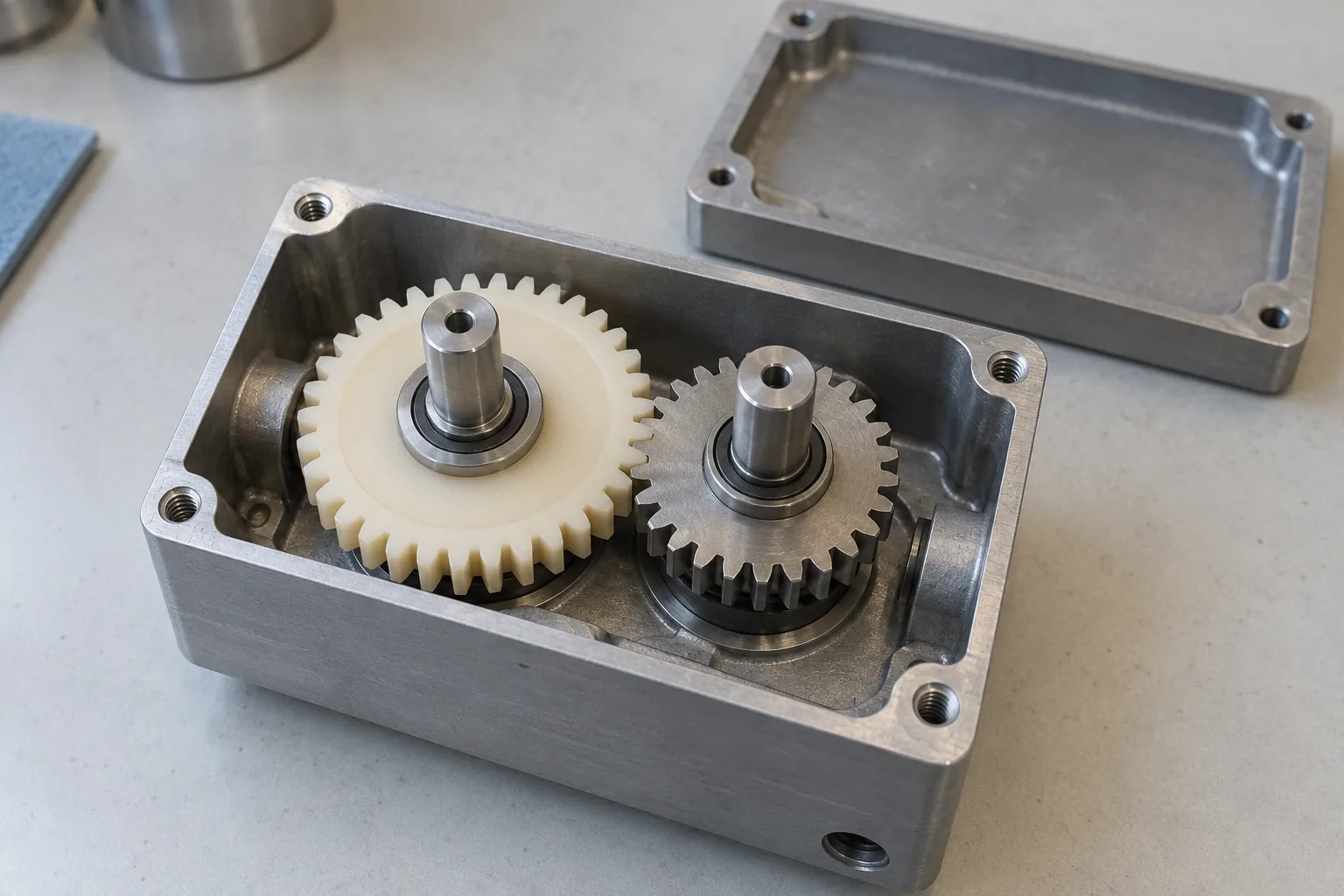
Consider a hypothetical molded spur gear driving a steel mating gear, with the shafts supported in a metal actuator housing. This arrangement is an illustration, not a reported installation. Changing ambient moisture can affect the polymer gear differently from its surroundings. The useful question is whether the assembled drive stays within its fit and operating requirements during storage and use.
| Selection dimension | Condition favoring POM | Condition keeping PA66 viable |
|---|---|---|
| Humidity-sensitive fit | Limited clearance margin makes low moisture uptake valuable, provided the candidate passes the duty evaluation. | The documented conditioning range leaves adequate engagement and shaft-fit margins. |
| Mechanical and thermal duty | The selected formulation meets loaded operation without relying on dimensional stability as proof of durability. | Grade evidence supports the required response at the expected temperature and moisture state. |
| Available application evidence | Representative molded-part and assembly results support this route. | Equivalent evidence exists for the nylon route; dry specimen results alone leave a gap. |
Compare grades in the moisture state the gear will experience
PA66 absorbs moisture from its surroundings. This can enlarge a molded part and alter stiffness and toughness, so a freshly molded gear and a gear after humid storage may behave differently. POM's low moisture uptake reduces this particular concern, but does not remove thermal movement, molding variation or load-related deformation.
Conditioning means deliberately bringing a part to a defined moisture state before evaluation or delivery. BASF's Ultramid guidance distinguishes dry and conditioned material properties and explains that moisture absorption depends on grade and exposure conditions. Use the exact candidate datasheet and its stated test method rather than borrowing a value from another formulation.
Ask the resin supplier which moisture states the published information represents. Then compare candidate data under compatible temperature and test conditions, recording any gaps. If the service state is poorly represented, make molded-part exposure testing part of the selection evidence. A conditioning treatment prepares an initial state; it does not freeze that state when the surrounding humidity later changes.

Translate dimensional movement into backlash and shaft fit
Backlash is the free movement between mating teeth before the opposite tooth faces take up load. In the hypothetical actuator, growth of the polymer teeth can consume that clearance while the housing holds the shaft spacing. Loss of clearance may produce drag or interference. The result depends on the tooth form and the movement of the rest of the assembly, so visible expansion alone does not establish a fault.
The bore deserves a separate check. Free expansion can enlarge an unconstrained hole; contact with a shaft can restrain movement and change the stresses or fit instead. Housing motion, shaft support, gear runout and molding distortion also contribute. Nominal CAD dimensions therefore do not guarantee the operating relationship.
Mark the tooth, bore and housing features that control function on the drawing. Measure those features in agreed material states, then check the assembled mechanism at the environmental conditions that threaten its clearance limits. If engagement tightens with exposure, determine whether tooth geometry, center distance or distorted support is responsible before changing resin. If the train becomes too loose, evaluate lost motion against the actuator's positioning requirement.
Make load and wear a separate selection test
A gear can retain its dimensions during storage yet deflect under torque or wear against its mate. Temperature, lubrication, sliding contact and sustained load influence that behavior. Creep means gradual deformation while load remains applied; it can change engagement even when an unloaded inspection looks satisfactory.
Assess each candidate with the intended steel mating gear and lubrication arrangement in the hypothetical example. Record loaded motion, resistance to turning, tooth condition and any unacceptable performance change. Use the same duty and acceptance criteria for the comparison, while allowing the molding and conditioning practice each material needs.
If POM holds fit but fails the required contact or load behavior, its moisture advantage is insufficient: evaluate another documented grade, a geometry change or the PA66 route. If PA66 meets the mechanical duty but loses clearance after exposure, investigate fit allowances and conditioning before retaining it. When neither route satisfies the combined requirements, another material or a redesigned mechanism remains a valid outcome.
Reinforcement or lubricant additives create a new grade comparison. Greater stiffness does not automatically yield better tooth contact or lower mating-surface wear. Review the actual formulation and molded surface rather than assuming glass reinforcement improves every gear application.
Specify the molding and inspection route with the resin
Changing polymer can change the relationship between the mold cavity and the finished gear. Tool compensation must suit the selected grade, processing conditions and intended measurement state. Reusing a cavity without this review risks carrying over a dimensional assumption that no longer applies.
Agree which features are inspected after molding, which are checked after conditioning, and how parts are stored between those steps. Compare production lots using the same measurement protocol. Otherwise, an apparent process shift may simply reflect different storage histories. For a repeatable dry-state inspection, define how that state is maintained; for conditioned acceptance, establish how it is reached and verified.
If lot results drift under a controlled protocol, investigate material identity and molding consistency before correcting the tool. If results differ mainly after storage, examine exposure and packaging alongside the part geometry. Any secondary machining must be included in this history, with final inspection tied to the agreed acceptance state.
Validate the mechanism, then compare complete delivery conditions
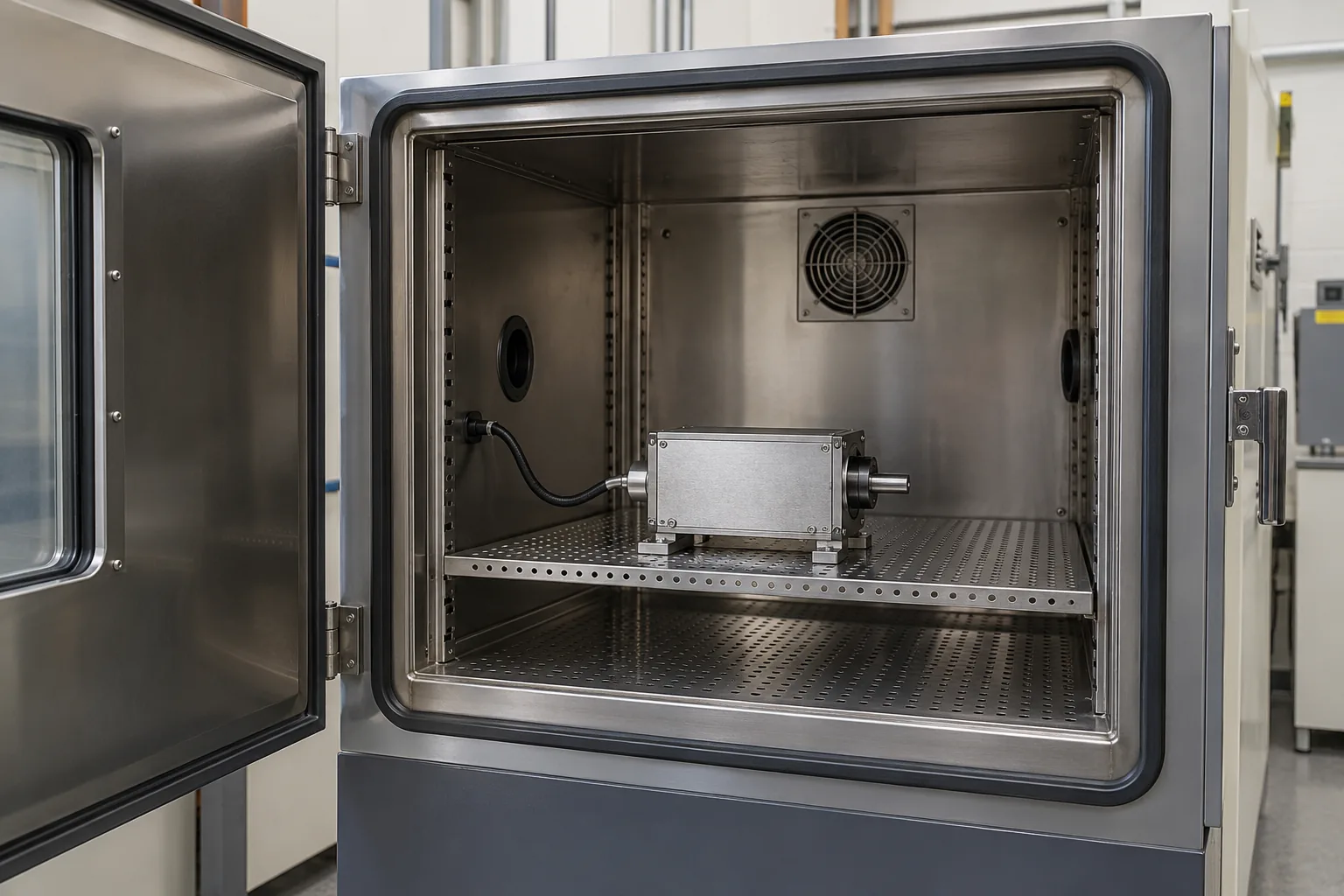
Start validation with representative gears in the intended housing and mating arrangement. Establish a baseline, expose the assembly to the agreed storage and operating envelope, and evaluate fit and function under the required duty. Include the transitions that matter to use, rather than checking only a comfortable laboratory state.
A machined sample can help investigate assembly access or selected fit features. A printed surrogate may help explain geometry. Before drawing a material-performance conclusion from either, ask whether its resin, processing history and tooth surfaces represent molded production closely enough. Document what the prototype can answer and reserve the remaining questions for representative parts.
If a candidate misses an acceptance goal, identify the failed function and adjust the relevant geometry, grade, conditioning or manufacturing route. Repeat the affected evaluation before committing. A passing fit check does not close a wear concern, and a satisfactory bench run does not establish a fixed service life.
Once the routes meet the engineering goals, compare required mold compensation or modification investment against the expected order quantity, subsequent batches and complete delivered cost per gear. A smaller order may make tooling investment harder to justify, but does not establish that an existing cavity is suitable: reuse still depends on evaluating the candidate grade, molding behavior and acceptance moisture state. Ask suppliers to itemize tooling work and ownership, the batch conditions behind each quotation, and conditioning, inspection and secondary-operation costs. Include resin availability, process control, rejected parts and maintenance implications when comparing the supply routes; a lower resin price can be offset by downstream work. Delivery timing should follow the actual manufacturing and verification plan.
Prepare an RFQ that can resolve the material choice
Give the supplier enough information to propose candidate grades and an evidence plan for your drive. Bring observed tightness, lost motion or tooth damage records if available, with the storage and operating circumstances attached. These inputs help separate an environmental fit issue from a contact, load or process problem.
- Geometry package: CAD, tooth definition, bore details, tolerances and the drawing features that determine actuator function.
- Resin scope: exact proposed molding grades, permitted alternatives and any reinforcement or lubricant formulation restrictions.
- Operating duty: torque-speed behavior, loading duration and the performance changes the mechanism must avoid.
- Exposure history: storage conditions, service temperature and humidity envelope, and meaningful transitions between them.
- Contact arrangement: mating material, housing and shaft support, lubrication and relevant assembly constraints.
- Acceptance protocol: backlash and center-distance requirements, inspection timing, conditioning practice and measurement method.
- Supply requirements: tooling ownership, lot quantities, quality criteria, requested schedule and applicable secondary operations.
Frequently asked questions
Why can a gear feel satisfactory at assembly but become troublesome after humid storage?
Assembly may occur before the gear has reached the moisture state it will experience later. The housing can also delay exposure without eliminating it. Keep a storage history with the sample and compare operation after representative exposure; an immediate assembly check answers a narrower question.
How should repeat orders stay tied to the gear that was approved?
Put the approved resin designation, drawing and acceptance protocol on the purchase specification, and ask the supplier to notify you before substituting material or changing an agreed process. Request batch-linked material identity and inspection records so later fit complaints can be traced to the relevant delivery. Use that record trail to decide which parts need investigation; paperwork alone is not proof of acceptable operation.
What evidence is needed before replacing an existing POM gear with PA66?
Identify which earlier approvals remain relevant and which depend on the original resin. Obtain candidate-grade information for the intended moisture state, review cavity compensation, and evaluate the replacement in the existing mechanism. Dimensional interchangeability at receipt is insufficient evidence for substitution across service conditions.
If a drive becomes stiff, is humidity the first change to make?
First capture when the stiffness appears and isolate whether resistance comes from tooth engagement, the shaft interface or another assembly feature. Compare an affected mechanism with its earlier condition where possible. A humidity correlation guides testing, but does not exclude poor alignment, lubrication changes or molding distortion.