
Highly versatile and cost-effective
It strikes a better balance between cost, processing efficiency, and performance, making it suitable for rapid iteration and small-batch delivery.
ABS Engineering Plastic is a very common general-purpose choice in machining engineering plastics: considering cost, processing efficiency, and appearance, it is suitable for structural parts, appearance parts, and functional verification prototypes. When you want parts to have a certain rigidity, are easy to post-process, and aim for small batches/rapid iteration, ABS is often the most cost-effective solution.
ABS Engineering Plastic is a very common general-purpose choice in machining engineering plastics: considering cost, processing efficiency, and appearance, it is suitable for structural parts, appearance parts, and functional verification prototypes. When you want parts to have a certain rigidity, are easy to post-process, and aim for small batches/rapid iteration, ABS is often the most cost-effective solution.
Order suggestion: If there are exterior/assembly surfaces, please define "key surfaces" in the remarks; ABS is more sensitive to sharp corner stress and thin-walled large planar surfaces, so it is recommended to add fillets and reinforcing ribs; If repeated screw assembly and disassembly are required, it is recommended to evaluate inserts/structural optimization and provide 2D annotations (hole position/tolerance/reference).
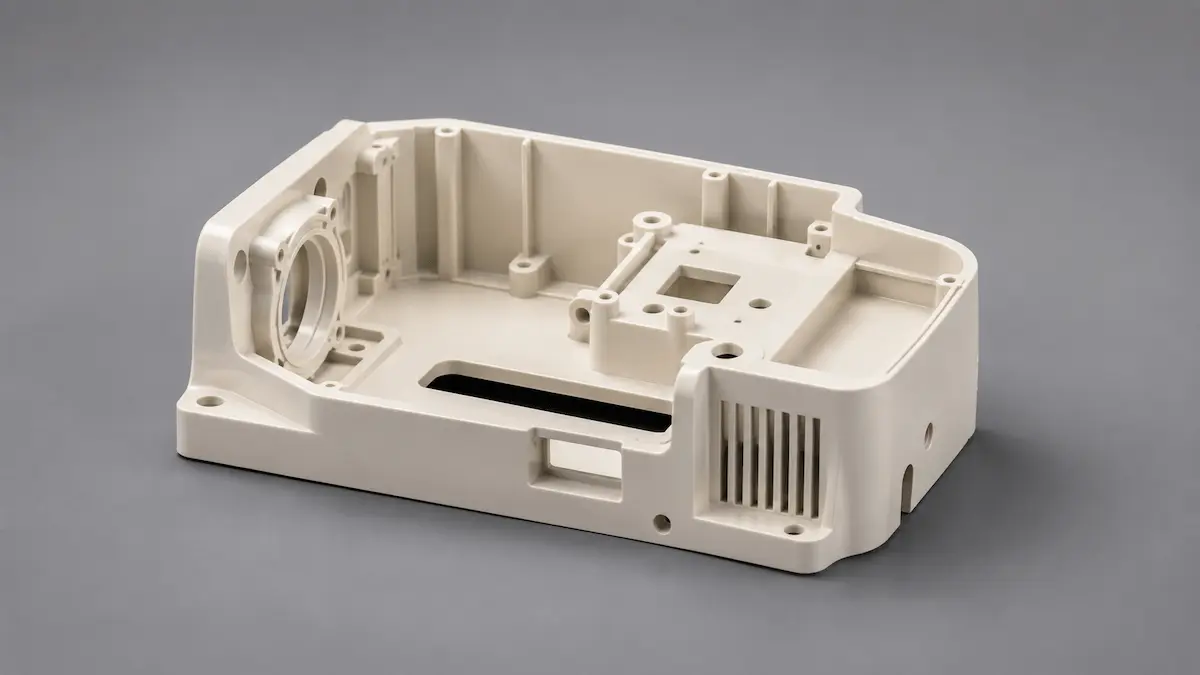
ABS Engineering Plastic is a very common general-purpose choice in machining engineering plastics: considering cost, processing efficiency, and appearance, it is suitable for structural parts, appearance parts, and functional verification prototypes. When you want parts to have a certain rigidity, are easy to post-process, and aim for small batches/rapid iteration, ABS is often the most cost-effective solution.
It strikes a better balance between cost, processing efficiency, and performance, making it suitable for rapid iteration and small-batch delivery.
General structural parts/appearance parts: require controllable costs, fast processing, and stable delivery; Functional verification samples: assembly verification, interference checks, initial structural prototype trial assembly; Post-processing required: sanding or painting to achieve a uniform texture; Silk screen or laser engraving for identification
Prolonged high temperatures near heat sources: It is recommended to evaluate materials with better temperature resistance; High impact/high toughness: It is recommended to evaluate Polycarbonate (PC), Nylon (PA), and other more impact-resistant materials; High wear resistance / low friction sliding: It is recommended to evaluate material systems such as Acetal (POM), Nylon (PA)+addition, etc
Order suggestion: If there are exterior/assembly surfaces, please define "key surfaces" in the remarks; ABS is more sensitive to sharp corner stress and thin-walled large planar surfaces, so it is recommended to add fillets and reinforcing ribs; If repeated screw assembly and disassembly are required, it is recommended to evaluate inserts/structural optimization and provide 2D annotations (hole position/tolerance/reference).
| Process | CNC machining (engineering plastics) |
|---|---|
| Materials | ABS(Acrylonitrile-butadiene-styrene copolymer) |
| Typical colors | Natural color/black, etc. (based on in-stock plates/bars; High consistency requirements, recommended painting) |
| Dimensional tolerances | Conventional ±0.20 mm (based on structure and reference); Key holes/key faces are recommended to indicate tolerances or note "accuracy first" |
| Minimum Wall Thickness | Recommended ≥ 1.0 mm (for thin-walled/large flat surfaces, reinforcement or increased thickness is suggested to reduce deformation risk) |
| Minimum aperture | Recommended ≥ 1.5–2.0 meters; It is recommended to reserve allowance for fitting/assembly holes and reaming/reaming holes |
| Chamfer/rounded corners | It is recommended to set the interior angle above R0.5 (to reduce stress concentration and cracking risk) |
| Surface and appearance | Machined surfaces can achieve a good appearance; For display pieces, it is recommended to grind + paint to unify texture and color differences |
| Typical applications | Structural parts, appearance parts, fixtures and fixtures, assembly verification parts, and small-batch terminal parts |
| Post-Processing | Sanding, silk screening, laser engraving, spray painting |
| Typical delivery time | Related to size, quantity, processing difficulty, and post-processing; After uploading the documents, specify the delivery date and expedited options |
Highly versatile and cost-effective; Wide range of appearance and post-processing space; Suitable for structural parts and functional verification; Electrical insulation is user-friendly
It strikes a better balance between cost, processing efficiency, and performance, making it suitable for rapid iteration and small-batch delivery.
Combining sanding and painting can achieve a more unified display effect; It can also be used with silkscreen printing or laser engraving to achieve clear identification.
Used for assembly verification, interference inspection, fixtures, and light-to-medium load parts, with high delivery efficiency.
Wall thickness and deformation control: Avoid ultra-thin large flat surfaces; Reinforcement or increased thickness if necessary to reduce processing stress and the risk of deformation during use. Internal Corner Fillets and Stress Concentration: Internal corners should be rounded as much as possible (recommended R0.5+) to reduce cracking risk and improve machining stability. Hole position and assembly: It is recommended to reserve allowance for fitting/positioning holes and perform secondary processing (reaming/reaming); Please provide 2D annotations and references for key hole positions. Screw connection: Repeatedly disassemble...
Avoid ultra-thin large flat surfaces; Reinforcement or increased thickness may be added if necessary to reduce processing stress and the risk of deformation during use.
Internal corners should be rounded as much as possible (recommended R0.5+) to reduce cracking risk and improve machining stability.
It is recommended to reserve allowance for fitting/positioning holes and perform secondary processing (reaming/reaming); Please provide 2D annotations and datums for key hole positions.
For repeated disassembly and assembly, it is recommended to thicken the structure and reasonably countersunk holes; If more reliable connections are needed, the assembly method and number of tests can be specified in the remarks.
polishing; Spray painting; Screen printing; Laser carving
Order suggestion: If there are exterior/assembly surfaces, please define "key surfaces" in the remarks; ABS is more sensitive to sharp corner stress and thin-walled large planar surfaces, so it is recommended to add fillets and reinforcing ribs; If repeated screw assembly and disassembly are required, it is recommended to evaluate inserts/structural optimization and provide 2D annotations (hole position/tolerance/reference).
Used to improve knife texture and edge feel, enhancing appearance consistency; For display surfaces, more refined transitions and texture control are recommended.
Used to unify color and texture (matte/matte/semi-matte/highlight, etc.), significantly enhancing the "finished product" appearance; It is recommended to provide reference images or effect requirements.
Suitable for logos, markings, scales, and other graphic and text information; It is recommended to provide vector files and position dimension descriptions to facilitate quick alignment and mass production consistency.
Used for durable labeling such as QR codes, serial numbers, and nameplate information; If you need depth and contrast, it's recommended to first confirm the style and position.
Wall thickness and deformation control: Avoid ultra-thin large flat surfaces; Reinforcement or increased thickness if necessary to reduce processing stress and the risk of deformation during use. Internal Corner Fillets and Stress Concentration: Internal corners should be rounded as much as possible (recommended R0.5+) to reduce cracking risk and improve machining stability. Hole position and assembly: It is recommended to reserve allowance for fitting/positioning holes and perform secondary processing (reaming/reaming); Please provide 2D annotations and datums for key hole positions.
Prolonged high temperatures near heat sources: It is recommended to evaluate materials with better temperature resistance; High impact/high toughness: It is recommended to evaluate Polycarbonate (PC), Nylon (PA), and other more impact-resistant materials; High wear resistance / low friction sliding: It is recommended to evaluate material systems such as Acetal (POM), Nylon (PA)+addition, etc.; High chemical corrosion environment: It is recommended to select more chemically resistant materials based on medium and temperature
Prolonged high temperatures near heat sources: It is recommended to evaluate materials with better temperature resistance; High impact/high toughness: It is recommended to evaluate Polycarbonate (PC), Nylon (PA), and other more impact-resistant materials; High wear resistance / low friction sliding: It is recommended to evaluate material systems such as Acetal (POM), Nylon (PA)+addition, etc.; High chemical corrosion environment: It is recommended to select more chemically resistant materials based on medium and temperature
Order suggestion: If there are exterior/assembly surfaces, please define "key surfaces" in the remarks; ABS is more sensitive to sharp corner stress and thin-walled large planar surfaces, so it is recommended to add fillets and reinforcing ribs; If repeated screw assembly and disassembly are required, it is recommended to evaluate inserts/structural optimization and provide 2D annotations (hole position/tolerance/reference).
After uploading 3D/2D drawings and supplementing materials, quantities, tolerances, surface treatments, and delivery requirements, XPartsLab will provide next steps in 3D printing manufacturability, cost, and delivery pathways.