Support Hours: 09:00–18:00 (GMT+8) · Messages and quote requests are accepted 24/7.
Material Database

ADC12 Aluminum Alloy

Suitable for mass production of die-casting, complex structural housings, medium-strength metal parts, thin-walled aluminum alloy parts, and mass production of industrial components.

Material description

ADC12 Aluminum Alloy is a commonly used aluminum-silicon-copper cast aluminum alloy material for die casting, featuring excellent flowability, formability, dimensional stability, and mass production efficiency. It is very suitable for manufacturing aluminum alloy die-cast parts with complex structures, thin walls, and large batches, commonly used in automotive parts, electronic and electrical housings, mechanical housings, heat dissipation structural components, hardware parts, and industrial equipment components. Compared to materials like CNC 6061 Aluminum Alloy and 7075, ADC12 is more suitable for mass production by die casting, rather than high-strength precision cutting.

ADC12 aluminum alloyDie-cast aluminum ADC12Aluminum die-cast ADC12Aluminum-silicon-copper alloyJIS ADC12A383 type die-cast aluminumDie-cast aluminum alloyAluminum alloy die-castings
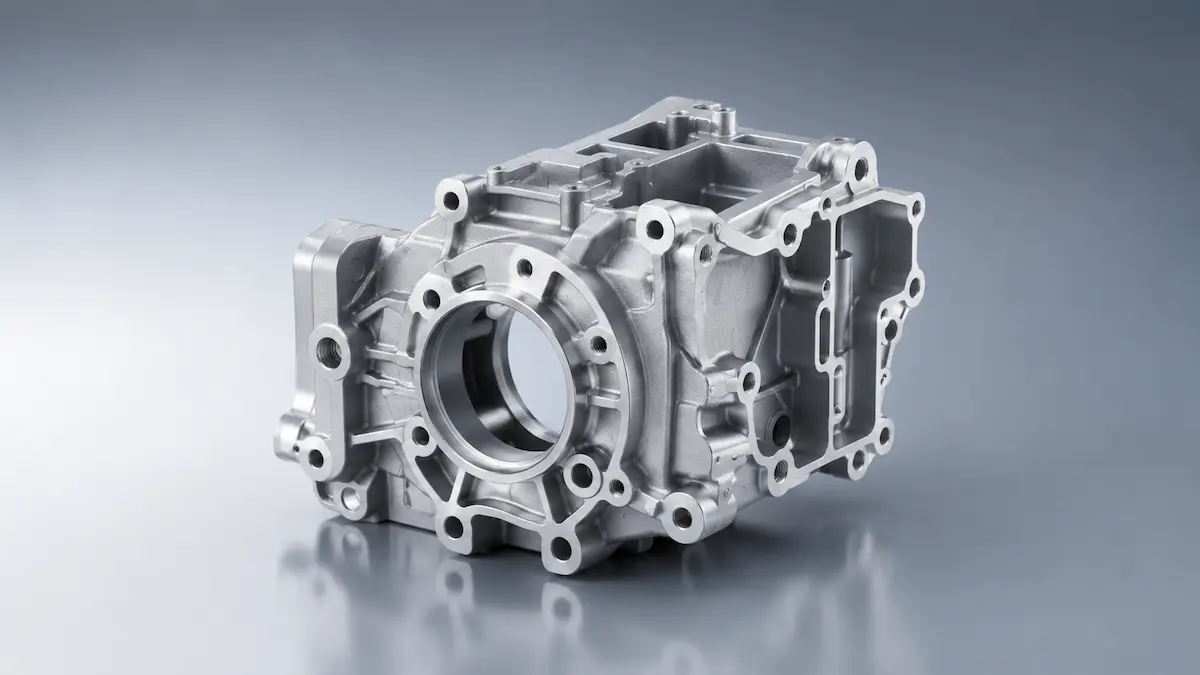
The biggest feature of ADC12 is its excellent die casting fluiditySuitable for one-time molding of complex shapesTendon positionHole positionThin-walled shells and batch structural componentsIt can be rapidly formed in moldsSuitable for mass productionThe cost per piece is more advantageous after mass productionBut ADC12 contains siliconCopper and other elements
ADC12 Aluminum Alloy
CNC MachiningMetals

Material compatibility assessment

By focusing on application scenarios, boundaries of advantages, and non-recommended scenarios, it helps sales, customer service, and quoting staff quickly determine whether the material meets current part requirements.

Core advantages

It has good flowability, is suitable for die casting molding, complex structures, thin-walled parts, high mass production efficiency, good dimensional stability, relatively controllable material costs, and can be processed with sandblasting, painting, powder, electrophoresis, shot blasting, and machining post-processing.

Suitable for the product

Automotive die-cast parts, motor housings, electronic and electrical appliance housings, communication equipment housings, mechanical equipment housings, lighting fixture housings, radiator housings, pump housings, valve housings, brackets, mounting seats, hardware accessories, small structural parts, batch aluminum alloy functional parts, die-cast exterior parts.

Not suitable for the product

Ultra-high strength load-bearing parts, high toughness impact resistant parts, high-precision CNC structural parts, high electrical conductivity requirements, high corrosion resistance exposed parts, strong welded structural parts, decorative parts requiring high-quality anodized appearance, long-term strongly corrosive environment parts, food direct contact parts, and aerospace high-strength structural parts.

Key parameter references

The following parameters come from product information and material knowledge fields, used for design review, quotation communication, and preliminary judgment before material selection.

Material positioningSuitable for mass production of die-casting, complex structural housings, medium-strength metal parts, thin-walled aluminum alloy parts, and mass production of industrial components.
Precision performanceADC12 die-cast parts have good repeatability in mass production, suitable for complex structures and medium-precision parts. Actual accuracy is affected by mold accuracy, die-casting equipment, material shrinkage, part dimensions, wall thickness uniformity, demolding angle, post-processing, and surface treatment. Key assembly surfaces, positioning holes, threaded holes, sealing surfaces, and high-precision hole positions usually require die casting before CNC finishing.
Dimensional tolerancesThe standard dimensional tolerances for ADC12 die-cast parts can be referenced ± 0.10mm-±0.30mm. Small structural parts and mold controls with good control are easier to stabilize dimensions; Large components, thin-walled parts, complex structural parts, and multiple post-processing parts may reach ±0.30mm-±0.80mm or higher. This value is a standard reference range and does not guarantee absolute tolerances for all structures; key dimensions are recommended to be guaranteed through post-processing.
Minimum Wall ThicknessFor small ADC12 die-cast parts, the local wall thickness can be referenced as 1.0mm-1.5mm, but it is not recommended to use large areas with overly thin wall thickness. Walls that are too thin easily cause insufficient filling, cold insulation, deformation, insufficient strength, and coating defects. The load-bearing structure, mounting positions, and large housing should be appropriately thickened.
Recommended wall thicknessStandard die-cast shells and structural components are recommended with wall thicknesses of 2.0mm-3.0mm; small thin-walled shells can be designed to 1.5mm-2.0mm depending on structure and mold capacity; mounting bases, screw posts, reinforcing rib roots, and load-bearing positions are recommended 2.5mm-4.0mm, and stress concentration is reduced through fillet and transition structures.
Minimum apertureThe recommended hole size for die casting is no less than 1.5mm-2.0mm. Smaller holes, deep holes, precision holes, and threaded holes are recommended to be achieved through post-processing. Mold core-pulling holes need to consider core-pulling strength, demolding angle, hole depth, and mold lifespan. It is recommended to reserve machining allowance for positioning holes, sealing holes, threaded bottom holes, and assembly holes. After die-casting, drilling, reaming, or tapping holes is recommended.
Assembly clearanceFor ordinary die-cast parts, it is recommended to reserve 0.15mm-0.40mm on one side; for unmachined die-cast surface assembly, it is recommended to appropriately increase the gap; for movable fits, it is recommended to reserve 0.30mm-0.60mm on one side. If subsequent painting, powder spraying, electrophoresis, or chemical treatment is needed, additional consideration should be given to coating thickness to avoid over-tightening or scratching the coating.
Detailed performanceADC12 die casting is suitable for achieving rib positions, column positions, steps, mounting seats, signage, shallow textures, and complex shell structures. Fine text, logos, and decorative textures should avoid being too shallow or too fine; it is recommended that raised or recessed details should be no less than 0.3mm-0.5mm. High-precision appearance textures, precise markings, and decorative effects can be achieved through mold etching, spraying, screen printing, laser marking, or post-processing.
Surface effectThe original die-cast surface of the ADC12 is usually silver-gray or light gray metal, with visible parting lines, ejector pin marks, flow marks, or slight die-casting textures. After shot blasting and sandblasting, a relatively uniform matte gray surface can be obtained; After painting, powder spraying, or electrophoresis, more stable appearance colors and protective effects can be achieved. If you pursue high-end natural metal or anodized texture, ADC12 is usually not as suitable as 6061 aluminum alloy.

Typical application scenarios

Based on material characteristics and suitable product ranges, customer needs are broken down into easier application directions to determine.

Product validation

Automotive die-cast parts, motor housings, electronic and electrical appliance housings, communication equipment housings, mechanical equipment housings, lighting fixture housings, radiator housings, pump housings, valve housings, brackets, mounting seats, hardware accessories, small structural parts, batch aluminum alloy functional parts, die-cast exterior parts.

Reasons for material selection

Suitable for mass production of die-casting, complex structural housings, medium-strength metal parts, thin-walled aluminum alloy parts, and mass production of industrial components.

Material characteristics

The biggest feature of ADC12 is its excellent die casting fluidity, making it suitable for one-time forming of complex shapes, rib positions, hole positions, thin-walled housings, and batch structural parts. It can be quickly formed in molds, suitable for mass production, and has a higher cost per piece after mass production. However, ADC12 contains elements like silicon and copper, so its corrosion resistance and anodized appearance are generally inferior to wrought aluminum alloys like 6061 and 5052, and its strength and toughness are not suitable as substitutes for high-strength aluminum alloys or steel parts.

Design and risk review

Based on wall thickness, hole position, assembly clearance, dimensional tolerances, and material usage risks, determine in advance whether the part structure is suitable for ADC12 Aluminum Alloy.

Design considerations

  • When designing ADC12 die castings
  • Attention should be paid to uniform wall thickness
  • Release angle
  • Rounded transitions
  • Gate position
  • Exhaust
  • Thimble position
  • Parting line
Precision performanceADC12 die-cast parts have good repeatability in mass production, suitable for complex structures and medium-precision parts. Actual accuracy is affected by mold accuracy, die-casting equipment, material shrinkage, part dimensions, wall thickness uniformity, demolding angle, post-processing, and surface treatment. Key assembly surfaces, positioning holes, threaded holes, sealing surfaces, and high-precision hole positions usually require die casting before CNC finishing.
Dimensional tolerancesThe standard dimensional tolerances for ADC12 die-cast parts can be referenced ± 0.10mm-±0.30mm. Small structural parts and mold controls with good control are easier to stabilize dimensions; Large components, thin-walled parts, complex structural parts, and multiple post-processing parts may reach ±0.30mm-±0.80mm or higher. This value is a standard reference range and does not guarantee absolute tolerances for all structures; key dimensions are recommended to be guaranteed through post-processing.
Quality riskThe main risks of ADC12 include die casting porosity, shrinkage cavities, cold isolation, flow marks, distortion, surface sand holes, exposed pores after machining, and spray adhesion issues. It is suitable for die-casting batch parts but not for all high-strength or high-precision scenarios. When it involves airtightness, sealing surfaces, threaded holes, load-bearing mounting positions, and surface spraying surfaces, control should be made in advance in mold design, gating system, venting, post-processing allowance, and quality inspection standards.
Surface effectThe original die-cast surface of the ADC12 is usually silver-gray or light gray metal, with visible parting lines, ejector pin marks, flow marks, or slight die-casting textures. After shot blasting and sandblasting, a relatively uniform matte gray surface can be obtained; After painting, powder spraying, or electrophoresis, more stable appearance colors and protective effects can be achieved. If you pursue high-end natural metal or anodized texture, ADC12 is usually not as suitable as 6061 aluminum alloy.

Post-processing and assembly precautions

Post-processing of ADC12 Aluminum Alloy affects appearance, dimensions, hole position, assembly clearance, and usage validation results, and should be explained in advance during quotation, DFM review, and sample confirmation stages.

Post-processing options

Post-processing should focus on appearance display, dimensional fitting, connection assembly, and testing verification. Parts involving assembly positions need to be reserved in advance for machining, coating, and trial assembly allowances.

Leave the armor on the frontierDe-defluffing: Used to improve the appearance, assembly, or validation of parts, it is necessary to confirm dimensions, strength, and delivery impact based on material properties.
Remove burrsDeburring is used to improve the appearance of parts, assembly, or functional verification effects, and it is necessary to confirm the impact on dimensions, strength, and delivery in combination with material characteristics.
PelletizingShot blasting is used to improve the appearance, assembly, or validation of parts, and must be combined with material properties to confirm dimensions, strength, and delivery impact.
SandblastingAchieve a more uniform matte surface, suitable for engineering prototype display and slight surface mark reduction.
Vibrating grindingVibratory grinding is used to improve the appearance, assembly, or validation of parts, and must be combined with material properties to confirm dimensions, strength, and delivery impact.
PolishingImproves support marks, layer lines, and edge feel, but will slightly alter local dimensions and the shape of sharp edges.
Spray paintEnhances color and appearance consistency, but will increase coating thickness, so assembly surfaces need to allow for clearance.
Powder sprayingSuitable for metal surface protection and color consistency; when coatings are thick, assembly gaps must be reserved.

Key control point

Size impactADC12 die-cast parts usually have gates; Parting line; Blade of the Blade; Ejector pin marks and local die-cast textures; It requires a donning of the blade; polishing; Shot blasting or sandblasting improves the surface; ADC12 is not suitable for high-quality anodized finishes
Assembly clearanceFor positions involving snapping, plugging, sliding, or enclosure closure, the clearance needs to be adjusted according to post-processing thickness, material shrinkage, and trial assembly results.
Hole Position StrengthThreading, inserting nuts, locking screws, and the areas around positioning holes need to ensure wall thickness to avoid cracks, stripped threads, or chipped edges during post-processing or assembly.
Environmental matchingWhen used in high-temperature, outdoor, humid, friction, or load-bearing scenarios, post-processing materials, adhesives, coatings, and fasteners must also meet the corresponding usage environment.

Structure and usage boundaries

For common issues such as threads, snaps, strength, temperature resistance, and weather resistance, identify in advance whether the material needs to be replaced or if another processing method should be used.

Thread Recommendation

Applicable ScopeADC12 can be tapped, but the thread strength and resistance to repeated disassembly and assembly of aluminum die-cast parts are limited.
Risk pointFor ordinary threaded holes, it is recommended to drill and tap the thread after die-casting;
Recommended practiceFor high-strength or frequently disassembly locations, it is recommended to use wire screw sleeves, embedded screw sleeves, die-cast inserts, or metal insert structures. Add fillets and reinforcing ribs at the base of the screw post to prevent cracking or thread slipping during locking.

Buckle recommendation

Applicable ScopeADC12 is not suitable for designing large deformation elastic buckles like plastic.
Risk pointMetal slots, limit steps, pressure plates, screw fixation, pin connections, or small deformation locking structures can be designed, but repeated buckle deformation relying on material elasticity should be avoided.
Recommended practiceWhen elastic buckles are needed, consider spring steel, stainless steel springs, plastic parts, or standard hardware solutions.

Strength and Environment

Mechanical strengthADC12 has medium strength and good adaptability to die casting molding, making it suitable for housings, brackets, housings, mounting bases, and general industrial structural components.
Environmental boundaryIts strength and toughness are generally not as good as high-strength aluminum alloys like 7075 or 2A12, and it is not suitable as a substitute for steel parts or high-strength load-bearing components.
Recommended practiceFor load-bearing structures, focus should be paid to wall thickness, rib position, fillets, pores, thread position, and load direction. ADC12 has better temperature resistance than plastics and resin materials, making it suitable for general metal engineering environments and medium-temperature usage scenarios. However, it is not a specialized superalloy, and prolonged high temperatures affect strength, dimensional stability, and surface treatment layers. When applied near heat sources, around the engine, motor housing, or heat dissipation structures, verification should be conducted considering specific temperature, load, and surface treatment. ADC12 has average corrosion resistance; exposure to humidity, salt spray, acids, alkalis, or outdoor environments can easily cause oxidation, corrosion spots, or surface darkening. Since ADC12 is generally not suitable for high-quality anodized finishes, outdoor or high-quality parts with high appearance requirements are recommended to use powder coating, painting, electrophoresis, passivation, chemical conversion films, or other surface protection treatments to improve weather resistance and appearance stability.

Alternative material selection and final judgment

When customer demand exceeds ADC12 Aluminum Alloy material boundaries, it is necessary to combine strength, temperature resistance, toughness, long-term stability, and mass production goals to promptly recommend alternative materials or processing technologies.

Alternative material suggestions

If CNC precision machining and better anodizing results are needed, 6061 aluminum alloy can be chosen; If higher strength is required, 7075 aluminum alloy or 2A12 aluminum alloy can be chosen; If sheet metal bending and corrosion-resistant casing are needed, 5052 aluminum alloy can be chosen; If higher corrosion resistance and long-term outdoor stability are required,316L Stainless Steel or TC4 Titanium Alloy (Ti-6Al-4V) can be chosen; For small-batch verification, photosensitive resin, nylon, CNC aluminum alloy, or metal 3D printed samples can be chosen.

Material selection suggestions

If customers need to mass-produce complex aluminum alloy housings, brackets, housings, or medium-strength structural components, the ADC12 is the appropriate choice. If the customer is still in the prototyping stage, with limited quantities or structures not yet finalized, it is recommended to first verify the structure using CNC aluminum alloy, 3D printing, or soft mold samples, and then proceed to die casting and mold making. If customers require high strength, high toughness, high corrosion resistance, or high-end anodized appearances, priority should be given to 6061, 7075, 5052, stainless steel, or other materials.

Already have the blueprints? Directly enter the quotation for custom parts

After uploading 3D/2D drawings and supplementing materials, quantities, tolerances, surface treatments, and delivery requirements, XPartsLab will provide next steps in 3D printing manufacturability, cost, and delivery pathways.