Support Hours: 09:00–18:00 (GMT+8) · Messages and quote requests are accepted 24/7.
Material Database

Phenolic Resin (Bakelite)

CNC insulation materials suitable for electrical insulating parts, jig plates, mechanical supports, heat-resistant pads, switch electrical components, tooling fixtures, and medium to low load insulating structural parts.

Material description

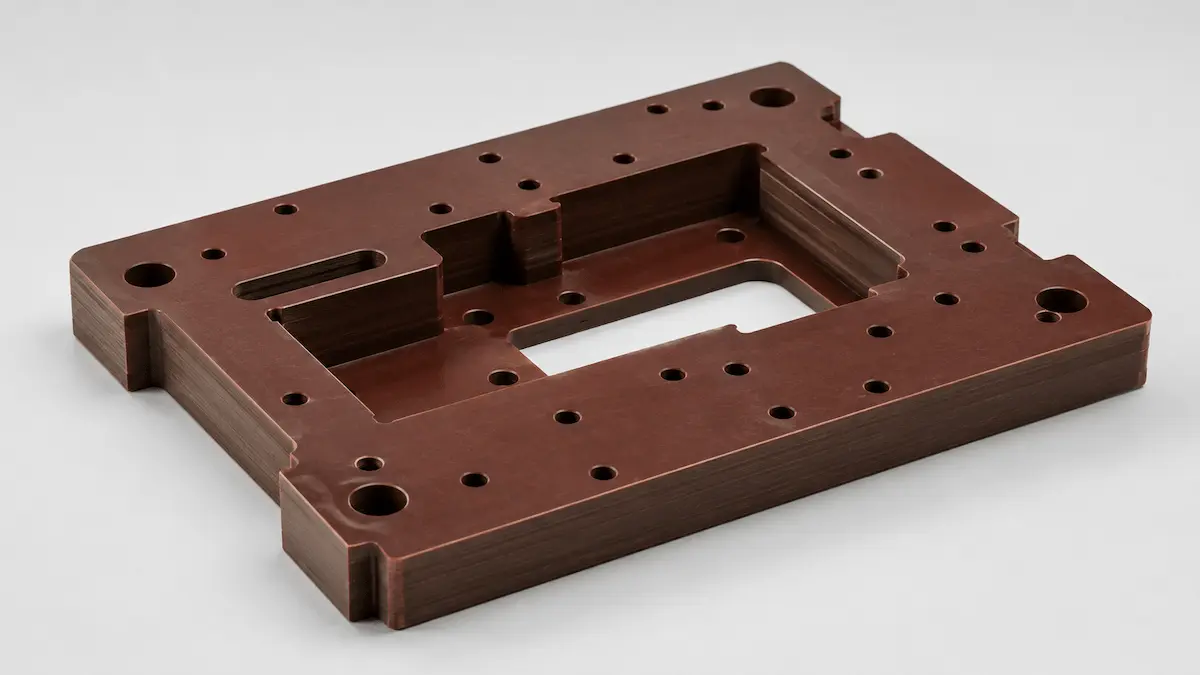
CNC Phenolic Resin (Bakelite) is a phenolic resin laminate material part made by CNC machining. It is usually made by pressing phenolic resin with paper-based, fabric-based, or other reinforcing materials, and has good electrical insulation, heat resistance, rigidity, dimensional stability, and machinability. It is commonly used in insulating boards, jig plates, switchgear components, fixture pads, electronic and electrical structural components, mechanical supports, and heat-resistant insulating parts. Compared to ordinary plastics, Phenolic Resin (Bakelite) has higher rigidity, better heat resistance, and more stable insulation properties; Compared to FR4, Phenolic Resin (Bakelite) generally offers better workability, but strength, moisture resistance, and overall insulation stability must be determined according to the specific material grade.

Phenolic Resin (Bakelite)Phenolic boardPhenolic resin boardBakelite boardCNC Phenolic Resin (Bakelite)Machining Phenolic Resin (Bakelite)Insulating Phenolic Resin (Bakelite) boardPhenolic laminateBuki Phenolic Resin (Bakelite)Paper-based Phenolic Resin (Bakelite)
The main feature of Phenolic Resin (Bakelite) is its excellent insulation performanceIt has relatively high rigidityIt has good heat resistanceSuitable for making electrical isolationMechanical support and jig partsIts material feels relatively hardUsually not suitable for making elastic parts or high-impact housingsPhenolic Resin (Bakelite) powder may appear at the edges after processingThe border collapsedLayered or burrs
Phenolic Resin (Bakelite)
CNC MachiningPlastics

Material compatibility assessment

By focusing on application scenarios, boundaries of advantages, and non-recommended scenarios, it helps sales, customer service, and quoting staff quickly determine whether the material meets current part requirements.

Core advantages

It has good electrical insulation, good heat resistance, good rigidity, good dimensional stability, good processing performance, relatively controllable costs, suitable for CNC machining, jigs and insulation support scenarios, and is more suitable for heat-resistant insulation applications than ordinary plastics.

Suitable for the product

Insulating boards, insulating gaskets, electrical switch parts, electronic and electrical support parts, jig plates, tooling fixtures, mechanical pads, heat-resistant isolation boards, internal equipment insulation structures, power distribution equipment insulation parts, instrument and meter insulation parts, positioning blocks, isolation blocks, and mechanical structural components for low to medium loads.

Not suitable for the product

Transparent appearance parts, high-toughness snap-fit parts, high-impact parts, high-elasticity structural parts, high-gloss appearance parts, long-term load-bearing structural parts, food direct contact parts, medical implant parts, long-term moisture-immersion parts, strong acid and strong alkali environment parts, high-precision decorative parts, parts requiring flexible deformation.

Key parameter references

The following parameters come from product information and material knowledge fields, used for design review, quotation communication, and preliminary judgment before material selection.

Material positioningCNC insulation materials suitable for electrical insulating parts, jig plates, mechanical supports, heat-resistant pads, switch electrical components, tooling fixtures, and medium to low load insulating structural parts.
Precision performanceCNC Phenolic Resin (Bakelite) can achieve good planar machining accuracy, hole position accuracy, and general structural dimensional accuracy, making it suitable for jig plates, insulating boards, positioning blocks, and internal structural components of equipment. Actual accuracy is affected by sheet thickness, lamination direction, tool condition, clamping method, machining parameters, hole size, and edge chipping. For positioning holes, assembly holes, and insulation isolation surfaces, hole position, tolerances, and hole quality should be controlled separately.
Dimensional tolerancesThe standard dimensional tolerances for CNC machined Phenolic Resin (Bakelite) can be referenced as ±0.05mm-±0.15mm, while ordinary insulating boards and fixtures can be evaluated at ±0.10mm-±0.30mm. Large plates, thin plates, densely pore parts, and complex slot components may experience greater deviations. These values are standard reference ranges and are not absolute guaranteed tolerances for all structures. Positioning holes, assembly surfaces, and key insulation structures should be separately marked with tolerance requirements.
Minimum Wall ThicknessFor ordinary CNC machining Phenolic Resin (Bakelite) the wall thickness of the structure is recommended not less than 1.0mm. Thin walls, narrow bridges, slender strips, and areas with narrow hole edge spacing are prone to chipping, cracking, or delamination. When used as insulation boards, jig boards, and support structures, designs with overly narrow connecting ribs and overly thin edges should be avoided.
Recommended wall thicknessStandard insulation boards, gaskets, and jig boards are recommended at 1.5mm-3.0mm; structures requiring assembly force, screw locking, positioning, or clamping are recommended at least 2.0mm; for large panels and fixture boards requiring flatness, it is recommended to increase thickness or add support structures to avoid warping and deformation.
Minimum apertureCNC drilling can achieve smaller hole diameters, but small holes are prone to burrs, chipped edges, or dust residue at the hole openings. Standard designs recommend hole diameters not less than 1.0mm; dense holes, positioning holes, and assembly holes should be evaluated separately based on tool type, hole spacing, and plate thickness. The recommended distance from holes to edges is not less than 1.0mm-1.5mm, and important assembly holes and load-bearing holes should appropriately increase the margin.
Assembly clearanceFor general assembly, it is recommended to reserve 0.10mm-0.30mm on one side; for insertion, positioning, and fixture assembly, it is recommended to reserve 0.05mm-0.20mm based on hole position accuracy, plate thickness, and machining burrs. If there are many parts or repeated disassembly and assembly are required, the gap should be appropriately enlarged, and the hole openings should be chamfered and deburred to avoid insertion difficulties, edge cracking, or assembly interference.
Detailed performancePhenolic Resin (Bakelite) suitable for machining holes, grooves, steps, chamfers, windows, positioning holes, counterbos, and simple structural details. Because the material is relatively hard and has a laminated structure, excessive small text, sharp corners, thin edges, and complex decorative textures can easily cause chipped edges, layering, or fuzzy edges. Logos and markings are recommended to be achieved through silkscreen printing, engraving, or laser marking, but complex decoration is not recommended on key insulating surfaces and high-precision hole areas.
Surface effectPhenolic Resin (Bakelite) raw surface is usually brown, black, reddish-brown, or dark brown, giving it a laminated texture. The surface is relatively hard but not a high-gloss material. CNC-machined edges may show light-colored cut surfaces, powdery textures, or laminated textures. Chamfering, sanding, and cleaning will make the edges look neater. Phenolic Resin (Bakelite) is more of a functional material, usually used for internal insulation, jigs, and supports, and is not suitable as a high-end decorative exterior.

Typical application scenarios

Based on material characteristics and suitable product ranges, customer needs are broken down into easier application directions to determine.

Product validation

Insulating boards, insulating gaskets, electrical switch parts, electronic and electrical support parts, jig plates, tooling fixtures, mechanical pads, heat-resistant isolation boards, internal equipment insulation structures, power distribution equipment insulation parts, instrument and meter insulation parts, positioning blocks, isolation blocks, and mechanical structural components for low to medium loads.

Reasons for material selection

CNC insulation materials suitable for electrical insulating parts, jig plates, mechanical supports, heat-resistant pads, switch electrical components, tooling fixtures, and medium to low load insulating structural parts.

Material characteristics

The main features of Phenolic Resin (Bakelite) are good insulation, high rigidity, and good heat resistance, making it suitable for electrical isolation, mechanical supports, and fixture parts. Its material texture is relatively hard and is generally not suitable for making elastic parts or high-impact shells. Phenolic Resin (Bakelite) after machining, edges may develop powder, chipping, delamination, or burrs. Design and machining require reasonable control of hole edge spacing, wall thickness, chamfering, and cutting parameters.

Design and risk review

Based on wall thickness, hole position, assembly clearance, dimensional tolerances, and material usage risks, determine in advance whether the part structure is suitable for Phenolic Resin (Bakelite).

Design considerations

  • When designing CNC Phenolic Resin (Bakelite) parts
  • Insulation spacing should be given special consideration
  • Creep distance
  • Hole margins
  • The planks are thick
  • Cutting edge cutting and assembly methods
  • For sharp corners, it is recommended to add rounded corners
  • For the opening, it is recommended to chamfer and remove burrs
Precision performanceCNC Phenolic Resin (Bakelite) can achieve good planar machining accuracy, hole position accuracy, and general structural dimensional accuracy, making it suitable for jig plates, insulating boards, positioning blocks, and internal structural components of equipment. Actual accuracy is affected by sheet thickness, lamination direction, tool condition, clamping method, machining parameters, hole size, and edge chipping. For positioning holes, assembly holes, and insulation isolation surfaces, hole position, tolerances, and hole quality should be controlled separately.
Dimensional tolerancesThe standard dimensional tolerances for CNC machined Phenolic Resin (Bakelite) can be referenced as ±0.05mm-±0.15mm, while ordinary insulating boards and fixtures can be evaluated at ±0.10mm-±0.30mm. Large plates, thin plates, densely pore parts, and complex slot components may experience greater deviations. These values are standard reference ranges and are not absolute guaranteed tolerances for all structures. Positioning holes, assembly surfaces, and key insulation structures should be separately marked with tolerance requirements.
Quality riskThe main risks of Phenolic Resin (Bakelite) include edge chipping, lamination delamination, processing dust, hole burrs, thin-wall cracking, performance changes after moisture absorption, and weak appearance consistency. It is suitable for insulation and fixture structures, but not for high appearance, high impact, large deformation, or prolonged damp environments. When used in electrical insulation scenarios, special attention should be paid to hole position accuracy, insulation distance, creepage distance, surface cleanliness, edge burrs, and operating environment humidity.
Surface effectPhenolic Resin (Bakelite) raw surface is usually brown, black, reddish-brown, or dark brown, giving it a laminated texture. The surface is relatively hard but not a high-gloss material. CNC-machined edges may show light-colored cut surfaces, powdery textures, or laminated textures. Chamfering, sanding, and cleaning will make the edges look neater. Phenolic Resin (Bakelite) is more of a functional material, usually used for internal insulation, jigs, and supports, and is not suitable as a high-end decorative exterior.

Post-processing and assembly precautions

Post-processing of Phenolic Resin (Bakelite) affects appearance, dimensions, hole position, assembly clearance, and usage validation results, and should be explained in advance during quotation, DFM review, and sample confirmation stages.

Post-processing options

Post-processing should focus on appearance display, dimensional fitting, connection assembly, and testing verification. Parts involving assembly positions need to be reserved in advance for machining, coating, and trial assembly allowances.

Remove burrsDeburring is used to improve the appearance of parts, assembly, or functional verification effects, and it is necessary to confirm the impact on dimensions, strength, and delivery in combination with material characteristics.
ChamferChamfering is used to improve the appearance of parts, assembly, or functional verification effects, and the dimensions, strength, and delivery impact need to be confirmed in combination with material characteristics.
PolishingImproves support marks, layer lines, and edge feel, but will slightly alter local dimensions and the shape of sharp edges.
Trim the edgesEdge trimming is used to improve the appearance, assembly, or validation of parts, and must be combined with material properties to confirm dimensions, strength, and delivery impact.
CNC millingCNC milling is used to improve part appearance, assembly, or usage validation, requiring confirming dimensions, strength, and delivery impact based on material properties.
CNC drillingCNC drilling is used to improve the appearance, assembly, or validation of parts, requiring confirmation of dimensions, strength, and delivery impact based on material properties.
GroovingSlotting is used to improve the appearance, assembly, or validation of parts, and must be combined with material properties to confirm dimensions, strength, and delivery impact.
CarvingEngraving is used to improve the appearance, assembly, or validation of parts, and must be combined with material properties to confirm dimensions, strength, and delivery impact.

Key control point

Size impactPhenolic Resin (Bakelite) Dust and phenolic odors are produced during processing; Proper vacuuming is necessary; Protection and cleaning; The machining edges may appear white; the border collapsed; Layered or burrified; For appearance, it is recommended to bevel or lightly polish the edges; During drilling and grooving, avoid feeding too fast that could cause edge chipping
Assembly clearanceFor positions involving snapping, plugging, sliding, or enclosure closure, the clearance needs to be adjusted according to post-processing thickness, material shrinkage, and trial assembly results.
Hole Position StrengthThreading, inserting nuts, locking screws, and the areas around positioning holes need to ensure wall thickness to avoid cracks, stripped threads, or chipped edges during post-processing or assembly.
Environmental matchingWhen used in high-temperature, outdoor, humid, friction, or load-bearing scenarios, post-processing materials, adhesives, coatings, and fasteners must also meet the corresponding usage environment.

Structure and usage boundaries

For common issues such as threads, snaps, strength, temperature resistance, and weather resistance, identify in advance whether the material needs to be replaced or if another processing method should be used.

Thread Recommendation

Applicable ScopePhenolic Resin (Bakelite) can process low-strength threads, but is not suitable for frequent disassembly and high locking force connections.
Risk pointOrdinary positioning and low-load connections can be directly tapped;
Recommended practiceFor important connection points, it is recommended to use metal nuts, inserts, pressure rivets, sleeves, or screw holes with nuts for fixation. Ensure sufficient margin and wall thickness around the screw holes to avoid delamination, cracking, or chipping during tightening.

Buckle recommendation

Applicable ScopePhenolic Resin (Bakelite) is not suitable for designing large deformation elastic buckles like plastic.
Risk pointThe material has high rigidity but limited toughness, and the snap is prone to cracking, delamination, or chipping when subjected to force.
Recommended practiceIt can be designed with low-deformation slots, limit steps, screw fixing, positioning pins, pressure plate fixing, or slot structures. If elastic snaps are needed, Polycarbonate (PC), Nylon (PA), Acetal (POM), ABS, or metal spring materials should be chosen.

Strength and Environment

Mechanical strengthPhenolic Resin (Bakelite) has good rigidity and moderate mechanical strength, making it suitable for insulation support plates, jig plates, pads, and internal equipment structural components.
Environmental boundaryIts compressive strength and rigidity surpass many ordinary plastics, but its impact resistance and toughness are not as good as engineering plastics like ABS, Polycarbonate (PC), and nylon.
Recommended practiceThe load-bearing structure should focus on plate thickness, hole edge spacing, lamination direction, screw locking force, and edge cracking risk. Phenolic Resin (Bakelite) temperature resistance is better than ordinary plastics such as ABS and Acrylic (PMMA), making it suitable for medium-temperature environments in electronic and electrical equipment. Prolonged high temperatures may cause resin aging, color changes, strength reduction, or alterations in insulation performance. When used near heat sources, motors, power modules, or high-temperature test fixtures, verification should be conducted based on actual temperature, duration, and electrical requirements. Phenolic Resin (Bakelite) is more stable in ordinary indoor environments, but long-term humidity, outdoor sunlight, ultraviolet rays, acidic or alkaline conditions, or strong corrosive environments may lead to moisture absorption, aging, discoloration, delamination, or reduced insulation performance. When used in humid or high-voltage electrical environments, attention should be paid to moisture protection, dust prevention, edge sealing, and surface cleanliness. If long-term outdoor use is required, it is recommended to add coating protection or choose insulation materials better suited for outdoor use.

Alternative material selection and final judgment

When customer demand exceeds Phenolic Resin (Bakelite) material boundaries, it is necessary to combine strength, temperature resistance, toughness, long-term stability, and mass production goals to promptly recommend alternative materials or processing technologies.

Alternative material suggestions

If higher electrical insulation stability and mechanical strength are required, FR4 epoxy board can be chosen; If better toughness and appearance are needed, CNC ABS or Polycarbonate (PC) can be chosen; If better wear resistance and dimensional stability are needed, CNC Acetal (POM) can be chosen; If higher temperature resistance and high-end insulation performance are required, Polyether Ether Ketone (PEEK), PPS, ceramic, or high-performance insulation boards can be chosen; If you only want low-cost insulating gaskets, you can choose Polyvinyl Chloride (PVC), Polypropylene (PP), PET, or ordinary insulating plastic boards.

Material selection suggestions

If customers mainly care about insulation, heat resistance, rigidity, cost control, and CNC machining convenience, CNC Phenolic Resin (Bakelite) is a more suitable choice. If customers require higher strength, better moisture resistance, and more stable electronic and electrical performance, FR4 is usually more suitable. If customers need appearance parts, snap fasteners, or impact-resistant structures, it is not recommended to prioritize Phenolic Resin (Bakelite); instead, ABS, Polycarbonate (PC), Nylon (PA), Acetal (POM), or metal structural parts should be considered.

Already have the blueprints? Directly enter the quotation for custom parts

After uploading 3D/2D drawings and supplementing materials, quantities, tolerances, surface treatments, and delivery requirements, XPartsLab will provide next steps in 3D printing manufacturability, cost, and delivery pathways.