
Core advantages
It can achieve a transparent effect, fine surface, high molding precision, excellent detail performance, suitable for complex exterior structures, for displaying internal structures, and for producing transparent appearance samples.
High-precision 3D printed transparent materials suitable for transparent appearance display, internal structure observation, product verification, and rapid prototyping.
Clear Resin – Transparent is a transparent resin material used for photocuring 3D printing, suitable for creating product models that require internal structure observation, display of transparent appearance, verification of optical shapes, or production of transparent samples. It features high molding precision, excellent detail performance, and the ability to achieve transparent or semi-transparent effects. However, transparency is affected by printing layers, support marks, polishing, transparent paint spraying, part thickness, and post-curing results.
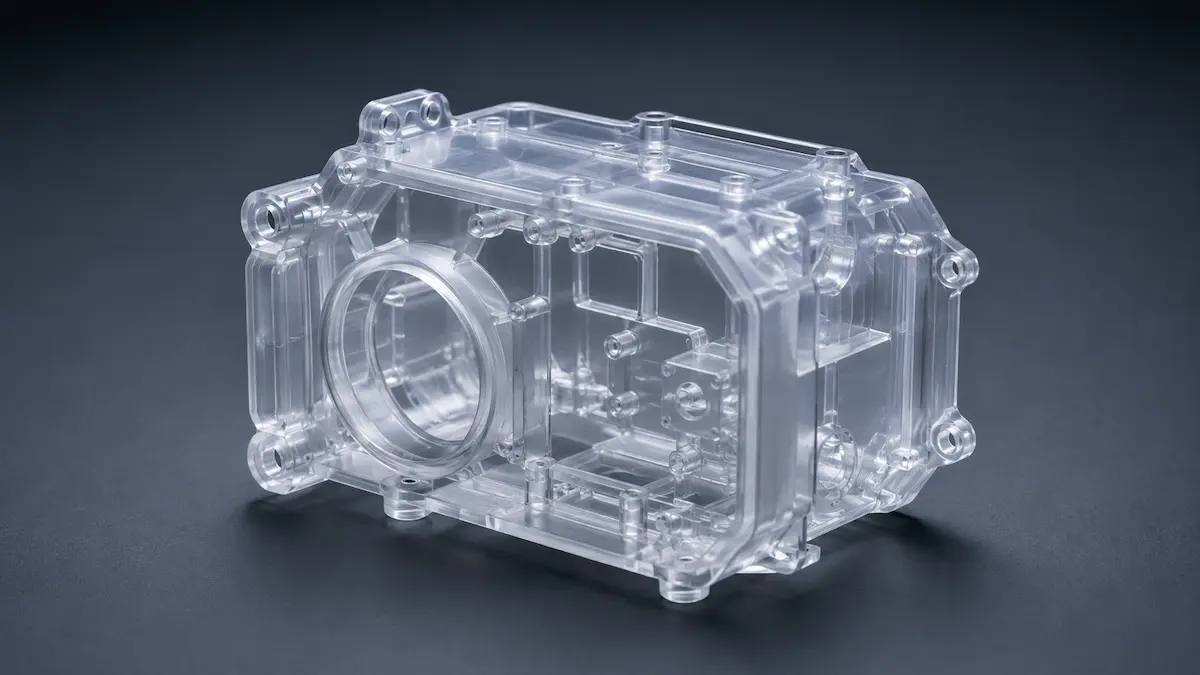
By focusing on application scenarios, boundaries of advantages, and non-recommended scenarios, it helps sales, customer service, and quoting staff quickly determine whether the material meets current part requirements.
It can achieve a transparent effect, fine surface, high molding precision, excellent detail performance, suitable for complex exterior structures, for displaying internal structures, and for producing transparent appearance samples.
Transparent appearance prototypes, transparent display models, lampshade samples, light guide structure verification parts, transparent housing models, medical device transparent samples, consumer electronics transparent housing models, fluid observation models, internal structure display parts, and small-batch transparent samples.
High-precision optical lenses, long-term load-bearing components, high-temperature use parts, high-impact parts, outdoor long-term use parts, long-term immersion parts, high-frequency snap-on fasteners, high-strength threaded parts, and final functional components requiring long-term optical transparency.
The following parameters come from product information and material knowledge fields, used for design review, quotation communication, and preliminary judgment before material selection.
| Material positioning | High-precision 3D printed transparent materials suitable for transparent appearance display, internal structure observation, product verification, and rapid prototyping. |
|---|---|
| Precision performance | Clear Resin – Transparent usually has good molding precision, suitable for ordinary appearance parts, transparent structure verification parts, and assembly verification parts. Actual accuracy is affected by part dimensions, printing direction, support position, cleaning, post-curing, grinding and polishing, and transparent paint thickness. |
| Dimensional tolerances | Standard dimensional tolerances can refer to ± 0.10mm to ±0.30mm. This value is a reference value for conventional processes and does not guarantee the absolute tolerance of all structures. If transparent parts require sanding, polishing, or applying clear paint, local dimensions may change. It is recommended to reserve margin for precision assembly positions and perform post-processing if necessary. |
| Minimum Wall Thickness | It is recommended that the wall thickness be no less than 1.0mm. For small non-stressed appearances, localized areas can be about 0.8mm, but large-area use is not recommended. Transparent thin-walled parts are prone to deformation, support marks, and post-processing damage; for large transparent parts, the wall thickness should be no less than 1.5mm. |
| Recommended wall thickness | For ordinary transparent exterior parts, 1.2mm-2.0mm is recommended; parts that require polishing, transparent paint, or transport protection should be appropriately thickened; For large transparent shells, it is recommended to add reinforcing ribs or locally thicken them to avoid deformation and cracking. |
| Minimum aperture | The recommended aperture is no less than 1.0mm. Small pores in transparent resin may shrink due to resin residue, insufficient cleaning, or post-curing effects. It is recommended to reserve machining allowance for precision holes, screw holes, and assembly holes, and drill holes later if necessary. |
| Assembly clearance | For ordinary assembly, it is recommended to reserve 0.15mm-0.30mm on one side; for movable fits, 0.30mm-0.50mm should be reserved on one side; if polishing, transparent paint, or UV coating is needed later, an additional gap of about 0.10mm-0.20mm should be added on one side. |
| Detailed performance | Raised text, fine textures, and decorative lines are recommended to be no less than 0.3mm-0.5mm. Transparent materials reduce the visual contrast of some shallow relief details, and if the details are too small, they may weaken during printing, cleaning, sanding, polishing, or clear paint spraying. |
| Surface effect | The original surface is usually transparent, semi-transparent, or slightly matte with a transparent effect, with slight layering and support marks visible. After fine polishing, polishing, and transparent paint spraying, transparency, glossiness, and visual texture are significantly improved, but it is usually still difficult to achieve the optical-grade transparency effect of injection-molded transparent Polycarbonate (PC) or acrylic Acrylic (PMMA). |
Based on material characteristics and suitable product ranges, customer needs are broken down into easier application directions to determine.
Transparent appearance prototypes, transparent display models, lampshade samples, light guide structure verification parts, transparent housing models, medical device transparent samples, consumer electronics transparent housing models, fluid observation models, internal structure display parts, and small-batch transparent samples.
High-precision 3D printed transparent materials suitable for transparent appearance display, internal structure observation, product verification, and rapid prototyping.
Clear Resin – Transparent can print transparent or semi-transparent parts, allowing customers to visually see the internal structure of the product or verify the transparent appearance. When first printed, there is usually a slight matte finish, layering, or support marks. After post-processing such as polishing, polishing, and applying clear paint, the transparency and surface texture are noticeably improved.
Based on wall thickness, hole position, assembly clearance, dimensional tolerances, and material usage risks, determine in advance whether the part structure is suitable for Clear Resin – Transparent.
Post-processing of Clear Resin – Transparent affects appearance, dimensions, hole position, assembly clearance, and usage validation results, and should be explained in advance during quotation, DFM review, and sample confirmation stages.
Post-processing should focus on appearance display, dimensional fitting, connection assembly, and testing verification. Parts involving assembly positions need to be reserved in advance for machining, coating, and trial assembly allowances.
For common issues such as threads, snaps, strength, temperature resistance, and weather resistance, identify in advance whether the material needs to be replaced or if another processing method should be used.
When customer demand exceeds Clear Resin – Transparent material boundaries, it is necessary to combine strength, temperature resistance, toughness, long-term stability, and mass production goals to promptly recommend alternative materials or processing technologies.
If higher transparency and effects closer to mass-produced plastic are needed, CNC-machined acrylic Acrylic (PMMA) or Polycarbonate (PC) transparent sheets can be chosen; If higher impact resistance is required, CNC transparent Polycarbonate (PC) can be chosen; If only semi-transparent display effects are needed, you can choose regular post-treatment with transparent photosensitive resin; If mass production of transparent parts is needed, it is recommended to consider materials such as injection molded Polycarbonate (PC), Acrylic (PMMA), or transparent ABS.
If customers mainly focus on transparent exterior display, internal structure observation, and rapid prototyping, Clear Resin – Transparent is a suitable choice. If customers care about high light transmittance, long-term weather resistance, impact resistance, high-temperature resistance, or true optical-grade transparency, priority should be given to CNC transparent Polycarbonate (PC), CNC acrylic Acrylic (PMMA), or injection-molded transparent materials.
After uploading 3D/2D drawings and supplementing materials, quantities, tolerances, surface treatments, and delivery requirements, XPartsLab will provide next steps in 3D printing manufacturability, cost, and delivery pathways.