Support Hours: 09:00–18:00 (GMT+8) · Messages and quote requests are accepted 24/7.
Material Database

Graphite

CNC carbon materials suitable for EDM electrodes, high-temperature jigs, conductive parts, wear-resistant self-lubricating parts, thermal field parts, seals, and special industrial functional parts.

Material description

Graphite is a carbon material part made by CNC machining, featuring high temperature resistance, good electrical conductivity, good thermal conductivity, good self-lubrication, good chemical corrosion resistance, and a low coefficient of thermal expansion. It is commonly used in electrodes, EDM electrodes, mold electrodes, high-temperature jigs, wear-resistant sliding parts, sealing rings, Graphite crucibles, thermal field parts, and special industrial functional components. Compared to metal materials, Graphite is lightweight, has good high-temperature resistance and self-lubricating properties, but its strength, toughness, and impact resistance are weaker.

GraphiteCNC GraphiteMachining GraphiteGraphite electrodesEDM Graphite electrodesDischarge GraphiteCarbon GraphiteIndustrial GraphiteGao Chun GraphiteFine particles Graphite
CNC Graphite has distinct functional material propertiesIts core advantage lies in its resistance to high temperaturesConductivitySelf-lubricating and low thermal expansionIt is suitable for EDM electrodesHigh-temperature tooling and special sliding friction partsGraphite the material itself is relatively brittleLimited impact and bending resistanceCornerThin walls
Graphite
CNC MachiningCarbon materials

Material compatibility assessment

By focusing on application scenarios, boundaries of advantages, and non-recommended scenarios, it helps sales, customer service, and quoting staff quickly determine whether the material meets current part requirements.

Core advantages

It has good high-temperature resistance, good electrical conductivity, good thermal conductivity, good self-lubrication, low coefficient of thermal expansion, good chemical corrosion resistance, light weight, suitable for EDM electrode processing, and special working conditions with high temperature and low friction.

Suitable for the product

EDM discharge electrodes, mold electrodes, Graphite jigs, high-temperature fixtures, sintering jigs, heat treatment supports, Graphite sealing rings, Graphite bearings, sliding blocks, Graphite crucibles, conductive blocks, thermal field parts, semiconductor equipment auxiliary parts, vacuum furnace parts, glass hot-bending molds, special high-temperature resistant tooling.

Not suitable for the product

High-strength load-bearing parts, high-impact parts, high-toughness structural parts, high-elasticity snap-fit parts, thin-walled complex-appearance parts, long-term tension structural parts, high-precision high-strength threaded parts, high-gloss appearance parts, food direct contact parts, medical implant parts, strongly oxidized high-temperature environment parts, and structural parts requiring metal toughness.

Key parameter references

The following parameters come from product information and material knowledge fields, used for design review, quotation communication, and preliminary judgment before material selection.

Material positioningCNC carbon materials suitable for EDM electrodes, high-temperature jigs, conductive parts, wear-resistant self-lubricating parts, thermal field parts, seals, and special industrial functional parts.
Precision performanceCNC Graphite can achieve good machining accuracy, making it especially suitable for EDM electrodes, complex electrode profiles, and precision high-temperature tooling. Because Graphite materials are brittle, small sharp corners, thin edges, small holes, and deep grooves are prone to chipping. Actual accuracy is affected by Graphite particle size, material density, tool condition, machining path, clamping method, and edge structure. Precision electrodes and assembly surfaces should be individually controlled for tolerances, surface roughness, and edge chipping requirements.
Dimensional tolerancesThe general dimensional tolerances of CNC machined Graphite can be evaluated as ± 0.03mm to ±0.10mm, while ordinary structural parts can be evaluated at ±0.05mm to ±0.20mm. Small electrodes, sharp corner structures, thin-walled parts, deep grooves, and large Graphite components may require loosened tolerances or anti-chipping designs depending on the structure. This value is a standard reference range and does not guarantee absolute tolerances for all structures. Key EDM electrode dimensions and assembly surfaces should be separately marked with tolerance requirements.
Minimum Wall ThicknessThe wall thickness of ordinary CNC machined Graphite structure is recommended to be no less than 1.0mm-1.5mm. Thin-walled, sharp-angled, slender rods, and narrow bridge structures are prone to cracking or breaking, so large-area over-thin designs are not recommended. When used for electrode sharp corners, thin ribs, or deep groove structures, thickness or rounded corners should be appropriately thickened or rounded according to Graphite particle size, machining tool, and discharge losses.
Recommended wall thicknessFor ordinary Graphite structural parts, 2.0mm-4.0mm is recommended; for high-temperature jigs, Graphite fixtures, Graphite electrode bodies, and positions bearing clamping forces, it is recommended to be at least 3.0mm; slender electrodes, thin sheet electrodes, and areas requiring transport protection should be appropriately thickened, and chamfers, rounded corners, or support structures should be added to reduce the risk of fracture.
Minimum apertureCNC drilling can achieve smaller hole diameters, but Graphite small and deep holes are prone to chipped edges, rough hole walls, or dust residue. For general designs, the recommended aperture is no less than 1.0mm-1.5mm. Deep holes, threaded holes, assembly holes, and positioning holes should ensure sufficient hole margin spacing. For hole openings, chamfering is recommended to avoid edge chipping and assembly cracking.
Assembly clearanceFor ordinary assembly, it is recommended to reserve 0.10mm-0.30mm on one side; Graphite when fitting with metal, avoid overfilling, excessive overfilling, or forced compression to prevent Graphite cracking. High-temperature assembly should consider differences in thermal expansion and changes in operating temperature. The electrode clamping position should ensure sufficient clamping area to avoid excessive local clamping force that could cause cracking. If the Graphite surface requires coating or dipping treatment, dimensional changes should be additionally considered.
Detailed performanceCNC Graphite suitable for machining electrode profiles, holes, grooves, steps, chamfers, curved surfaces, cavities, and ordinary structural details. Fine grain Graphite can render better details, but small sharp corners, thin edges, elongated columns, and tiny text are prone to chipping or damage. EDM electrode details should consider subsequent discharge losses and correction margins. Logos and markings can be engraved or laser-marked, but it is not recommended to design complex decorative textures in weak corners.
Surface effectCNC Graphite raw surface is usually black or dark gray-black, with a matte, fine-grained, or powdery texture. After finishing, the surface can be relatively flat, but it lacks metallic luster and is not suitable for high-end appearance parts. Graphite surface is prone to getting dirty, powder, or leaving black marks, so dust prevention is important during cleaning and packaging. If surface stability needs improvement, impregnation, coating, or oxidation resistance treatments can be performed.

Typical application scenarios

Based on material characteristics and suitable product ranges, customer needs are broken down into easier application directions to determine.

Product validation

EDM discharge electrodes, mold electrodes, Graphite jigs, high-temperature fixtures, sintering jigs, heat treatment supports, Graphite sealing rings, Graphite bearings, sliding blocks, Graphite crucibles, conductive blocks, thermal field parts, semiconductor equipment auxiliary parts, vacuum furnace parts, glass hot-bending molds, special high-temperature resistant tooling.

Reasons for material selection

CNC carbon materials suitable for EDM electrodes, high-temperature jigs, conductive parts, wear-resistant self-lubricating parts, thermal field parts, seals, and special industrial functional parts.

Material characteristics

CNC Graphite has distinct functional material properties, with core advantages in high temperature resistance, electrical conductivity, self-lubrication, and low thermal expansion. It is suitable for EDM electrodes, high-temperature tooling, and special sliding friction parts. Graphite materials themselves are brittle, with limited impact and bending resistance; edges, thin walls, thin rods, and sharp structures are prone to chipping or breaking. Graphite dust is generated during processing, so proper vacuum suction, protection, and cleaning are necessary.

Design and risk review

Based on wall thickness, hole position, assembly clearance, dimensional tolerances, and material usage risks, determine in advance whether the part structure is suitable for Graphite.

Design considerations

  • When designing CNC Graphite parts
  • Material brittleness should be given special consideration
  • The edges and corners cracked and cracked
  • Clamping method
  • The walls are thick
  • Hole margin spacing and subsequent operating conditions
  • It is recommended to change the sharp corners to small rounded corners or chamfers
  • The slender structure should be appropriately thickened
Precision performanceCNC Graphite can achieve good machining accuracy, making it especially suitable for EDM electrodes, complex electrode profiles, and precision high-temperature tooling. Because Graphite materials are brittle, small sharp corners, thin edges, small holes, and deep grooves are prone to chipping. Actual accuracy is affected by Graphite particle size, material density, tool condition, machining path, clamping method, and edge structure. Precision electrodes and assembly surfaces should be individually controlled for tolerances, surface roughness, and edge chipping requirements.
Dimensional tolerancesThe general dimensional tolerances of CNC machined Graphite can be evaluated as ± 0.03mm to ±0.10mm, while ordinary structural parts can be evaluated at ±0.05mm to ±0.20mm. Small electrodes, sharp corner structures, thin-walled parts, deep grooves, and large Graphite components may require loosened tolerances or anti-chipping designs depending on the structure. This value is a standard reference range and does not guarantee absolute tolerances for all structures. Key EDM electrode dimensions and assembly surfaces should be separately marked with tolerance requirements.
Quality riskThe main risks of CNC Graphite include material brittleness, cracking at edges and corners, thin-wall fracture, dust contamination, chipped edges of holes, insufficient thread strength, surface powder shedding, and oxidation loss under strong oxidation high-temperature environments. It is suitable for high-temperature resistance, conductivity, self-lubrication, and EDM electrode applications, but not for high-strength structural components. When used for electrodes, focus should be paid to electrode size, sharp angle strength, discharge loss, surface quality, and clamping method; When used for high-temperature components, confirm whether the environment contains an oxidizing atmosphere.
Surface effectCNC Graphite raw surface is usually black or dark gray-black, with a matte, fine-grained, or powdery texture. After finishing, the surface can be relatively flat, but it lacks metallic luster and is not suitable for high-end appearance parts. Graphite surface is prone to getting dirty, powder, or leaving black marks, so dust prevention is important during cleaning and packaging. If surface stability needs improvement, impregnation, coating, or oxidation resistance treatments can be performed.

Post-processing and assembly precautions

Post-processing of Graphite affects appearance, dimensions, hole position, assembly clearance, and usage validation results, and should be explained in advance during quotation, DFM review, and sample confirmation stages.

Post-processing options

Post-processing should focus on appearance display, dimensional fitting, connection assembly, and testing verification. Parts involving assembly positions need to be reserved in advance for machining, coating, and trial assembly allowances.

Remove burrsDeburring is used to improve the appearance of parts, assembly, or functional verification effects, and it is necessary to confirm the impact on dimensions, strength, and delivery in combination with material characteristics.
ChamferChamfering is used to improve the appearance of parts, assembly, or functional verification effects, and the dimensions, strength, and delivery impact need to be confirmed in combination with material characteristics.
Lightly polishedLight sanding is used to improve the appearance, assembly, or validation of parts, requiring confirmation of dimensions, strength, and delivery impact based on material properties.
CNC millingCNC milling is used to improve part appearance, assembly, or usage validation, requiring confirming dimensions, strength, and delivery impact based on material properties.
CNC turning is requiredCNC turning is used to improve the appearance, assembly, or validation of parts, requiring confirmation of dimensions, strength, and delivery impact based on material properties.
DrillingDrilling is used to improve the appearance, assembly, or validation of parts, and must be combined with material properties to confirm dimensions, strength, and delivery impact.
GroovingSlotting is used to improve the appearance, assembly, or validation of parts, and must be combined with material properties to confirm dimensions, strength, and delivery impact.
CarvingEngraving is used to improve the appearance, assembly, or validation of parts, and must be combined with material properties to confirm dimensions, strength, and delivery impact.

Key control point

Size impactGraphite processing generates a large amount of dust; Specialized vacuuming and protective measures are required; Edges are prone to chipping; It is recommended to bevel or round all corners; Graphite surfaces are not suitable for ordinary painting and bonding as the main connection methods; If you need to increase strength; Reduces porosity or improves surface properties; Dipping or coating treatments can be considered
Assembly clearanceFor positions involving snapping, plugging, sliding, or enclosure closure, the clearance needs to be adjusted according to post-processing thickness, material shrinkage, and trial assembly results.
Hole Position StrengthThreading, inserting nuts, locking screws, and the areas around positioning holes need to ensure wall thickness to avoid cracks, stripped threads, or chipped edges during post-processing or assembly.
Environmental matchingWhen used in high-temperature, outdoor, humid, friction, or load-bearing scenarios, post-processing materials, adhesives, coatings, and fasteners must also meet the corresponding usage environment.

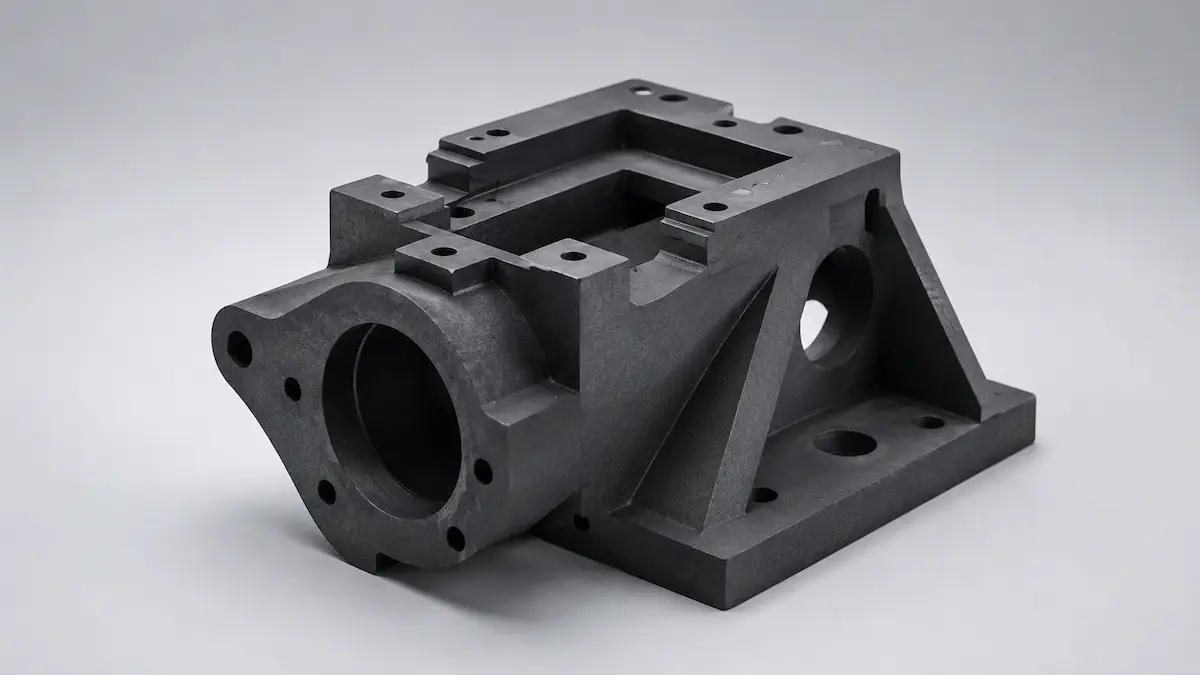
Structure and usage boundaries

For common issues such as threads, snaps, strength, temperature resistance, and weather resistance, identify in advance whether the material needs to be replaced or if another processing method should be used.

Thread Recommendation

Applicable ScopeGraphite can process low-strength threads, but the thread strength is much lower than that of metal, making them unsuitable for high locking force and frequent disassembly.
Risk pointFor ordinary positioning or low-load connections, Graphite threads can be tried;
Recommended practiceIt is recommended to fix important connection points with metal clamps, pressure plates, inserts, through-hole bolts, or external structures. Ensure sufficient wall thickness around the threaded holes to prevent cracking or tooth chipping during locking.

Buckle recommendation

Applicable ScopeGraphite is not suitable for designing elastic clips like plastic, nor for any large-deformation clip structure.
Risk pointIt can be designed with low-deformation positioning grooves, limiting steps, pressure plate fixing, external clamp fixing, or bolt hole-piercing fixation.
Recommended practiceIf elastic buckles are needed, Acetal (POM), Nylon (PA), Polycarbonate (PC), metal spring, or engineering plastic materials should be chosen.

Strength and Environment

Mechanical strengthGraphite has good compressive resistance, but weak tensile, bending, and impact resistance, and overall exhibits characteristics of a hard and brittle material.
Environmental boundaryIt is suitable for withstanding compression, electrical conduction, thermal conductivity, self-lubrication, and high-temperature resistance, but is not suitable as a high-strength structural component.
Recommended practiceLoad-bearing structures should avoid bending, stretching, impact, and local clamping; reliability should be improved through thickening, rounded corners, supporting, and proper clamping. Graphite has excellent high-temperature resistance, can withstand very high temperatures in non-oxidizing or inert atmospheres, and is suitable for vacuum furnaces, sintering, heat treatment, and high-temperature tooling scenarios. However, in oxygen-rich environments, oxidative ablation occurs at high temperatures, and the higher the temperature, the more pronounced the oxidation. If used in high-temperature environments, consider anti-oxidation coatings, protective atmospheres, or other high-temperature resistant materials such as ceramics, heat-resistant steel, or nickel-based alloys. Graphite has good chemical stability at room temperature and is resistant to most corrosive media, but the material is porous and easily absorbs oil, moisture, and dust. Prolonged humid environments may affect surface cleanliness and assembly performance. Graphite not suitable for outdoor decorative or high-end appearance. For high-temperature, corrosive, or vacuum scenarios, the appropriate Graphite grade and surface treatment plan should be selected based on the medium, atmosphere, temperature, and purity requirements.

Alternative material selection and final judgment

When customer demand exceeds Graphite material boundaries, it is necessary to combine strength, temperature resistance, toughness, long-term stability, and mass production goals to promptly recommend alternative materials or processing technologies.

Alternative material suggestions

If higher strength and metal toughness are required, stainless steel, mold steel, titanium alloy, or aluminum alloy can be chosen; If higher conductivity and better mechanical strength are required, Pure CopperT2, TU2 Oxygen-Free Copper, or C18150 Chromium Zirconium Copper can be chosen; If higher wear resistance and strength are needed, Tungsten Carbide, SKD11, or ceramic can be chosen; If insulation and high-temperature resistance are required, ceramic, alumina, or silicon nitride can be chosen; If you only use ordinary fixtures, you can choose Phenolic Resin (Bakelite), FR4, Acetal (POM), or aluminum alloy.

Material selection suggestions

If customers require EDM electrodes, high-temperature resistant fixtures, conductive tooling, self-lubricating sliding parts, or low-thermal expansion structures, CNC Graphite is the right choice. If customers require high-strength load-bearing, impact resistance, precision threads, or long-term tension structures, it is not recommended to prioritize Graphite; metal, ceramic, or high-performance engineering plastics should be considered. When selecting Graphite, focus on confirming Graphite grade, particle size, density, strength, conductivity, operating temperature, and processing detail requirements.

Already have the blueprints? Directly enter the quotation for custom parts

After uploading 3D/2D drawings and supplementing materials, quantities, tolerances, surface treatments, and delivery requirements, XPartsLab will provide next steps in 3D printing manufacturability, cost, and delivery pathways.