Material Database

Nylon 66 (PA66)

CNC engineering plastic materials suitable for manufacturing wear-resistant parts, mechanical transmission parts, sliding structural parts, insulating parts, lightweight structural parts, guide parts, and medium to low load engineering plastic functional parts.

Material description

CNC Nylon 66 (PA66) is a nylon engineering plastic material manufactured through CNC machining methods, featuring good strength, rigidity, wear resistance, heat resistance, impact resistance, and mechanical stability. Compared to Nylon (PA)6, Nylon (PA)66 generally have better rigidity, temperature resistance, and dimensional stability, but toughness and water absorption still require attention. It is suitable for manufacturing wear-resistant parts, gears, sliders, guide parts, shaft sleeves, insulating parts, mechanical structural parts, and medium to low load engineering plastic parts.

Nylon Nylon (PA)66CNC nylon Nylon (PA)66Nylon (PA)66 nylon plateNylon (PA)66 nylon rodMachining nylon Nylon (PA)66Engineering plastics Nylon (PA)66Polyamide Nylon (PA)66Nylon 66White nylon Nylon (PA)66
Compared to Nylon (PA)6, the Nylon 66 (PA66) of CNC usually has better strengthRigidity and temperature resistanceSuitable for manufacturing mechanical transmission partsWear-resistant partsInsulating components and medium- to low-load structural componentsIt is more suitable for engineering applications than ordinary plasticsLighter than metalEasier to absorb shocksIt also has certain self-lubrication and friction-reducing propertiesHowever, Nylon (PA)66 still belongs to nylon materials with relatively obvious water absorption
Nylon 66 (PA66)
CNC MachiningPlastics

Material compatibility assessment

By focusing on application scenarios, boundaries of advantages, and non-recommended scenarios, it helps sales, customer service, and quoting staff quickly determine whether the material meets current part requirements.

Core advantages

It has good strength, better rigidity than Nylon (PA)6, good wear resistance, good heat resistance, good impact resistance, good insulation, light weight, suitable for CNC machining, suitable for replacing some light-load metal structural parts, and suitable for mechanical transmission and sliding fitting scenarios.

Suitable for the product

Gears, sliders, guide rails, shaft sleeves, bushings, rollers, pads, guide blocks, wear-resistant plates, insulating plates, mechanical brackets, light-load structural parts, fixtures and jigs, conveying equipment parts, packaging equipment parts, automation equipment parts, non-metallic connectors, wear-resistant spacers, electrical insulation parts.

Not suitable for the product

High-precision long-term dimensional stabilization parts, long-term immersion parts, high-temperature long-term load-bearing parts, high-rigidity heavy-duty structural parts, high-strength threaded parts, food direct contact parts, strong acid and alkali environment parts, long-term outdoor exposure parts, extremely wear-resistant precision transmission parts, and assembly parts extremely sensitive to water absorption deformation.

Key parameter references

The following parameters come from product information and material knowledge fields, used for design review, quotation communication, and preliminary judgment before material selection.

Material positioningCNC engineering plastic materials suitable for manufacturing wear-resistant parts, mechanical transmission parts, sliding structural parts, insulating parts, lightweight structural parts, guide parts, and medium to low load engineering plastic functional parts.
Precision performanceCNC nylon Nylon (PA)66 can achieve good machining accuracy and is suitable for ordinary structural parts, wear-resistant parts, insulating parts, and assembly parts. Compared to Nylon (PA)6, Nylon (PA)66 dimensional stability is usually slightly better, but it is still affected by water absorption, temperature, elastic deformation, internal material stress, clamping method, and processing heat. For precision assembly positions, it is recommended to reserve allowance and verify dimensional stability in actual usage environments.
Dimensional tolerancesThe standard dimensional tolerances for CNC-machined nylon Nylon (PA)66 can be referenced as ± 0.05mm to ±0.20mm, while ordinary plastic structural parts can be evaluated at ±0.10mm to ±0.30mm. Large parts, thin-walled parts, elongated parts, and parts significantly affected by humidity may experience larger dimensional changes. This value is a general reference range and is not an absolute guarantee tolerance for all structures. It is recommended to mark tolerance requirements separately for precision mating surfaces, hole positions, bushing parts, and gear parts.
Minimum Wall ThicknessThe wall thickness of ordinary CNC machined structures is recommended to be no less than 1.0mm. Thin-walled areas are prone to processing deformation, clamping deformation, or use deformation; large-area designs that are too thin are not recommended. It is recommended to thicken the load-bearing positions, thread positions, press-fitting positions, and sliding wear points appropriately.
Recommended wall thicknessFor ordinary structural parts, 1.5mm-3.0mm is recommended; for bushings, bushings, sliders, gears, rollers, and load-bearing assembly positions, it is recommended to be at least 2.0mm; for large plate-shaped parts, elongated parts, and parts requiring flatness, it is recommended to increase thickness, reinforcement, or support structures to reduce deformation.
Minimum apertureCNC drilling can achieve smaller hole diameters, but nylon materials are prone to burrs and wire drawing at the orifices. For general designs, the recommended aperture is no less than 1.0mm. Deep holes, small holes, threaded holes, and precision positioning holes should be evaluated based on tool length, chip evacuation, material springback, and deburring requirements. For precision hole positioning, it is recommended to drill the hole before reaming or secondary finishing.
Assembly clearanceFor ordinary assemblies, it is recommended to reserve 0.10mm-0.30mm on one side; for sliding fits, it is recommended to reserve 0.20mm-0.50mm on one side; for moving parts, shaft sleeves, gears, and parts used in humid environments, it is recommended to appropriately increase the clearance. Since Nylon (PA)66 may expand after absorbing water, precision assemblies should not be designed to be too tight, or they may cause sticking, deformation, or assembly difficulties.
Detailed performanceCNC nylon Nylon (PA)66 is suitable for machining holes, grooves, steps, chamfers, fillets, tooth profiles, sliding surfaces, guide surfaces, and general structural details. Because the material is tough, overly small sharp corners, fine text, thin edges, and tiny grooves can easily cause burrs or unclear edges. Logos and text can be achieved through engraving, laser marking, or silkscreen printing, but complex textures are not recommended on high-wear or precision fit surfaces.
Surface effectThe original machined surface of CNC nylon Nylon (PA)66 is usually white, milky white, or pale yellow, with slight knife marks visible on the surface. After finishing, a relatively smooth plastic surface can be obtained, and grinding can improve burrs and edge quality. Nylon (PA)66 surfaces usually do not focus on a high-gloss appearance and are more suitable for functional and mechanical parts. After long-term use, the surface may turn yellow, darken, or show wear marks due to friction, oil stains, humidity, or UV exposure.

Typical application scenarios

Based on material characteristics and suitable product ranges, customer needs are broken down into easier application directions to determine.

Product validation

Gears, sliders, guide rails, shaft sleeves, bushings, rollers, pads, guide blocks, wear-resistant plates, insulating plates, mechanical brackets, light-load structural parts, fixtures and jigs, conveying equipment parts, packaging equipment parts, automation equipment parts, non-metallic connectors, wear-resistant spacers, electrical insulation parts.

Reasons for material selection

CNC engineering plastic materials suitable for manufacturing wear-resistant parts, mechanical transmission parts, sliding structural parts, insulating parts, lightweight structural parts, guide parts, and medium to low load engineering plastic functional parts.

Material characteristics

Compared to Nylon (PA)6 CNC Nylon 66 (PA66), they generally offer better strength, rigidity, and temperature resistance, making them suitable for manufacturing mechanical transmission parts, wear-resistant parts, insulating parts, and medium- to low-load structural components. It is more suitable for engineering applications than ordinary plastics, lighter than metal, easier to absorb shocks, and has certain self-lubricating and friction-reducing properties. However, Nylon (PA)66 is still a nylon material with significant water absorption, and changes in humidity affect size and performance, making it unsuitable for precision components that require extremely high long-term dimensional stability.

Design and risk review

Based on wall thickness, hole position, assembly clearance, dimensional tolerances, and material usage risks, determine in advance whether the part structure is suitable for Nylon 66 (PA66).

Design considerations

  • When designing CNC nylon Nylon (PA)66 parts
  • Water absorption rate should be a key consideration
  • Dimensional stability
  • Assembly clearance
  • Deformation during processing
  • Wall thickness and force direction
  • Sliding parts should ensure sufficient contact area and reasonable clearance
  • Lubrication is increased when necessary
Precision performanceCNC nylon Nylon (PA)66 can achieve good machining accuracy and is suitable for ordinary structural parts, wear-resistant parts, insulating parts, and assembly parts. Compared to Nylon (PA)6, Nylon (PA)66 dimensional stability is usually slightly better, but it is still affected by water absorption, temperature, elastic deformation, internal material stress, clamping method, and processing heat. For precision assembly positions, it is recommended to reserve allowance and verify dimensional stability in actual usage environments.
Dimensional tolerancesThe standard dimensional tolerances for CNC-machined nylon Nylon (PA)66 can be referenced as ± 0.05mm to ±0.20mm, while ordinary plastic structural parts can be evaluated at ±0.10mm to ±0.30mm. Large parts, thin-walled parts, elongated parts, and parts significantly affected by humidity may experience larger dimensional changes. This value is a general reference range and is not an absolute guarantee tolerance for all structures. It is recommended to mark tolerance requirements separately for precision mating surfaces, hole positions, bushing parts, and gear parts.
Quality riskThe main risks of CNC nylon Nylon (PA)66 include water absorption deformation, insufficient dimensional stability, thin-wall machining deformation, burrs, insufficient thread strength, high-temperature softening, and long-term stress creep. It is suitable for medium to low load wear-resistant and friction-reducing scenarios, but not suitable for long-term high temperature, high humidity, high precision, or high-load environments. When used for gears, sliders, shaft sleeves, and bushings, special attention should be paid to assembly clearance, operating temperature, lubrication conditions, water absorption, and wear life.
Surface effectThe original machined surface of CNC nylon Nylon (PA)66 is usually white, milky white, or pale yellow, with slight knife marks visible on the surface. After finishing, a relatively smooth plastic surface can be obtained, and grinding can improve burrs and edge quality. Nylon (PA)66 surfaces usually do not focus on a high-gloss appearance and are more suitable for functional and mechanical parts. After long-term use, the surface may turn yellow, darken, or show wear marks due to friction, oil stains, humidity, or UV exposure.

Post-processing and assembly precautions

Post-processing of Nylon 66 (PA66) affects appearance, dimensions, hole position, assembly clearance, and usage validation results, and should be explained in advance during quotation, DFM review, and sample confirmation stages.

Post-processing options

Post-processing should focus on appearance display, dimensional fitting, connection assembly, and testing verification. Parts involving assembly positions need to be reserved in advance for machining, coating, and trial assembly allowances.

Remove burrsDeburring is used to improve the appearance of parts, assembly, or functional verification effects, and it is necessary to confirm the impact on dimensions, strength, and delivery in combination with material characteristics.
ChamferChamfering is used to improve the appearance of parts, assembly, or functional verification effects, and the dimensions, strength, and delivery impact need to be confirmed in combination with material characteristics.
PolishingImproves support marks, layer lines, and edge feel, but will slightly alter local dimensions and the shape of sharp edges.
PolishingUsed to improve transparency or surface smoothness, may change edge details and local dimensions.
CNC millingCNC milling is used to improve part appearance, assembly, or usage validation, requiring confirming dimensions, strength, and delivery impact based on material properties.
CNC turning is requiredCNC turning is used to improve the appearance, assembly, or validation of parts, requiring confirmation of dimensions, strength, and delivery impact based on material properties.
DrillingDrilling is used to improve the appearance, assembly, or validation of parts, and must be combined with material properties to confirm dimensions, strength, and delivery impact.
attacked YaSuitable for low-strength thread verification; the hole edge must ensure wall thickness; frequent disassembly or high-torque locking is not recommended.

Key control point

Size impactNylon Nylon (PA)66 materials have good strength and toughness; Prone to burrs during processing; Brushing and local deformation; Requires the use of sharp tools and reasonable cutting parameters; Sanding and polishing can improve the surface; However, it is difficult to achieve a metallic mirror finish; Nylon (PA)66 Size may change after absorbing water; After machining, precision assembly is required
Assembly clearanceFor positions involving snapping, plugging, sliding, or enclosure closure, the clearance needs to be adjusted according to post-processing thickness, material shrinkage, and trial assembly results.
Hole Position StrengthThreading, inserting nuts, locking screws, and the areas around positioning holes need to ensure wall thickness to avoid cracks, stripped threads, or chipped edges during post-processing or assembly.
Environmental matchingWhen used in high-temperature, outdoor, humid, friction, or load-bearing scenarios, post-processing materials, adhesives, coatings, and fasteners must also meet the corresponding usage environment.

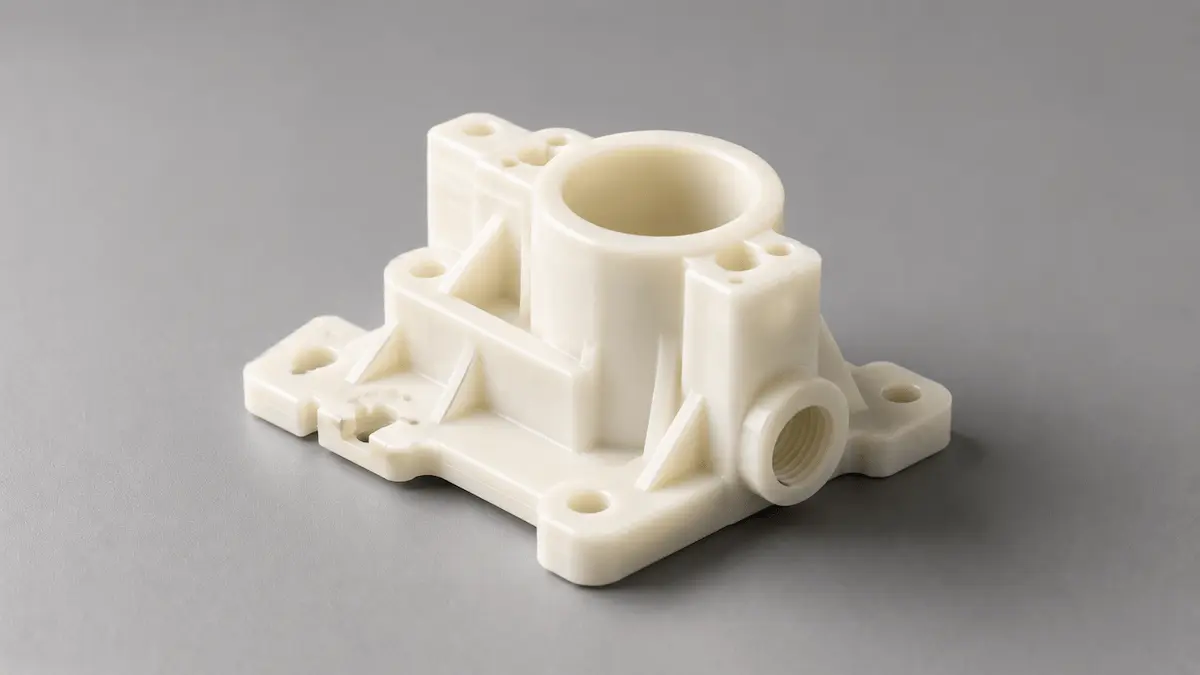
Structure and usage boundaries

For common issues such as threads, snaps, strength, temperature resistance, and weather resistance, identify in advance whether the material needs to be replaced or if another processing method should be used.

Thread Recommendation

Applicable ScopeNylon Nylon (PA)66 can be tapped or directly machined into internal and external threads, but the strength and resistance of plastic threads to repeated assembly and disassembly are limited.
Risk pointLow-strength connections can directly tap the tooth;
Recommended practiceFor frequent disassembly, high locking force, or highly reliable connection positions, it is recommended to use metal inserts, sleeves, press-in nuts, or enlarged thread specifications. When tightening screws, avoid overtightening to avoid chipping, cracking, or long-term creep loosening.

Buckle recommendation

Applicable ScopeNylon Nylon (PA)66 has good strength and rigidity, suitable for low to medium strength snaps and elastic structure validation, but its toughness and water absorption changes need to be considered.
Risk pointThe base of the clip should have rounded corners to control deformation and avoid stress concentration at sharp corners.
Recommended practiceIf a long-lasting fastener is required, it should be verified through material condition, humidity, wall thickness, and fatigue testing; If long-term stability is required, Acetal (POM), Nylon (PA)66 modified materials or specialized elastic materials can be considered.

Strength and Environment

Mechanical strengthCNC nylon Nylon (PA)66 offers good strength, rigidity, wear resistance, and impact resistance, making it suitable for medium to low load engineering plastic parts.
Environmental boundaryCompared to Nylon (PA)6, Nylon (PA)66 usually have better rigidity and temperature resistance;
Recommended practiceCompared to metal materials, their strength and rigidity are still lower, but they are lighter, have better shock absorption, and lower friction noise. During long-term stress, attention must be paid to creep and deformation. Load-bearing structures should improve reliability through wall thickness, rounded corners, reinforcing ribs, and reasonable assembly methods. Nylon Nylon (PA)66 generally has better temperature resistance than Nylon (PA)6 and ordinary low-end plastics, making it suitable for engineering plastics applications at certain temperatures. However, under prolonged high temperatures, it may still soften, deform, lose strength, or change in size. When used near heat sources, motors, frictional heating, or prolonged high-temperature scenarios, verification should be taken into account of actual temperature, load, and lubrication conditions; For higher high-temperature requirements, it is recommended to choose Polyether Ether Ketone (PEEK), PPS, Polycarbonate (PC), or metal materials. Nylon Nylon (PA)66 may be affected by humidity, ultraviolet rays, temperature changes, and oily environments over time, which may cause water absorption expansion, dimensional changes, yellowing of color, surface aging, or performance degradation. Nylon (PA)66 water absorption is usually lower than Nylon (PA)6 but still not negligible, as dimensional stability is affected in humid environments. For outdoor or high-humidity environments, it is recommended to conduct material stability assessments and, if necessary, choose modified materials such as Acetal (POM), Polyether Ether Ketone (PEEK), PPS, or fiberglass-reinforced Nylon (PA)66.

Alternative material selection and final judgment

When customer demand exceeds Nylon 66 (PA66) material boundaries, it is necessary to combine strength, temperature resistance, toughness, long-term stability, and mass production goals to promptly recommend alternative materials or processing technologies.

Alternative material suggestions

If better dimensional stability and low water absorption are required, CNC Acetal (POM) can be chosen; If higher temperature resistance and strength are required, CNC Polyether Ether Ketone (PEEK), PPS, or Polycarbonate (PC) can be chosen; If better toughness and impact resistance are needed, Nylon (PA)6 or modified nylon can be chosen; If higher abrasion resistance and lower friction are needed, oil-based nylon, MC nylon, or Acetal (POM) can be chosen; If higher rigidity and load-bearing capacity are required,6061 Aluminum Alloy, 7075, or stainless steel can be chosen; If only low-cost structural parts are made, ABS, Polypropylene (PP), or ordinary engineering plastics can be chosen.

Material selection suggestions

If customers require higher rigidity, temperature resistance, and mechanical strength than Nylon (PA)6, while still wanting to retain nylon's advantages in wear resistance, friction reduction, and lightweight design, CNC nylon Nylon (PA)66 is the right choice. If customers are more concerned about long-term dimensional stability, low water absorption, or precision transmission, it is recommended to prioritize Acetal (POM), Polyether Ether Ketone (PEEK), or metal materials. If the part is in a damp, water-soaked, or high-precision assembly environment for a long time, the Nylon (PA)66 should be used with caution and a larger dimensional allowance should be reserved.

Already have the blueprints? Directly enter the quotation for custom parts

After uploading 3D/2D drawings and supplementing materials, quantities, tolerances, surface treatments, and delivery requirements, XPartsLab will provide next steps in 3D printing manufacturability, cost, and delivery pathways.