Support Hours: 09:00–18:00 (GMT+8) · Messages and quote requests are accepted 24/7.
Material Database

Polybutylene Terephthalate (PBT)

Suitable for manufacturing electronic and electrical components, connectors, terminal blocks, automotive electrical components, heat-resistant structural parts, insulating components, sensor housings, and engineering plastic injection-molded parts with high dimensional stability requirements.

Material description

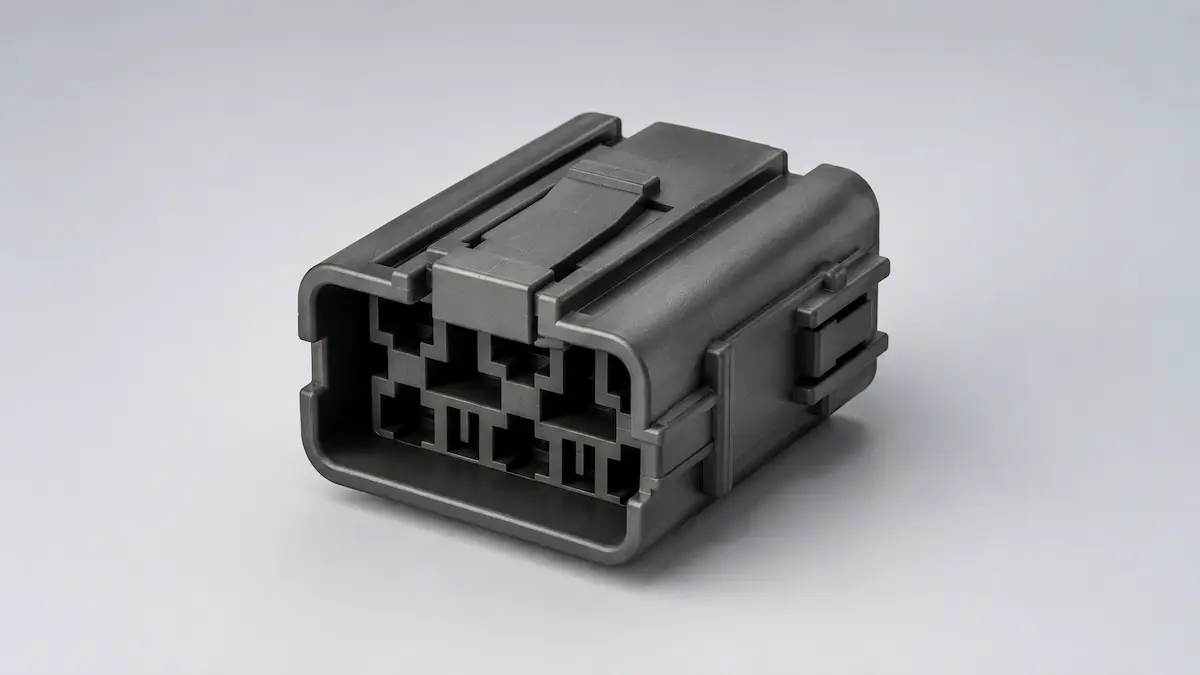
Polybutylene Terephthalate (PBT) is a commonly used thermoplastic engineering plastic material, featuring good dimensional stability, heat resistance, electrical insulation, chemical resistance, fatigue resistance, and molding efficiency. Polybutylene Terephthalate (PBT) commonly used in electronic and electrical connectors, switch components, relay housings, automotive electrical components, sensor housings, coil frames, terminal blocks, industrial equipment structural parts, and injection-molded parts requiring stable dimensions and electrical performance. Compared to Nylon (PA), Polybutylene Terephthalate (PBT) has lower water absorption and better dimensional stability; Compared to ABS, Polybutylene Terephthalate (PBT) has better heat resistance, chemical resistance, and electrical properties; Compared to Acetal (POM), Polybutylene Terephthalate (PBT) is more suitable for electrical insulation and heat-resistant structural components.

PBTPolybutylene terephthalateInjection molding Polybutylene Terephthalate (PBT)Polybutylene Terephthalate (PBT) injection-molded partsPolybutylene Terephthalate (PBT) plastic partsEngineering plastics Polybutylene Terephthalate (PBT)Glass fiber reinforced Polybutylene Terephthalate (PBT)Flame-retardant Polybutylene Terephthalate (PBT)Electrical-grade Polybutylene Terephthalate (PBT)Connectors Polybutylene Terephthalate (PBT) materials
The main characteristic of injection molding Polybutylene Terephthalate (PBT) is low water absorptionGood dimensional stabilityStable electrical performanceEspecially suitable for electronic and electrical appliances and automotive electrical partsPolybutylene Terephthalate (PBT) has good fluidity in injection moldingSuitable for thin wallsSmallComplex structures and batch precision partsOrdinary Polybutylene Terephthalate (PBT) has moderate strength and toughnessGlass fiber reinforced Polybutylene Terephthalate (PBT) can significantly improve rigidity
PBT
Injection MoldingPlastics

Material compatibility assessment

By focusing on application scenarios, boundaries of advantages, and non-recommended scenarios, it helps sales, customer service, and quoting staff quickly determine whether the material meets current part requirements.

Core advantages

It has good dimensional stability, low water absorption, excellent electrical insulation, good heat resistance, good chemical resistance, fast molding cycle, and good surface quality. It is suitable for precision injection molding, flame-retardant modification, and glass fiber reinforcement to enhance strength and rigidity.

Suitable for the product

Connectors, terminal blocks, relay housings, switch parts, coil frames, plug sockets, sensor housings, automotive electrical parts, automotive connectors, electronic and electrical structural parts, industrial control parts, motor insulation parts, internal structural parts of lighting fixtures, small precision structural parts, heat-resistant insulating brackets, and functional components for low to medium load loads.

Not suitable for the product

High-impact housing parts, high-toughness snap-fit parts, large deformation elastic parts, highly transparent appearance parts, high-gloss painted appearance parts, high-strength load-bearing parts, long-term strong acid and strong alkali ring zero parts, high wear-resistant heavy-load moving parts, food direct contact parts, medical implant parts, ultra-low temperature impact parts, and parts requiring Polycarbonate (PC)-level impact resistance.

Key parameter references

The following parameters come from product information and material knowledge fields, used for design review, quotation communication, and preliminary judgment before material selection.

Material positioningSuitable for manufacturing electronic and electrical components, connectors, terminal blocks, automotive electrical components, heat-resistant structural parts, insulating components, sensor housings, and engineering plastic injection-molded parts with high dimensional stability requirements.
Precision performanceInjection molding Polybutylene Terephthalate (PBT) are suitable for precision injection molding and batch stable production, with dimensional stability generally superior to Nylon (PA) materials, especially performing more stable in environments with varying humidity. Actual accuracy is affected by material shrinkage, glass fiber content, wall thickness, gate position, mold temperature, cooling system, product size, and structural complexity. Connector hole positions, terminal slots, snap positions, screw posts, and assembly surfaces should be carefully controlled during the mold design stage.
Dimensional tolerancesConventional dimensional tolerances for injection molding Polybutylene Terephthalate (PBT) can be referenced ± 0.05mm to ±0.20mm. Small precision structures and connector parts are easier to control under reasonable mold and process conditions; Large parts, thin-walled parts, elongated parts, fiberglass reinforcements, and structures with uneven thicknesses may have deviations of ±0.20mm-±0.60mm or more. This value is a standard reference range and is not an absolute guarantee tolerance for all structures. It is recommended to define tolerances separately for precision terminal holes, latches, assembly surfaces, and positioning structures.
Minimum Wall ThicknessInjection molding Polybutylene Terephthalate (PBT) recommends a minimum wall thickness of no less than 0.8mm-1.0mm. Small connectors, terminal blocks, and thin-walled electrical components can be further optimized based on material flow and mold capability, but large-area over-thinning is not recommended. Fiberglass reinforced Polybutylene Terephthalate (PBT), load-bearing structures, screw posts, snap bases, and assembly load-bearing positions should have wall thickness appropriately increased to avoid insufficient strength, broken welding lines, or unstable molding.
Recommended wall thicknessFor ordinary Polybutylene Terephthalate (PBT) structural parts, 1.2mm-2.5mm is recommended; for small electronic and electrical components and connectors, 0.8mm-2.0mm is recommended; for fiberglass reinforced Polybutylene Terephthalate (PBT) structural parts, automotive electrical parts, screws, and load-bearing assembly positions, 1.5mm-3.0mm is recommended. The wall thickness should be as uniform as possible to avoid local over-thickness that can cause shrinkage, dents, or warping.
Minimum apertureFor injection molding Polybutylene Terephthalate (PBT) small holes, the recommended hole diameter should not be less than 0.8mm-1.2mm. Deep small holes, slender terminal holes, and dense insert holes should be evaluated based on mold insertion needle strength, venting, and molding stability. Screw holes, positioning holes, and terminal slots should consider shrinkage, draft angle, material flow, and subsequent assembly. High-precision hole positions can be ensured through mold insert finishing or post-injection machining.
Assembly clearanceFor ordinary plastic parts, it is recommended to reserve 0.05mm-0.20mm on one side; for movable fits, 0.20mm-0.40mm should be reserved on one side; connectors, terminal blocks, and precision assembly structures should be designed separately according to terminal size, shrinkage, fiberglass orientation, and assembly force. Polybutylene Terephthalate (PBT) has low water absorption and good dimensional stability, but high-temperature environments and fiberglass orientation still affect assembly conditions. Key locations are recommended to be verified through mold trials.
Detailed performanceInjection molding Polybutylene Terephthalate (PBT) can achieve clear rib positions, column positions, clips, slots, terminal holes, text, logos, and fine structures. Raised text, recessed text, and decorative textures are recommended to be no less than 0.2mm-0.5mm. Overly fine structures may weaken due to mold processing, insufficient venting, fiberglass filling, or welding lines. Connector and terminal structures should focus on controlling small holes, thin walls, sharp corners, and insert strength.
Surface effectThe original surface of injection molding Polybutylene Terephthalate (PBT) is usually white, black, natural color, or plastic surface after masterbatch coloring, achieving matte, fine-grained, leather-textured, and ordinary glossy finishes. The surface of fiberglass Polybutylene Terephthalate (PBT) reinforced fibers may have slight floating fibers, flow marks, or fiber textures. Polybutylene Terephthalate (PBT) is more of an engineering functional material and is not as suitable as ABS for high-gloss painted exterior parts, but it can achieve a more stable and clean functional appearance in electronics, electrical appliances, and automotive electrical components.

Typical application scenarios

Based on material characteristics and suitable product ranges, customer needs are broken down into easier application directions to determine.

Product validation

Connectors, terminal blocks, relay housings, switch parts, coil frames, plug sockets, sensor housings, automotive electrical parts, automotive connectors, electronic and electrical structural parts, industrial control parts, motor insulation parts, internal structural parts of lighting fixtures, small precision structural parts, heat-resistant insulating brackets, and functional components for low to medium load loads.

Reasons for material selection

Suitable for manufacturing electronic and electrical components, connectors, terminal blocks, automotive electrical components, heat-resistant structural parts, insulating components, sensor housings, and engineering plastic injection-molded parts with high dimensional stability requirements.

Material characteristics

The main features of injection molded Polybutylene Terephthalate (PBT) are low water absorption, good dimensional stability, and stable electrical performance, making them especially suitable for electronic and electrical components in automobiles. Polybutylene Terephthalate (PBT) has good fluidity in injection molding, suitable for thin-walled, small-scale, complex structures, and batch precision parts. Ordinary Polybutylene Terephthalate (PBT) have moderate strength and toughness. Glass fiber reinforced Polybutylene Terephthalate (PBT) can significantly improve rigidity, strength, and heat resistance, but also cause warping, floating fibers, reduced weld line strength, and mold wear.

Design and risk review

Based on wall thickness, hole position, assembly clearance, dimensional tolerances, and material usage risks, determine in advance whether the part structure is suitable for Polybutylene Terephthalate (PBT).

Design considerations

  • When designing injection-molded Polybutylene Terephthalate (PBT) parts
  • Attention should be paid to uniform wall thickness
  • Release angle
  • Rounded transitions
  • Gate position
  • Exhaust
  • Fiberglass direction
  • Welding line position and dimensional stability
Precision performanceInjection molding Polybutylene Terephthalate (PBT) are suitable for precision injection molding and batch stable production, with dimensional stability generally superior to Nylon (PA) materials, especially performing more stable in environments with varying humidity. Actual accuracy is affected by material shrinkage, glass fiber content, wall thickness, gate position, mold temperature, cooling system, product size, and structural complexity. Connector hole positions, terminal slots, snap positions, screw posts, and assembly surfaces should be carefully controlled during the mold design stage.
Dimensional tolerancesConventional dimensional tolerances for injection molding Polybutylene Terephthalate (PBT) can be referenced ± 0.05mm to ±0.20mm. Small precision structures and connector parts are easier to control under reasonable mold and process conditions; Large parts, thin-walled parts, elongated parts, fiberglass reinforcements, and structures with uneven thicknesses may have deviations of ±0.20mm-±0.60mm or more. This value is a standard reference range and is not an absolute guarantee tolerance for all structures. It is recommended to define tolerances separately for precision terminal holes, latches, assembly surfaces, and positioning structures.
Quality riskThe main risks in injection molding Polybutylene Terephthalate (PBT) include insufficient drying causing hydrolysis, shrinkage, warping, insufficient weld line strength, fiberglass floating, surface flow marks, warping, uneven dimensional shrinkage, screw post cracking, and snap breakage. Polybutylene Terephthalate (PBT) has good dimensional stability, but that doesn't mean all structures won't deform. When used for connectors, terminal blocks, automotive electrical components, and precision assemblies, focus should be paid to controlling material drying, mold temperature, gate position, glass fiber orientation, fusion line position, and assembly tolerances.
Surface effectThe original surface of injection molding Polybutylene Terephthalate (PBT) is usually white, black, natural color, or plastic surface after masterbatch coloring, achieving matte, fine-grained, leather-textured, and ordinary glossy finishes. The surface of fiberglass Polybutylene Terephthalate (PBT) reinforced fibers may have slight floating fibers, flow marks, or fiber textures. Polybutylene Terephthalate (PBT) is more of an engineering functional material and is not as suitable as ABS for high-gloss painted exterior parts, but it can achieve a more stable and clean functional appearance in electronics, electrical appliances, and automotive electrical components.

Post-processing and assembly precautions

Post-processing of Polybutylene Terephthalate (PBT) affects appearance, dimensions, hole position, assembly clearance, and usage validation results, and should be explained in advance during quotation, DFM review, and sample confirmation stages.

Post-processing options

Post-processing should focus on appearance display, dimensional fitting, connection assembly, and testing verification. Parts involving assembly positions need to be reserved in advance for machining, coating, and trial assembly allowances.

Leave the armor on the frontierDe-defluffing: Used to improve the appearance, assembly, or validation of parts, it is necessary to confirm dimensions, strength, and delivery impact based on material properties.
and repaired the borderEdge trimming is used to improve the appearance, assembly, or validation of parts, and must be combined with material properties to confirm dimensions, strength, and delivery impact.
DryingDrying is used to improve the appearance, assembly, or validation of parts, and dimensions, strength, and delivery impact must be confirmed based on material properties.
Humidity regulation controlHumidity control is used to improve the appearance, assembly, or validation of parts, and must be combined with material properties to confirm dimensions, strength, and delivery impact.
Screen printingSilk-screen printing is used to improve the appearance of parts, assembly, or functional verification effects, and it is necessary to confirm the dimensions, strength, and delivery impact in combination with the material characteristics.
Pad printingPad printing is used to improve the appearance of parts, assembly, or functional verification effects, and it is necessary to confirm the dimensions, strength, and delivery impact in combination with material characteristics.
Laser carvingLaser engraving is used to improve the appearance, assembly, or validation of parts, and must be combined with material properties to confirm dimensions, strength, and delivery impact.
Laser markingLaser marking is used to improve the appearance, assembly, or validation of parts, and must be combined with material properties to confirm dimensions, strength, and delivery impact.

Key control point

Size impactPolybutylene Terephthalate (PBT) must be thoroughly dried before injection molding; Otherwise, silver patterns are likely to appear; Bubbles; Hydrolysis; Strength decline and surface defects; Flame-retardant Polybutylene Terephthalate (PBT) and glass fiber reinforced Polybutylene Terephthalate (PBT) affect injection molding temperature; Mold temperature; Exhaust and gate designs are more sensitive
Assembly clearanceFor positions involving snapping, plugging, sliding, or enclosure closure, the clearance needs to be adjusted according to post-processing thickness, material shrinkage, and trial assembly results.
Hole Position StrengthThreading, inserting nuts, locking screws, and the areas around positioning holes need to ensure wall thickness to avoid cracks, stripped threads, or chipped edges during post-processing or assembly.
Environmental matchingWhen used in high-temperature, outdoor, humid, friction, or load-bearing scenarios, post-processing materials, adhesives, coatings, and fasteners must also meet the corresponding usage environment.

Structure and usage boundaries

For common issues such as threads, snaps, strength, temperature resistance, and weather resistance, identify in advance whether the material needs to be replaced or if another processing method should be used.

Thread Recommendation

Applicable ScopePolybutylene Terephthalate (PBT) can use self-tapping screws, directly injection-molded holes, or machined low-strength threads, but for frequent disassembly and high locking positions, hot-melt copper nuts, ultrasonic copper nuts, metal inserts, or insert injection structures are recommended.
Risk pointAdd fillets and reinforcing ribs at the base of the screw column to prevent cracking, loose teeth, or whitening.
Recommended practiceGlass fiber reinforced Polybutylene Terephthalate (PBT) screw posts have better rigidity, but the risks of brittleness and cracking also need to be controlled.

Buckle recommendation

Applicable ScopePolybutylene Terephthalate (PBT) can be used for low to medium strength buckle structures, but ordinary Polybutylene Terephthalate (PBT) has less toughness than Nylon (PA), Polycarbonate (PC), and Polycarbonate (PC)+ABS, so buckle deformation should not be too large.
Risk pointThe base of the clip should have rounded corners to avoid sharp corners and overly thin cross-sections.
Recommended practiceFiberglass Polybutylene Terephthalate (PBT) reinforced clips have high rigidity but are more prone to brittle breaks, so careful design is necessary. If frequent disassembly or high-toughness clips are required, it is recommended to consider Nylon (PA), Polycarbonate (PC), Acetal (POM), or toughening Polybutylene Terephthalate (PBT) and verify them through sample testing.

Strength and Environment

Mechanical strengthInjection-molded Polybutylene Terephthalate (PBT) have good mechanical strength, rigidity, and fatigue resistance. After glass fiber reinforcement, strength and rigidity are significantly improved, making it suitable for electronic and electrical structural components, automotive electrical components, and precision functional components.
Environmental boundaryCompared to ABS and Polypropylene (PP), Polybutylene Terephthalate (PBT) has better heat resistance and dimensional stability;
Recommended practiceCompared to metal materials, Polybutylene Terephthalate (PBT) is lighter and has better insulation, but its ultimate load capacity and rigidity are still limited. The load-bearing structure should be verified based on wall thickness, glass fiber content, load direction, and safety factor. Polybutylene Terephthalate (PBT) temperature resistance is superior to conventional plastics such as ABS, Polypropylene (PP), and Polyethylene (PE), making it suitable for applications in electronics, electrical, and automotive parts at certain temperatures. Fiberglass-reinforced Polybutylene Terephthalate (PBT) and flame-retardant Polybutylene Terephthalate (PBT) can further enhance heat resistance and structural stability. At high temperatures, attention should still be paid to strength loss, creep, warping, and long-term aging. If the product is exposed to higher temperatures for a long time, PPS, Polyether Ether Ketone (PEEK), Nylon (PA)66+GF, or metal materials should be evaluated. Polybutylene Terephthalate (PBT) has low water absorption, with humidity less than Nylon (PA) effect on size, and good stability in ordinary indoor and automotive electrical environments. However, long-term outdoor UV exposure, damp heat circulation, and chemical media may lead to aging, discoloration, brittleness, or performance degradation. For outdoor or harsh environments, it is recommended to choose weather-resistant modified Polybutylene Terephthalate (PBT), flame-retardant weather-resistant grades, or other more suitable materials, and conduct tests for temperature, humidity, UV, and chemical media.

Alternative material selection and final judgment

When customer demand exceeds Polybutylene Terephthalate (PBT) material boundaries, it is necessary to combine strength, temperature resistance, toughness, long-term stability, and mass production goals to promptly recommend alternative materials or processing technologies.

Alternative material suggestions

If higher toughness and impact resistance are required, Polycarbonate (PC), Polycarbonate (PC)+ABS, or modified Nylon (PA) can be chosen; If higher temperature resistance and stronger dimensional stability are required, PPS, Polyether Ether Ketone (PEEK), or LCP can be chosen; If higher wear resistance and low friction are required, Acetal (POM) is available; If lower-cost ordinary structural parts are needed, ABS or Polypropylene (PP) can be chosen; If better durability after water absorption and fatigue resistance are needed, Nylon (PA)6 or Nylon (PA)66 can be chosen; If high-end electrical connector materials are needed, flame-retardant Polybutylene Terephthalate (PBT), fiberglass-reinforced Polybutylene Terephthalate (PBT), PPS, or LCP can be selected according to requirements.

Material selection suggestions

If customers require materials with dimensional stability, electrical insulation, heat resistance, chemical resistance, and suitable for batch precision injection molding, Polybutylene Terephthalate (PBT) is an excellent choice. Electronic connectors, terminal blocks, relay housings, automotive electrical components, and small precision structural parts are given priority Polybutylene Terephthalate (PBT). If the product requires high-impact, high-toughness snap-ons, strong surface paint, or large-size housings, it is not recommended to prioritize ordinary Polybutylene Terephthalate (PBT); instead, consider Polycarbonate (PC), Polycarbonate (PC)+ABS, Nylon (PA), or other modified materials.

Already have the blueprints? Directly enter the quotation for custom parts

After uploading 3D/2D drawings and supplementing materials, quantities, tolerances, surface treatments, and delivery requirements, XPartsLab will provide next steps in 3D printing manufacturability, cost, and delivery pathways.