Material Database

Acrylic (PMMA)

Suitable for mass production of high-transparency exterior parts, transparent panels, lampshades, light guides, observation windows, decorative parts, display parts, instrument windows, and injection-molded plastic parts requiring high gloss and transparency effects.

Material description

Acrylic (PMMA) is a highly transparent thermoplastic material, commonly known as acrylic or acrylic, featuring excellent transparency, surface gloss, appearance texture, dimensional stability, and good weather resistance. Acrylic (PMMA) commonly used for transparent housings, lampshades, light guide components, display panels, observation windows, decorative parts, instrument windows, automotive lampshade samples, and highly transparent plastic parts. Compared to Polycarbonate (PC), Acrylic (PMMA) transparency and surface hardness are usually better, but impact resistance is weaker; Compared to transparent ABS or transparent resin, Acrylic (PMMA) is more suitable for mass production of highly transparent and high-gloss finished parts.

PMMAAcrylicAcrylicInjection molding Acrylic (PMMA)Acrylic (PMMA) injection-molded partsAcrylic injection-molded partsTransparent Acrylic (PMMA)Transparent acrylicPolymethyl methacrylateAcrylic plastic parts
The core feature of injection molding Acrylic (PMMA) is high transparencyHigh gloss and good appearance performanceSuitable for transparent panels that customers can see directlyLampshadeObserve windows and decorative elementsIts transparency is usually better than Polycarbonate (PC)The surface hardness is also relatively highIt is less likely to cause fine scratches as easily as Polycarbonate (PC)However Acrylic (PMMA) the material tends to be hard and brittleImpact resistance and toughness are not as good as Polycarbonate (PC)
PMMA
Injection MoldingPlastics

Material compatibility assessment

By focusing on application scenarios, boundaries of advantages, and non-recommended scenarios, it helps sales, customer service, and quoting staff quickly determine whether the material meets current part requirements.

Core advantages

High transparency, good surface gloss, good appearance texture, hardness higher than Polycarbonate (PC), good weather resistance, good dimensional stability, suitable for high-transparency appearance parts, polished and high-gloss surfaces, and ideal for light-guiding and display products.

Suitable for the product

Transparent housings, observation windows, instrument viewing windows, display panels, lamp covers, light guide parts, optical decorative parts, transparent buttons, transparent face covers, acrylic signs, display parts, cosmetic packaging parts, home appliance transparent parts, automotive lampshade samples, medical equipment transparent covers, consumer electronics transparent decorative parts, transparent protective covers.

Not suitable for the product

High-impact parts, high-toughness snap-fit parts, drop-resistant housings, high-temperature long-term use parts, strong acid and alkali environment parts, strong solvent contact parts, long-term load-bearing structural parts, frequently disassembled threaded parts, long-term direct contact parts of food, medical implants, ultra-high-precision optical lenses, high-strength structural parts.

Key parameter references

The following parameters come from product information and material knowledge fields, used for design review, quotation communication, and preliminary judgment before material selection.

Material positioningSuitable for mass production of high-transparency exterior parts, transparent panels, lampshades, light guides, observation windows, decorative parts, display parts, instrument windows, and injection-molded plastic parts requiring high gloss and transparency effects.
Precision performanceInjection molding Acrylic (PMMA) can achieve good batch forming accuracy and are suitable for transparent panels, lampshades, light guides, and standard assembly structures. Actual accuracy is affected by material shrinkage, wall thickness, gate position, mold temperature, cooling system, product dimensions, transparency requirements, and injection molding parameters. Transparent exterior parts should not be judged solely by size; it is also necessary to control flow marks, weld lines, shrinkage, optical distortion, and surface scratches.
Dimensional tolerancesConventional dimensional tolerances for injection molding Acrylic (PMMA) can be referenced ± 0.10mm to ±0.30mm, making small sizes and simple structures easier to control; Large transparent parts, thin-walled parts, elongated parts, uneven thickness parts, and high-gloss appearance parts may have deviations of ±0.30mm-±0.80mm or more. These values represent the standard reference range and are not absolute guarantees for all structural tolerances. It is recommended to define tolerances separately for transparent assembly surfaces, snaps, screw holes, light guide structures, and appearance edges.
Minimum Wall ThicknessInjection molding Acrylic (PMMA) recommends a minimum wall thickness of no less than 1.0mm. For small, non-stressed local areas, it can be reduced to about 0.8mm, but it is not recommended for large-area use. Transparent parts with walls that are too thin can easily cause insufficient filling, flow marks, insufficient strength, or deformation; If the wall thickness is too thick, shrinkage, bubbles, increased cooling time, and optical deformation are more likely.
Recommended wall thicknessStandard transparent panels and small appearance parts are recommended 1.5mm-2.5mm; lampshades, observation windows, transparent housings, and assemblies are recommended 2.0mm-3.0mm; transparent parts requiring screw fixing, bonding, transport protection, or good rigidity are recommended 2.5mm-4.0mm, and cracking risk is reduced through rounding, chamfering, and reasonable support.
Minimum apertureFor injection molding Acrylic (PMMA) small holes, the recommended hole diameter should not be less than 1.0mm-1.5mm. Deep small holes and slender columns need to be evaluated in conjunction with mold insertion needle strength, venting, and molding stability. Screw holes, positioning holes, and assembly holes should have sufficient hole margins reserved. Hole openings should be chamfered to avoid stress concentration, cracking, or assembly whitening. The holes in transparent exterior parts should avoid edges, sharp corners, and high-stress areas as much as possible.
Assembly clearanceFor ordinary plastic parts, it is recommended to reserve 0.10mm-0.30mm on one side; for movable fits, 0.30mm-0.50mm per side; for transparent exterior parts, polished parts, and coated parts, it is recommended to appropriately enlarge the gap to avoid scratches and stress concentration. The screw fixing position should not be too tight; it is recommended to use washers, limit posts, metal inserts, or torque control to avoid hole edge cracking and stress whitening.
Detailed performanceInjection molding Acrylic (PMMA) can achieve clear transparent edges, shallow reliefs, logos, light-guided textures, matte textures, fine decorative lines, and ordinary structural details. Raised text, recessed text, and textures are recommended to be no less than 0.3mm-0.5mm. Structures that are too fine may be weakened by mold processing, injection molding flow, polishing, or spraying. Details of light guides and transparent parts also need to consider light refraction, shrinkage marks, and the position of welding lines.
Surface effectInjection molding Acrylic (PMMA) can achieve a variety of appearance effects, including high transparency, high gloss, matte translucent, milky translucent, and dyed translucent. High-gloss transparent Acrylic (PMMA) surface close to glass, suitable for display and decorative products; Matte Acrylic (PMMA) can achieve soft light transmission and are suitable for lampshades and light guides. The appearance quality of transparent parts heavily depends on mold polishing, injection molding processes, material drying, venting, and packaging protection.

Typical application scenarios

Based on material characteristics and suitable product ranges, customer needs are broken down into easier application directions to determine.

Product validation

Transparent housings, observation windows, instrument viewing windows, display panels, lamp covers, light guide parts, optical decorative parts, transparent buttons, transparent face covers, acrylic signs, display parts, cosmetic packaging parts, home appliance transparent parts, automotive lampshade samples, medical equipment transparent covers, consumer electronics transparent decorative parts, transparent protective covers.

Reasons for material selection

Suitable for mass production of high-transparency exterior parts, transparent panels, lampshades, light guides, observation windows, decorative parts, display parts, instrument windows, and injection-molded plastic parts requiring high gloss and transparency effects.

Material characteristics

The core features of injection molding Acrylic (PMMA) are high transparency, high gloss, and good appearance, making them suitable for transparent panels, lampshades, observation windows, and decorative parts that customers can see directly. Its transparency is usually better than Polycarbonate (PC), and its surface hardness is higher, making it less likely to cause fine scratches like Polycarbonate (PC). However, Acrylic (PMMA) materials tend to be hard and brittle, with inferior impact resistance and toughness compared to Polycarbonate (PC). Screw holes, clips, sharp corners, and thin-walled areas are prone to cracking, bleaching, or stress cracks.

Design and risk review

Based on wall thickness, hole position, assembly clearance, dimensional tolerances, and material usage risks, determine in advance whether the part structure is suitable for Acrylic (PMMA).

Design considerations

  • When designing injection-molded Acrylic (PMMA) parts
  • Focus should be on controlling uniform wall thickness
  • Rounded transitions
  • Release angle
  • Gate position
  • Welding line position
  • Ejector pin position and assembly stress
  • Sharp corners and hole edges should have rounded corners
Precision performanceInjection molding Acrylic (PMMA) can achieve good batch forming accuracy and are suitable for transparent panels, lampshades, light guides, and standard assembly structures. Actual accuracy is affected by material shrinkage, wall thickness, gate position, mold temperature, cooling system, product dimensions, transparency requirements, and injection molding parameters. Transparent exterior parts should not be judged solely by size; it is also necessary to control flow marks, weld lines, shrinkage, optical distortion, and surface scratches.
Dimensional tolerancesConventional dimensional tolerances for injection molding Acrylic (PMMA) can be referenced ± 0.10mm to ±0.30mm, making small sizes and simple structures easier to control; Large transparent parts, thin-walled parts, elongated parts, uneven thickness parts, and high-gloss appearance parts may have deviations of ±0.30mm-±0.80mm or more. These values represent the standard reference range and are not absolute guarantees for all structural tolerances. It is recommended to define tolerances separately for transparent assembly surfaces, snaps, screw holes, light guide structures, and appearance edges.
Quality riskThe main risks in injection molding Acrylic (PMMA) include brittle materials, insufficient impact resistance, transparent surface flow marks, gas marks, weld lines, shrinkage, stress bleaching, screw hole cracking, snap breakage, surface scratches, and bond bleaching. Acrylic (PMMA) suitable for high-transparency appearance parts, but not for high-impact and tough structural parts. When used for transparent housings, lampshades, observation windows, and decorative parts, focus should be paid to controlling mold polishing grade, gate position, wall thickness uniformity, demolding method, assembly pressure, and packaging protection.
Surface effectInjection molding Acrylic (PMMA) can achieve a variety of appearance effects, including high transparency, high gloss, matte translucent, milky translucent, and dyed translucent. High-gloss transparent Acrylic (PMMA) surface close to glass, suitable for display and decorative products; Matte Acrylic (PMMA) can achieve soft light transmission and are suitable for lampshades and light guides. The appearance quality of transparent parts heavily depends on mold polishing, injection molding processes, material drying, venting, and packaging protection.

Post-processing and assembly precautions

Post-processing of Acrylic (PMMA) affects appearance, dimensions, hole position, assembly clearance, and usage validation results, and should be explained in advance during quotation, DFM review, and sample confirmation stages.

Post-processing options

Post-processing should focus on appearance display, dimensional fitting, connection assembly, and testing verification. Parts involving assembly positions need to be reserved in advance for machining, coating, and trial assembly allowances.

Leave the armor on the frontierDe-defluffing: Used to improve the appearance, assembly, or validation of parts, it is necessary to confirm dimensions, strength, and delivery impact based on material properties.
and repaired the borderEdge trimming is used to improve the appearance, assembly, or validation of parts, and must be combined with material properties to confirm dimensions, strength, and delivery impact.
PolishingUsed to improve transparency or surface smoothness, may change edge details and local dimensions.
Flame polishingFlame polishing is used to improve the appearance, assembly, or validation of parts, and must be combined with material properties to confirm dimensions, strength, and delivery impact.
Sandblasted and frostedSandblasted and frosted is used to improve the appearance, assembly, or validation of parts, and must be determined by combining material properties with dimensions, strength, and delivery impact.
Screen printingSilk-screen printing is used to improve the appearance of parts, assembly, or functional verification effects, and it is necessary to confirm the dimensions, strength, and delivery impact in combination with the material characteristics.
Pad printingPad printing is used to improve the appearance of parts, assembly, or functional verification effects, and it is necessary to confirm the dimensions, strength, and delivery impact in combination with material characteristics.
Laser carvingLaser engraving is used to improve the appearance, assembly, or validation of parts, and must be combined with material properties to confirm dimensions, strength, and delivery impact.

Key control point

Size impactAcrylic (PMMA) transparent parts for scratches; Flow marks; Gas Pattern; Welding lines; Stress bleaching and bonding bubbles are very sensitive; Flame polishing and mechanical polishing can improve edge transparency; However, improper temperature and time control can lead to deformation; Whitening or internal stress
Assembly clearanceFor positions involving snapping, plugging, sliding, or enclosure closure, the clearance needs to be adjusted according to post-processing thickness, material shrinkage, and trial assembly results.
Hole Position StrengthThreading, inserting nuts, locking screws, and the areas around positioning holes need to ensure wall thickness to avoid cracks, stripped threads, or chipped edges during post-processing or assembly.
Environmental matchingWhen used in high-temperature, outdoor, humid, friction, or load-bearing scenarios, post-processing materials, adhesives, coatings, and fasteners must also meet the corresponding usage environment.

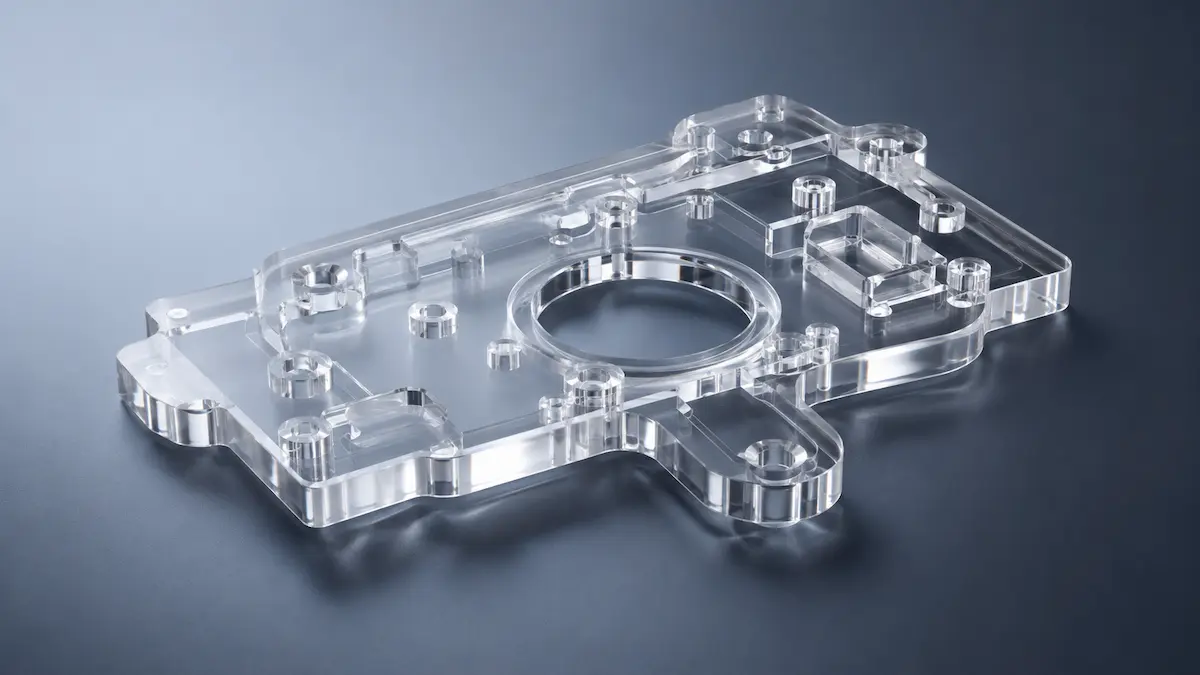
Structure and usage boundaries

For common issues such as threads, snaps, strength, temperature resistance, and weather resistance, identify in advance whether the material needs to be replaced or if another processing method should be used.

Thread Recommendation

Applicable ScopeAcrylic (PMMA) It is not recommended to directly inject mold high-strength precision threads.
Risk pointFor low-strength, low-frequency assembly and disassembly positions, self-tapping screws or directly formed hole positions can be used;
Recommended practiceFor frequent disassembly, high locking force, or highly reliable connection positions, it is recommended to use metal inserts, hot-melt nuts, sleeves, or screws with washers for fixation. Add rounded corners and reinforcing ribs at the root of the screw column to prevent cracking, thread slippage, whitening, or long-term stress cracking.

Buckle recommendation

Applicable ScopeAcrylic (PMMA) Not suitable for large deformation, frequent disassembly, or high-strength snap-fit structures.
Risk pointBecause the material is relatively hard and brittle, clips are prone to whitening, cracking, or breaking under stress.
Recommended practiceIf a snap must be designed, add rounded corners, thicken the root, reduce deformation, and preferably use it for low-frequency assembly or display verification. For long-term reliable buckles, it is recommended to switch to Polycarbonate (PC), Acetal (POM), Nylon (PA), Polycarbonate (PC)+ABS, or mass-produced specialized toughening materials.

Strength and Environment

Mechanical strengthInjection molding Acrylic (PMMA) has moderate strength, good surface hardness and rigidity, suitable for transparent exterior parts, display parts, lampshades, and ordinary structural parts.
Environmental boundaryIts impact resistance is lower than Polycarbonate (PC), making it unsuitable for drop-resistant, protective, and high-impact structures.
Recommended practiceLoad-bearing structures should focus on wall thickness, hole edge spacing, fillets, assembly pressure, and stress cracking risk. If stronger impact performance is required, Polycarbonate (PC) or modified Acrylic (PMMA) should be chosen. Acrylic (PMMA) Average temperature resistance, suitable for room temperature and general display applications. At higher temperatures, it may soften, deform, release stress, change in transparency, or change in size, making it unsuitable for long-term proximity to heat sources, high-temperature automotive environments, or high-temperature functional parts. If customers have high temperature resistance requirements, it is recommended to consider Polycarbonate (PC), PPSU, Polyethylene (PE) I, Polyether Ether Ketone (PEEK), glass, or metal materials. Acrylic (PMMA) has good weather resistance and transparency retention, usually superior to ordinary ABS and Polycarbonate (PC), and is widely used in outdoor displays, lampshades, and transparent decorative parts. However, long-term UV exposure, temperature and humidity changes, contaminants, and cleaning agents can still cause surface aging, slight yellowing, cracking, or loss of gloss. For outdoor use or long-term display, it is recommended to choose weather-resistant Acrylic (PMMA) and perform proper installation, edge protection, and surface cleaning and maintenance.

Alternative material selection and final judgment

When customer demand exceeds Acrylic (PMMA) material boundaries, it is necessary to combine strength, temperature resistance, toughness, long-term stability, and mass production goals to promptly recommend alternative materials or processing technologies.

Alternative material suggestions

If higher impact and drop resistance are required, Polycarbonate (PC) is the option; If lower-cost transparent verification is needed, transparent photosensitive resin or ordinary acrylic sheet processing can be chosen; If higher temperature resistance is required, Polycarbonate (PC), PPSU, or Polyethylene (PE) I can be chosen; If better chemical resistance is required, specific transparent engineering plastics or glass can be chosen; If a standard non-transparent shell is needed, you can choose ABS, Polycarbonate (PC)+ABS, or Polypropylene (PP); If truly optical-grade lenses are needed, optical-grade Acrylic (PMMA), Polycarbonate (PC), or glass should be chosen, combined with specialized optical molds and processes.

Material selection suggestions

If customers mainly care about transparency, surface gloss, display effect, and high-end transparent appearance, injection molding Acrylic (PMMA) is an excellent choice. If customers care more about drop resistance, impact resistance, long-term assembly reliability, or protective features, it is recommended to prioritize Polycarbonate (PC). If the product is used for outdoor transparent parts, it Acrylic (PMMA) have a good weather resistance foundation, but it is still recommended to confirm long-term performance by considering UV resistance rating, surface hardening, or coating solutions.

Already have the blueprints? Directly enter the quotation for custom parts

After uploading 3D/2D drawings and supplementing materials, quantities, tolerances, surface treatments, and delivery requirements, XPartsLab will provide next steps in 3D printing manufacturability, cost, and delivery pathways.