
High transparency, strong appearance
Suitable for transparent housings, window panels, and display structural components; It is more friendly to products that "have visible internal structures."
Acrylic (PMMA)(acrylic/acrylic) is commonly used in injection molding for transparent exterior parts, window panels, lampshades, and light-guiding parts. Its typical advantages are high transparency, good surface texture, and stable appearance. When you focus more on appearance and transparency and want better batch consistency through injection molding, Acrylic (PMMA) is a commonly used and mature choice.
Acrylic (PMMA)(acrylic/acrylic) is commonly used in injection molding for transparent exterior parts, window panels, lampshades, and light-guiding parts. Its typical advantages are high transparency, good surface texture, and stable appearance. When you focus more on appearance and transparency and want better batch consistency through injection molding, Acrylic (PMMA) is a commonly used and mature choice.
Order recommendation: For transparent/semi-transparent appearance parts, please specify in the remarks the light transmission requirements, appearance surface definition (Side A), and acceptable defect standards; Transparent parts are more sensitive to weld marks, gate marks, flow marks, and scratches; it is recommended to provide reference drawings or sample standards; Please attach 2D (PDF/DWG) and indicate tolerances for key assembly dimensions.
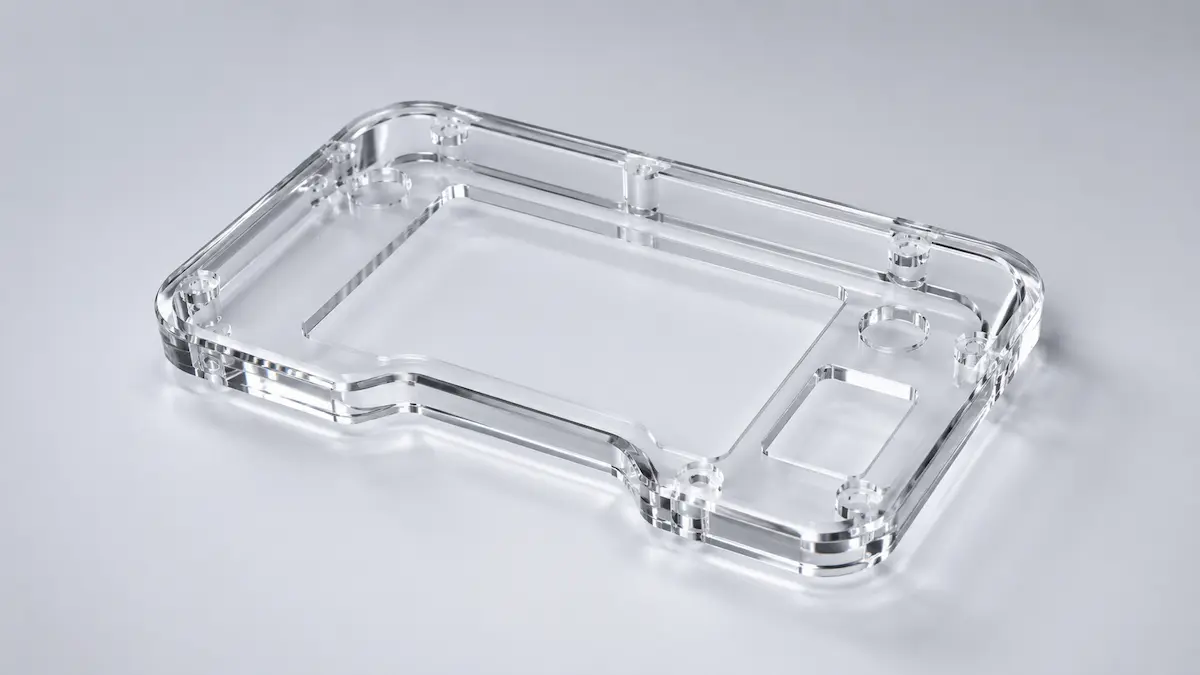
Acrylic (PMMA)(acrylic/acrylic) is commonly used in injection molding for transparent exterior parts, window panels, lampshades, and light-guiding parts. Its typical advantages are high transparency, good surface texture, and stable appearance. When you focus more on appearance and transparency and want better batch consistency through injection molding, Acrylic (PMMA) is a commonly used and mature choice.
Suitable for transparent housings, window panels, and display structural components; It is more friendly to products that "have visible internal structures."
Transparent/semi-transparent appearance parts: windows, transparent covers, face shields, lampshades, light guides; Clear appearance standards: requires stable surface texture and batch consistency; Signage requirements: panel silkscreen, laser engraving number, QR code, etc
High impact/strong drop resistance: Greater toughness needs can be assessed with Polycarbonate (PC) or modified materials; Long-term high-temperature environments: It is recommended to evaluate heat-resistant materials based on actual temperature and operating conditions; Extremely sensitive to weld marks and structurally complex: priority should be given to DFM and gate/vent scheme evaluation
Order recommendation: For transparent/semi-transparent appearance parts, please specify in the remarks the light transmission requirements, appearance surface definition (Side A), and acceptable defect standards; Transparent parts are more sensitive to weld marks, gate marks, flow marks, and scratches; it is recommended to provide reference drawings or sample standards; Please attach 2D (PDF/DWG) and indicate tolerances for key assembly dimensions.
| Process | Injection Molding |
|---|---|
| Materials | Acrylic (PMMA)(Acrylic / Acrylic) |
| Precision | ± 0.10–0.20 mm (depending on size range/mold/structure; It is recommended to mark tolerances for key dimensions and perform DFM confirmation) |
| Minimum Wall Thickness | ≥ 1.0 mm (it is recommended to make the wall thickness as uniform as possible; For transparent exterior parts, it is especially recommended to avoid sudden changes in thickness) |
| Focus on appearance | Weld marks, gate marks, flow marks, and scratches are more noticeable for transparent parts; It is recommended to define the allowable area between the A side and the gate |
| Release angle | Recommended 1°–2°; For transparent high-gloss surfaces, it's recommended to be more conservative to avoid scratches and smudging |
| Rounded corners and transitions | Sharp corners are prone to stress concentration and whitening; It is recommended to add rounded corners and smooth transitions |
| Post-Processing | Sanding, silk screening, laser engraving, polishing (transparent edges) |
| Typical delivery time | Related to structure, quantity, mold, and post-processing; After uploading the documents, specify the delivery date and expedited options |
High transparency, strong appearance; Good surface quality and stable texture; Suitable for screen printing and labeling; Transparent edges can be optimized
Suitable for transparent housings, window panels, and display structural components; It is more friendly to products that "have visible internal structures."
Injection molding achieves better batch consistency; Suitable for products with clear appearance standards and small-batch mass production.
Clear marking can be achieved on transparent substrates; Suitable for applications such as markings, logos, panel graphics, and more.
Priority definition of transparent appearance surfaces (A surface): Please mark/note which surfaces must be "clean." We will optimize the plan based on parting lines, gates, and ejection positions. Wall thickness should be as uniform as possible: transparent parts are more sensitive to shrinkage, ripples, and stress whitening; To avoid sudden thickness changes, hollowing out or rib positions may be used if necessary to replace thickening. Gate and weld mark management: The more complex the structure, the easier it is to see weld marks; It is recommended to arrange gates in the appearance permitted area and to provide ventilation and flow paths...
Please annotate/note which surfaces must be "clean." We will optimize the solution by combining the parting line, gate, and ejection position.
Transparent parts are more sensitive to shrinkage, ripples, and stress whitening; To avoid sudden thickness changes, hollowed/ribbed positions may be used instead of thickening if necessary.
The more complex the structure, the more likely it is to have weld marks; It is recommended to arrange gates in the appearance allowance area and leave space for exhaust and flow paths.
For the appearance, a more conservative demolding angle is recommended; Avoid strain and scar marks caused by deep cavity straight walls.
polishing; Screen printing; Laser carving; Polishing (transparent edge)
Order recommendation: For transparent/semi-transparent appearance parts, please specify in the remarks the light transmission requirements, appearance surface definition (Side A), and acceptable defect standards; Transparent parts are more sensitive to weld marks, gate marks, flow marks, and scratches; it is recommended to provide reference drawings or sample standards; Please attach 2D (PDF/DWG) and indicate tolerances for key assembly dimensions.
Used to remove burrs, minor scratches, and local defects from parting lines; For transparent parts, it is recommended to control the direction and grade of the polishing texture on the appearance surface.
Suitable for logos, labels, scales, and functional graphics; It is recommended to provide vector files with clear requirements for position, dimensions, and colors.
Suitable for serial numbers, QR codes, and wear-resistant labels; The laser engraving effect of transparent parts depends on contrast and grade/surface condition, so you can first make a sample to confirm.
Used to enhance the light transmission and appearance of transparent edges, reducing the foggy feeling after trimming and chamfering; Suitable for window edges, light guide edges, and decorative edges.
Priority definition of transparent appearance surfaces (A surface): Please mark/note which surfaces must be "clean." We will optimize the plan based on parting lines, gates, and ejection positions. Wall thickness should be as uniform as possible: transparent parts are more sensitive to shrinkage, ripples, and stress whitening; To avoid sudden thickness changes, hollowing out or rib positions may be used if necessary to replace thickening. Gate and weld mark management: The more complex the structure, the easier it is to see weld marks; It is recommended to arrange gates in the appearance permitted area and to provide ventilation and flow paths...
High impact/strong drop resistance: Greater toughness needs can be assessed with Polycarbonate (PC) or modified materials; Long-term high-temperature environments: It is recommended to evaluate heat-resistant materials based on actual temperature and operating conditions; Extremely sensitive to weld marks and structurally complex: priority should be given to DFM and gate/vent scheme evaluation; Ultra-small batch samples without mold opening: can be verified by CNC/3D printing before injection molding
High impact/strong drop resistance: Greater toughness needs can be assessed with Polycarbonate (PC) or modified materials; Long-term high-temperature environments: It is recommended to evaluate heat-resistant materials based on actual temperature and operating conditions; Extremely sensitive to weld marks and structurally complex: priority should be given to DFM and gate/vent scheme evaluation; Ultra-small batch samples without mold opening: can be verified by CNC/3D printing before injection molding
Order recommendation: For transparent/semi-transparent appearance parts, please specify in the remarks the light transmission requirements, appearance surface definition (Side A), and acceptable defect standards; Transparent parts are more sensitive to weld marks, gate marks, flow marks, and scratches; it is recommended to provide reference drawings or sample standards; Please attach 2D (PDF/DWG) and indicate tolerances for key assembly dimensions.
After uploading 3D/2D drawings and supplementing materials, quantities, tolerances, surface treatments, and delivery requirements, XPartsLab will provide next steps in 3D printing manufacturability, cost, and delivery pathways.