
The appearance is model-friendly
Suitable for demonstration samples and structural appearance verification; Consistency and texture can be enhanced through sanding or painting.
Polycarbonate (PC) is one of the common materials in engineering plastics that balances strength and toughness, making it suitable for creating appearance prototypes, electrical insulation components, and functional verification parts in CNC machining. If you want a cleaner look with transparent edges, you can choose polished (transparent edges); If you care more about silkscreen marking or uniform surface texture, you can also combine spray painting or silkscreen printing.
Polycarbonate (PC) is one of the common materials in engineering plastics that balances strength and toughness, making it suitable for creating appearance prototypes, electrical insulation components, and functional verification parts in CNC machining. If you want a cleaner look with transparent edges, you can choose polished (transparent edges); If you care more about silkscreen marking or uniform surface texture, you can also combine spray painting or silkscreen printing.
Order Recommendation: If there are key dimensions/mating surfaces/assembly holes, please provide STEP + 2D (PDF/DWG/DXF) markings; If you want a more "finished product" appearance (spray painting/silk screen/transparent edge polishing), please clearly state the appearance surface, target texture, and acceptable mark standards in the remarks. We will first conduct DFM before confirming the processing and post-treatment plan.
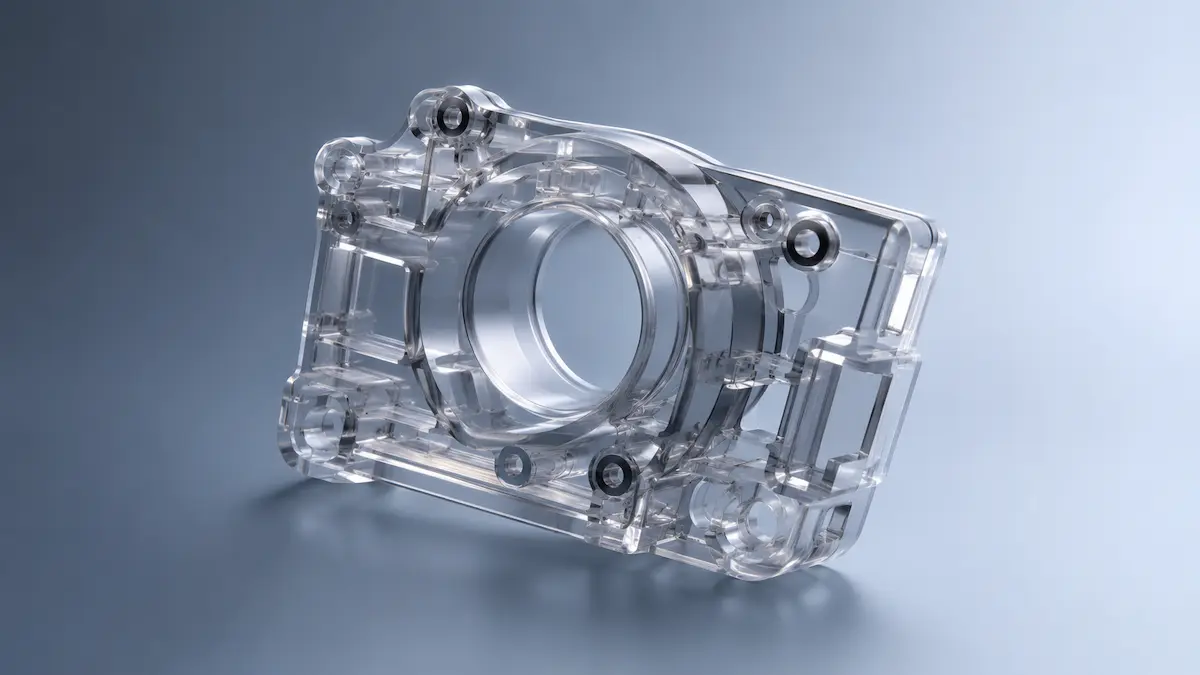
Polycarbonate (PC) is one of the common materials in engineering plastics that balances strength and toughness, making it suitable for creating appearance prototypes, electrical insulation components, and functional verification parts in CNC machining. If you want a cleaner look with transparent edges, you can choose polished (transparent edges); If you care more about silkscreen marking or uniform surface texture, you can also combine spray painting or silkscreen printing.
Suitable for demonstration samples and structural appearance verification; Consistency and texture can be enhanced through sanding or painting.
Appearance prototype: Samples that can be polished/spray-painted, and capable of silk screen/laser engraving marking; Electrical insulation structural components: brackets, housings, fasteners, etc., focusing on assembly and dimensional consistency; Functional verification: Requires rapid processing and small-batch verification of structure and assembly relationships
Long-term use at extreme high temperatures: Please evaluate the more temperature-resistant material system based on working conditions; High-wear sliding surfaces: It is recommended to evaluate wear-resistant materials or add surface solutions; Highly corrosive environments: It is recommended to choose materials that better match the medium
Order Recommendation: If there are key dimensions/mating surfaces/assembly holes, please provide STEP + 2D (PDF/DWG/DXF) markings; If you want a more "finished product" appearance (spray painting/silk screen/transparent edge polishing), please clearly state the appearance surface, target texture, and acceptable mark standards in the remarks. We will first conduct DFM before confirming the processing and post-treatment plan.
| Process | CNC Machining (Engineering Plastics Machining) |
|---|---|
| Materials | Polycarbonate (PC)(Polycarbonate, Polycarbonate (PC)) |
| Precision | ±0.2 |
| Minimum Wall Thickness | 1.0mm |
| Post-Processing | Chamfering, sanding, bonding, silkscreen printing, laser engraving, spray painting, polishing (transparent edges) |
| Typical delivery time | Related to size, quantity, structural complexity, and post-processing; After uploading the documents, specify the delivery date and expedited options |
Friendly appearance prototype; Common applications in electrical insulation; Capable of marking and traceability; Transparent edge polishing option
Suitable for demonstration samples and structural appearance verification; Consistency and texture can be enhanced through sanding or painting.
Suitable for scenarios such as insulated brackets, covers, and fixtures; Key dimensions and mounting holes are recommended with 2D annotations.
Supports silkscreen printing and laser engraving, suitable for displaying brand logos, scales, serial numbers, and other information.
Key dimensions and references: It is recommended to provide STEP + 2D (PDF/DWG/DXF) annotations; Key holes/key surface mark tolerances or notes with "Accuracy Priority".; Thin-walled and deep cavity: Thin-walled, deep-cavity, and long cantilever relies more on clamping and tool accessibility; It is recommended to do DFM first, and if necessary, process parts separately before bonding and assembly. Definition of Appearance: When sanding, painting, or transparent edge polishing is required, please clarify the appearance surface and acceptance standards to avoid over...
It is recommended to provide STEP + 2D (PDF/DWG/DXF) annotations; Key holes/key surface marking tolerances or note "Accuracy First".
Thin-walled, deep-cavity, and long cantilever arms rely more on clamping and tool accessibility; It is recommended to perform DFM first, and if necessary, perform partial machining before bonding and assembly.
When sanding, painting, or transparent edge polishing is required, please clarify the appearance surface and acceptance standards to avoid leaving knife marks/marks on key surfaces.
Provides vector files (AI/PDF/SVG), with position, dimensions, and orientation; For QR code/small print, it is recommended to reserve sufficient space and contrast conditions.
Chamfer; polishing; Adhesion; Screen printing; Laser carving; Spray painting; Polishing (transparent edge)
Order Recommendation: If there are key dimensions/mating surfaces/assembly holes, please provide STEP + 2D (PDF/DWG/DXF) markings; If you want a more "finished product" appearance (spray painting/silk screen/transparent edge polishing), please clearly state the appearance surface, target texture, and acceptable mark standards in the remarks. We will first conduct DFM before confirming the processing and post-treatment plan.
Used for removing edges, improving assembly and safety; If there are mating or positioning surfaces, please mark the chamfer on the drawing or indicate priority in the remarks.
Used to improve knife grain and surface appearance; For finer surface details, define the surface and acceptable texture standards.
Suitable for assembly and sealing after sub-part processing; It is recommended to note the force direction, appearance requirements, and whether fixture positioning is needed.
Suitable for logos, markings, scales, and other graphic and text information; It is recommended to provide vector files with annotations for position, size, and color requirements.
Key dimensions and references: It is recommended to provide STEP + 2D (PDF/DWG/DXF) annotations; Key holes/key surface mark tolerances or notes with "Accuracy Priority".; Thin-walled and deep cavity: Thin-walled, deep-cavity, and long cantilever relies more on clamping and tool accessibility; It is recommended to do DFM first, and if necessary, process parts separately before bonding and assembly. Definition of Appearance: When sanding, painting, or transparent edge polishing is required, please clarify the appearance surface and acceptance standards to avoid over...
Long-term use at extreme high temperatures: Please evaluate the more temperature-resistant material system based on working conditions; High-wear sliding surfaces: It is recommended to evaluate wear-resistant materials or add surface solutions; Highly corrosive environments: It is recommended to choose materials that better match the medium; High optical transmission/high transparency finished products: If you need to approach optical-grade transparency, it is recommended to confirm the materials and process route with the engineer
Long-term use at extreme high temperatures: Please evaluate the more temperature-resistant material system based on working conditions; High-wear sliding surfaces: It is recommended to evaluate wear-resistant materials or add surface solutions; Highly corrosive environments: It is recommended to choose materials that better match the medium; High optical transmission/high transparency finished products: If you need to approach optical-grade transparency, it is recommended to confirm the materials and process route with the engineer
Order Recommendation: If there are key dimensions/mating surfaces/assembly holes, please provide STEP + 2D (PDF/DWG/DXF) markings; If you want a more "finished product" appearance (spray painting/silk screen/transparent edge polishing), please clearly state the appearance surface, target texture, and acceptable mark standards in the remarks. We will first conduct DFM before confirming the processing and post-treatment plan.
After uploading 3D/2D drawings and supplementing materials, quantities, tolerances, surface treatments, and delivery requirements, XPartsLab will provide next steps in 3D printing manufacturability, cost, and delivery pathways.