
Lightweight
Low density, suitable for weight-sensitive structural parts and assemblies.
Polypropylene (Polypropylene (PP)) is one of the common engineering plastics. Its core advantages are lightweight design, chemical corrosion resistance/water resistance, and good insulation, making it very suitable for fixtures and fixtures, chemical media-related structural components, light-load functional components, and insulating components. When you focus more on corrosion resistance and weight, and high rigidity or high temperature resistance are not your top priorities, Polypropylene (PP) often the most cost-effective CNC machining choice.
Polypropylene (Polypropylene (PP)) is one of the common engineering plastics. Its core advantages are lightweight design, chemical corrosion resistance/water resistance, and good insulation, making it very suitable for fixtures and fixtures, chemical media-related structural components, light-load functional components, and insulating components. When you focus more on corrosion resistance and weight, and high rigidity or high temperature resistance are not your top priorities, Polypropylene (PP) often the most cost-effective CNC machining choice.
Order recommendations:Polypropylene (PP) The material leans toward "flexibility/low friction," which is not advantageous for high rigidity, load-bearing capacity, or heat resistance; If there are key fitting dimensions/positioning holes, please provide 2D annotations and specify references and tolerances; If you need screen printing, spray painting, or laser engraving, please specify the appearance and effect requirements in the remarks.
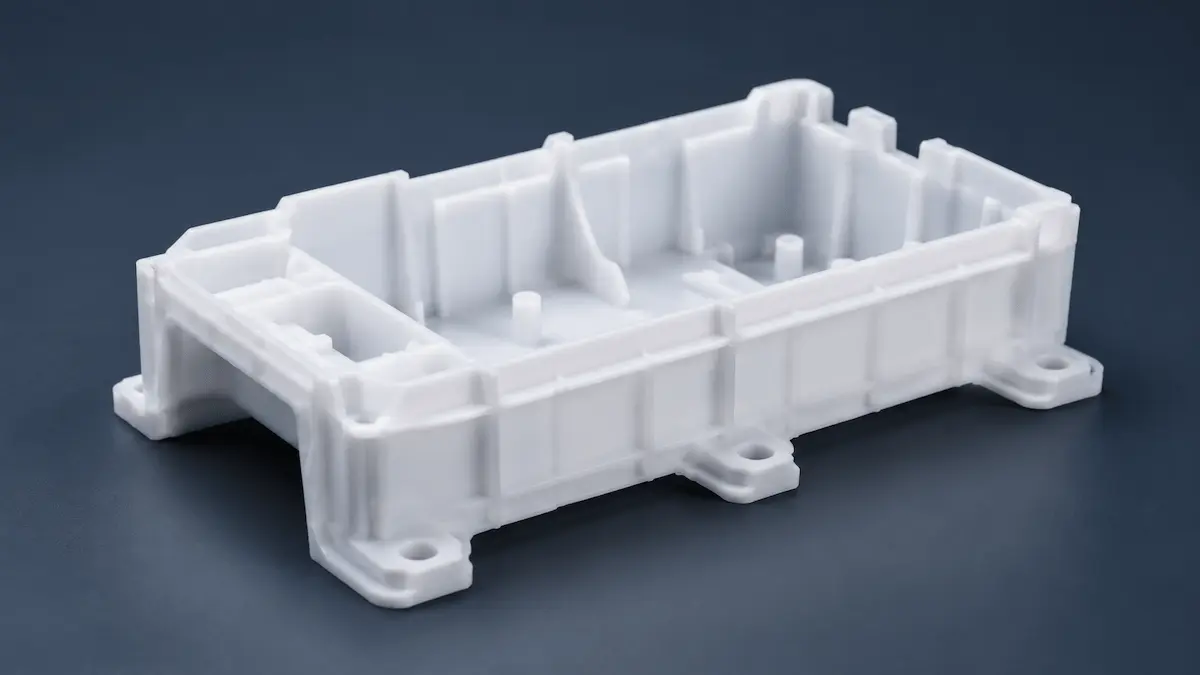
Polypropylene (Polypropylene (PP)) is one of the common engineering plastics. Its core advantages are lightweight design, chemical corrosion resistance/water resistance, and good insulation, making it very suitable for fixtures and fixtures, chemical media-related structural components, light-load functional components, and insulating components. When you focus more on corrosion resistance and weight, and high rigidity or high temperature resistance are not your top priorities, Polypropylene (PP) often the most cost-effective CNC machining choice.
Low density, suitable for weight-sensitive structural parts and assemblies.
Corrosion resistance/water resistance: structural components that come into contact with water, moisture, or general acidic or alkaline media; Lightweighting: Weight-sensitive components, internal housing structures, and tooling; Insulation: electrical isolation, protective components, insulating structural components
High rigidity/high load capacity:Acetal (POM), Nylon (PA), Polycarbonate (PC), or metal are preferred; Long-term high-temperature use: It is recommended to select heat-resistant material systems based on temperature/medium; Strong consistency and high adhesion: Spray painting/screen printing requires evaluation of adhesion and pre-treatment plans
Order recommendations:Polypropylene (PP) The material leans toward "flexibility/low friction," which is not advantageous for high rigidity, load-bearing capacity, or heat resistance; If there are key fitting dimensions/positioning holes, please provide 2D annotations and specify references and tolerances; If you need screen printing, spray painting, or laser engraving, please specify the appearance and effect requirements in the remarks.
| Process | CNC machining (Polypropylene (PP) engineering plastics) |
|---|---|
| Color | Natural color (often milky white or semi-transparent with a whitish tint); Painting and marking solutions can be evaluated according to requirements |
| Dimensional tolerances | Regular ± 0.10 meters; High precision up to ±0.05 mm (depends on size, structure, and clamping; key tolerances are recommended) |
| Minimum Wall Thickness | General structure: ≥1.0–1.5 mm; For larger planar or long thin walls, reinforcement or thickening is recommended to reduce the risk of deformation |
| Minimum aperture | Recommended ≥ 1.5–2.0 meters; Please note or provide process requirements for deep/small holes (expandable/reamed holes allowed) |
| Threading/assembly | can attack the teeth; For repeated disassembly and assembly, it is recommended to evaluate metal inserts or structural reinforcement (based on structure and stress). |
| Temperature Resistance | Short-term temperature resistance can be even higher; Long-term operating temperatures are usually recommended in the lower range (please evaluate high-temperature environments first). |
| Chemical resistance | More stable for most acidic, alkaline/aqueous media; For strongly oxidizing media/solvents, confirm according to operating conditions |
| Post-Processing | Sanding, silk screening, laser engraving, spray painting |
Lightweighting; Resistant to chemical corrosion and water; Good insulation performance; Logo and appearance can be reinforced
Low density, suitable for weight-sensitive structural parts and assemblies.
Structural components that are more stable in humid or aquatic environments and most acidic or alkaline environments, suitable for related working conditions.
Suitable for applications such as electrical insulation structural components, isolation gaskets, and protective components.
Avoid ultra-thin large flat surfaces:Polypropylene (PP) are more "flexible," and thin walls and large flat surfaces are more prone to deformation; It is recommended to reinforce, thicken, or use individual design parts. Hole Positioning and Assembly: Key positioning holes/fitting holes are recommended to provide 2D marking and references; If necessary, more stable fits can be achieved through reaming/reaming. Load and threading: It is recommended to increase the support area and fillet transitions in the load-bearing area; Repeated disassembly and assembly can assess insert or structural reinforcement. Chamfers and edges: It is recommended to add chamfer/...
Polypropylene (PP) Relatively "soft," thin walls and large planes are more prone to deformation; It is recommended to reinforce, thicken, or design by section.
Key positioning holes/fitting holes are recommended to provide 2D annotation and datums; When necessary, more stable fits can be achieved through reaming/reaming.
It is recommended to increase the support area and the transition between the fillet in the load-bearing zone; Repeated disassembly and assembly can assess inserts or structural reinforcement.
It is recommended to add chamfers or rounded corners to reduce the risk of burrs and bumps, improving assembly and feel.
polishing; Spray painting; Screen printing; Laser carving
Order recommendations:Polypropylene (PP) The material leans toward "flexibility/low friction," which is not advantageous for high rigidity, load-bearing capacity, or heat resistance; If there are key fitting dimensions/positioning holes, please provide 2D annotations and specify references and tolerances; If you need screen printing, spray painting, or laser engraving, please specify the appearance and effect requirements in the remarks.
Used to remove minor knife marks and edge burrs, enhancing tactile feel and appearance consistency; For the appearance, it is recommended to clearly specify the pattern direction and acceptable standards.
Used for color and texture consistency (matte/matte/highlight, etc.); It is recommended to provide reference images, colors, and definitions of appearance.
Suitable for logos, markings, scales, and other graphic and text information; It is recommended to provide vector files and location dimension descriptions.
Suitable for durability markings such as serial numbers, QR codes, and functional labels; Please note the content, position, and contrast requirements.
Avoid ultra-thin large flat surfaces:Polypropylene (PP) are more "flexible," and thin walls and large flat surfaces are more prone to deformation; It is recommended to reinforce, thicken, or use individual design parts. Hole Positioning and Assembly: Key positioning holes/fitting holes are recommended to provide 2D marking and references; If necessary, more stable fits can be achieved through reaming/reaming. Load and threading: It is recommended to increase the support area and fillet transitions in the load-bearing area; Repeated disassembly and assembly can assess inserts or structural reinforcement.
High rigidity/high load capacity:Acetal (POM), Nylon (PA), Polycarbonate (PC), or metal are preferred; Long-term high-temperature use: It is recommended to select heat-resistant material systems based on temperature/medium; Strong consistency and high adhesion: Painting/screen printing requires evaluation of adhesion and pretreatment plans; High wear resistance / low creep: It is recommended to evaluate Acetal (POM)/fill modified materials or metal solutions
High rigidity/high load capacity:Acetal (POM), Nylon (PA), Polycarbonate (PC), or metal are preferred; Long-term high-temperature use: It is recommended to select heat-resistant material systems based on temperature/medium; Strong consistency and high adhesion: Painting/screen printing requires evaluation of adhesion and pretreatment plans; High wear resistance / low creep: It is recommended to evaluate Acetal (POM)/fill modified materials or metal solutions
Order recommendations:Polypropylene (PP) The material leans toward "flexibility/low friction," which is not advantageous for high rigidity, load-bearing capacity, or heat resistance; If there are key fitting dimensions/positioning holes, please provide 2D annotations and specify references and tolerances; If you need screen printing, spray painting, or laser engraving, please specify the appearance and effect requirements in the remarks.
After uploading 3D/2D drawings and supplementing materials, quantities, tolerances, surface treatments, and delivery requirements, XPartsLab will provide next steps in 3D printing manufacturability, cost, and delivery pathways.