
Overall Balance (Cost/Appearance/Performance)
Suitable for prototyping and functional validation scenarios, making it easy to make controlled trade-offs between cost and performance.
Acetal (POM)(Saigang) is a commonly used material option in injection molding scenarios, suitable for balancing cost, appearance, and performance. If your key requirements lean more toward strength, temperature resistance, wear resistance, or appearance texture, you can choose higher-performance materials or adjust process routes based on the application scenario.
Acetal (POM)(Saigang) is a commonly used material option in injection molding scenarios, suitable for balancing cost, appearance, and performance. If your key requirements lean more toward strength, temperature resistance, wear resistance, or appearance texture, you can choose higher-performance materials or adjust process routes based on the application scenario.
Order Recommendation: If you have requirements for key dimensions, assembly fits, or appearance, please provide 2D (PDF/DWG/DXF) and indicate tolerances and references; If you require screen printing, laser engraving, spray painting, or other exterior techniques, please specify the location, color/texture, and acceptance standards in the remarks to ensure a one-time quote.
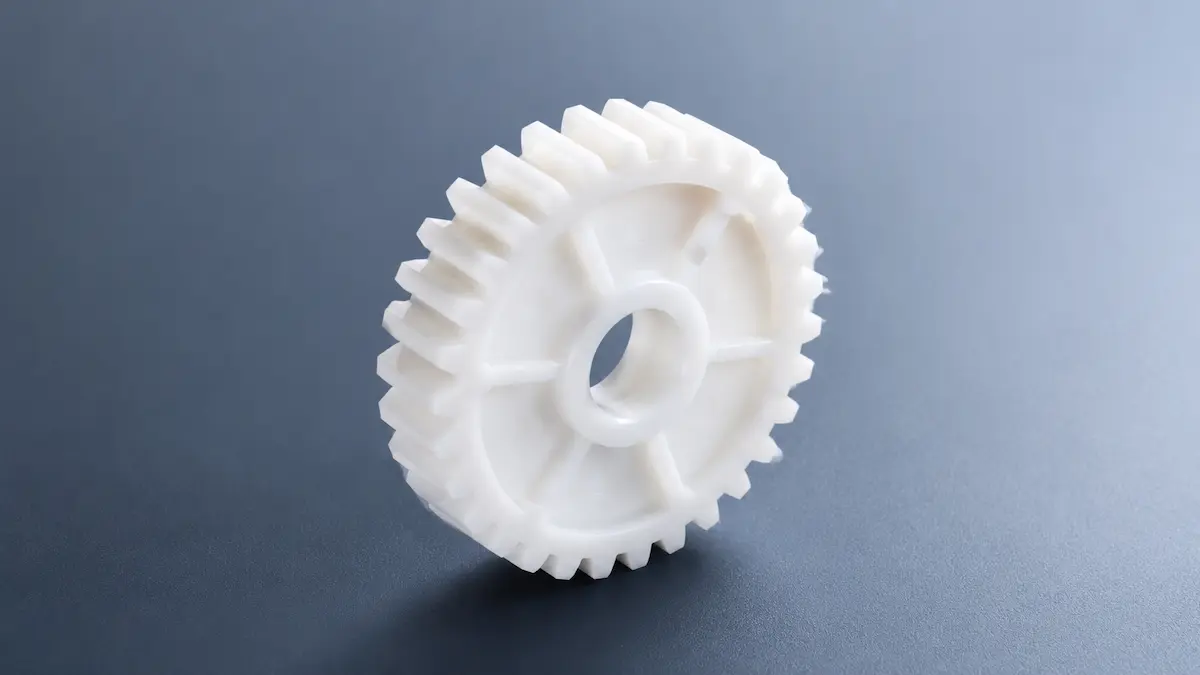
Acetal (POM)(Saigang) is a commonly used material option in injection molding scenarios, suitable for balancing cost, appearance, and performance. If your key requirements lean more toward strength, temperature resistance, wear resistance, or appearance texture, you can choose higher-performance materials or adjust process routes based on the application scenario.
Suitable for prototyping and functional validation scenarios, making it easy to make controlled trade-offs between cost and performance.
Low-cost general-purpose parts: injection molded parts sensitive to cost and requiring stable delivery; Appearance controllable: Aiming to improve consistency and recognition through spray painting, silk screening, or laser engraving; Higher surface quality is required: Parts that require tactile and surface appearance
Extreme temperature resistance/long-term high-temperature operation: It is recommended to select heat-resistant materials that better match actual working conditions; Highly corrosive/strong chemical media: material compatibility must be evaluated in conjunction with the media list; Extremely strict high-appearance A-level surfaces: It is recommended to simultaneously evaluate mold texture, parting lines, and spraying schemes
Order Recommendation: If you have requirements for key dimensions, assembly fits, or appearance, please provide 2D (PDF/DWG/DXF) and indicate tolerances and references; If you require screen printing, laser engraving, spray painting, or other exterior techniques, please specify the location, color/texture, and acceptance standards in the remarks to ensure a one-time quote.
| Process | Injection Molding |
|---|---|
| Materials | Acetal (POM)(Saigang) |
| Precision | ±0.2 |
| Minimum Wall Thickness | 1.0mm |
| Requirement Tags | Low-cost universal parts; High surface quality |
| Post-Processing | Sanding, silk screening, laser engraving, spray painting |
| Typical delivery time | Related to structural complexity, mold scheme, quantity, and post-processing; After uploading the documents, specify the delivery date and expedited options |
Comprehensive balance (cost/appearance/performance); Suitable for making "universal parts"; exterior extension space; Quotation and order routing are clear
Suitable for prototyping and functional validation scenarios, making it easy to make controlled trade-offs between cost and performance.
When you need plastic parts that can be delivered stably and can be produced at scale, Acetal (POM)(Saigang) is one of the common choices.
Post-processing such as sanding, painting, silk screening, and laser engraving can enhance recognition and product quality.
Wall thickness and uniformity: Try to keep the wall thickness consistent to avoid sudden changes in thickness that can cause shrinkage or warping; If necessary, use reinforcement ribs instead of solid thickened ones. Release angle: It is recommended to reserve a release angle on the sidewalls in all draft directions; The appearance/texture surfaces require a more ample slope to reduce strains. Fillet and stress concentration: Try to make rounded transitions between inner and outer corners to reduce the risk of cracking and bleaching, and improve mold filling flow. Gate/parting line/ejector pin marks: If there is any appearance prohibited...
Try to keep the wall thickness consistent to avoid sudden changes in thickness that can cause shrinkage or warping; If necessary, use reinforcement ribs instead of solid thickness.
It is recommended to reserve a demolding angle on the sidewalls in all draft directions; The appearance/texture surfaces require a more ample slope to reduce strains.
Internal and external corners should be rounded and transitioned as much as possible to reduce the risk of cracking and bleaching, and improve mold filling flow.
If there are any appearance no-discharge zones, please mark them in the drawings or remarks. We will prioritize optimizing gate and ejection solutions.
polishing; Screen printing; Laser carving; Spray paint
Order Recommendation: If you have requirements for key dimensions, assembly fits, or appearance, please provide 2D (PDF/DWG/DXF) and indicate tolerances and references; If you require screen printing, laser engraving, spray painting, or other exterior techniques, please specify the location, color/texture, and acceptance standards in the remarks to ensure a one-time quote.
Used to remove minor burrs and improve tactile feel; Clear acceptance standards (texture/gloss/feel) can be applied to the exterior.
Suitable for logos, markings, scales, and other graphic and text information; It is recommended to provide vector files with annotations for their positions and dimensions.
Suitable for serial numbers, QR codes, permanent identification, etc.; Please note the engraving content, size, and acceptable contrast.
Used for color and texture consistency (matte/matte/highlight, etc.); It is recommended to provide reference images or specify the color code and appearance requirements.
Wall thickness and uniformity: Try to keep the wall thickness consistent to avoid sudden changes in thickness that can cause shrinkage or warping; If necessary, use reinforcement ribs instead of solid thickened ones. Release angle: It is recommended to reserve a release angle on the sidewalls in all draft directions; The appearance/texture surfaces require a more ample slope to reduce strains. Fillet and stress concentration: Internal and external corners should be rounded as much as possible to reduce the risk of cracking and bleaching, and improve mold filling flow.
Extreme temperature resistance/long-term high-temperature operation: It is recommended to select heat-resistant materials that better match actual working conditions; Highly corrosive/strong chemical media: material compatibility must be evaluated in conjunction with the media list; Extremely strict high-appearance Class A surfaces: It is recommended to simultaneously evaluate mold texture, parting lines, and spraying schemes; Complex inverted or multi-slider structures: It is recommended to conduct a DFM review first, and optimize the structure or disassemble parts if necessary
Extreme temperature resistance/long-term high-temperature operation: It is recommended to select heat-resistant materials that better match actual working conditions; Highly corrosive/strong chemical media: material compatibility must be evaluated in conjunction with the media list; Extremely strict high-appearance Class A surfaces: It is recommended to simultaneously evaluate mold texture, parting lines, and spraying schemes; Complex inverted or multi-slider structures: It is recommended to conduct a DFM review first, and optimize the structure or disassemble parts if necessary
Order Recommendation: If you have requirements for key dimensions, assembly fits, or appearance, please provide 2D (PDF/DWG/DXF) and indicate tolerances and references; If you require screen printing, laser engraving, spray painting, or other exterior techniques, please specify the location, color/texture, and acceptance standards in the remarks to ensure a one-time quote.
After uploading 3D/2D drawings and supplementing materials, quantities, tolerances, surface treatments, and delivery requirements, XPartsLab will provide next steps in 3D printing manufacturability, cost, and delivery pathways.