Material Database

Polypropylene (PP)

A general-purpose plastic material suitable for low-cost batch injection molded parts, water- and chemical-resistant parts, daily necessities, packaging parts, automotive interior parts, light-duty structural parts, flexible hinge parts, and ordinary functional plastic parts.

Material description

Polypropylene (PP) is a commonly used thermoplastic material, also known as polypropylene, characterized by light weight, low cost, good water resistance, good chemical resistance, good fatigue bending resistance, and high molding efficiency. Polypropylene (PP) commonly used in daily necessities, packaging parts, automotive interior parts, home appliance internal structural parts, container covers, hinge structures, low-cost housings, snap fasteners, turnover parts, and ordinary functional plastic parts. Compared to Polyethylene (PE), Polypropylene (PP) generally has better rigidity and heat resistance; Compared to engineering plastics such as ABS, Polycarbonate (PC), and Acetal (POM), Polypropylene (PP) costs are lower, but their strength, appearance texture, and dimensional stability are relatively limited.

PPPolypropyleneInjection molding Polypropylene (PP)Polypropylene (PP) injection-molded partsPolypropylene (PP) plastic partsPolypropylene plasticDistribute Polypropylene (PP) and gather equallygathering together Polypropylene (PP)Changed Polypropylene (PP)Enhance Polypropylene (PP)
The biggest feature of injection molding Polypropylene (PP) is its low costLightweightIt has good water and chemical resistanceSuitable for mass production of ordinary plastic partsPolypropylene (PP) Low material densityThe product feels light to the touchSuitable for daily necessitiesLightweight packaging parts and automotive interiorsPolypropylene (PP) also has good fatigue bending resistanceIt is commonly used in integrated movable hinge structures
PP
Injection MoldingPlastics

Material compatibility assessment

By focusing on application scenarios, boundaries of advantages, and non-recommended scenarios, it helps sales, customer service, and quoting staff quickly determine whether the material meets current part requirements.

Core advantages

Low cost, light weight, good water resistance, good chemical resistance, good fatigue bending resistance, high molding efficiency, low density, good insulation, suitable for batch injection molding, suitable for thin-walled and ordinary structural parts, and can improve rigidity, impact resistance, and flame retardancy through modification.

Suitable for the product

Daily necessities shells, bottle caps, bucket lids, packaging accessories, storage boxes, plastic boxes, automotive interior parts, home appliance internal structural parts, low-strength brackets, thin-walled housings, movable hinges, flexible connection structures, low-load snap fasteners, light-duty laboratory equipment parts, water-resistant parts, chemical container auxiliary parts, toy parts, and general industrial plastic parts.

Not suitable for the product

High-strength load-bearing parts, high-rigidity structural parts, high-precision long-term dimensional stabilization parts, high-wear motion parts, high-gloss painted appearance parts, transparent appearance parts, high-temperature long-term load-bearing parts, high-strength threaded parts, precision gears, long-term outdoor exposure without UV-resistant modified parts, strong solvent environment parts, and parts requiring Polycarbonate (PC)-level impact resistance.

Key parameter references

The following parameters come from product information and material knowledge fields, used for design review, quotation communication, and preliminary judgment before material selection.

Material positioningA general-purpose plastic material suitable for low-cost batch injection molded parts, water- and chemical-resistant parts, daily necessities, packaging parts, automotive interior parts, light-duty structural parts, flexible hinge parts, and ordinary functional plastic parts.
Precision performanceInjection molding Polypropylene (PP) can meet the batch molding precision of ordinary plastic parts, but due to the material's high shrinkage rate, low rigidity, and obvious thermal expansion, dimensional stability is usually not as stable as ABS, Acetal (POM), Polycarbonate (PC), and Polybutylene Terephthalate (PBT). Actual accuracy is affected by Polypropylene (PP) grade, shrinkage rate, wall thickness, gate position, mold temperature, cooling system, product size, and injection molding parameters. Precision assembly positions, snap fits, sealing mats, and porous structures should be verified through mold trials.
Dimensional tolerancesConventional dimensional tolerances for injection molding Polypropylene (PP) can be referenced ± 0.15mm to ±0.40mm, making small sizes and simple structures relatively easier to control; Large parts, thin-walled parts, elongated parts, uneven thickness parts, and soft modified parts may have deviations of ±0.40mm-±1.00mm or more. This value is a standard reference range and is not an absolute guarantee tolerance for all structures. It is recommended to define separate tolerances for assembly holes, snaps, hinges, seals, and plug-in structures.
Minimum Wall ThicknessInjection molding Polypropylene (PP) recommends a minimum wall thickness of no less than 1.0mm. Small localized non-stressed areas can be used around 0.8mm, but large-area use is not recommended. Walls that are too thin are prone to insufficient filling, insufficient strength, or deformation; Walls that are too thick are prone to shrinkage, depression, increased cooling time, and dimensional instability.
Recommended wall thicknessOrdinary injection-molded Polypropylene (PP) structural parts are recommended to be 1.5mm-3.0mm; thin-walled packages, lids, and daily necessities can be designed to 1.0mm-2.0mm based on material flowability; 2.0mm-4.0mm is recommended for bearing assembly forces, compression forces, screw connections, or positions requiring shape maintenance, and to reduce deformation through rounded corners, reinforcing ribs, and uniform wall thickness distribution.
Minimum apertureFor injection molding Polypropylene (PP) small holes, the recommended hole diameter should not be less than 1.0mm-1.5mm. Deep small holes and slender columns need to be evaluated in conjunction with mold insertion needle strength, venting, and molding stability. Screw holes, positioning holes, and assembly holes should consider shrinkage, draft angle, and material springback. High-precision hole positions can be achieved by drilling after injection molding or by inserts.
Assembly clearanceFor ordinary plastic parts, it is recommended to reserve 0.20mm-0.50mm on one side; for movable fits, it is recommended to reserve 0.40mm-0.80mm on one side. Due to the Polypropylene (PP) shrinkage rate and thermal expansion being relatively large, and the material has a certain degree of flexibility, the assembly gap should not be too tight. Clips, hinges, covers, sealing auxiliary structures, and insertions should be validated using material hardness, springback, compression amount, and long-term creep for sample validation.
Detailed performanceInjection molding Polypropylene (PP) can achieve standard rib positions, column positions, slots, snaps, movable hinges, shallow textures, and basic logos, but the detail clarity is usually not as high as that of ABS, Polycarbonate (PC), Polybutylene Terephthalate (PBT), and other materials. For raised text, recessed text, and decorative textures, it is recommended to be no less than 0.4mm-0.6mm. Fine textures, small letters, thin edges, and sharp corners are prone to weakening due to material flexibility, shrinkage, or demolding. Identification can be achieved through mold text, silk screening, pad printing, laser marking, or labeling.
Surface effectThe original surface of injection molded Polypropylene (PP) is usually white, milky white, translucent milky white, black, or plastic surfaces that have been colored with masterbatch coloring, resulting in a softer and more functional texture. Polypropylene (PP) can be made with matte, fine-grain, matte texture, leather texture, or regular glossy finishes, but they are not suitable for high-gloss spray finishes. After long-term use, the surface may develop whitening, scratches, aging, or color changes due to friction, oil stains, UV rays, or chemical environmental effects.

Typical application scenarios

Based on material characteristics and suitable product ranges, customer needs are broken down into easier application directions to determine.

Product validation

Daily necessities shells, bottle caps, bucket lids, packaging accessories, storage boxes, plastic boxes, automotive interior parts, home appliance internal structural parts, low-strength brackets, thin-walled housings, movable hinges, flexible connection structures, low-load snap fasteners, light-duty laboratory equipment parts, water-resistant parts, chemical container auxiliary parts, toy parts, and general industrial plastic parts.

Reasons for material selection

A general-purpose plastic material suitable for low-cost batch injection molded parts, water- and chemical-resistant parts, daily necessities, packaging parts, automotive interior parts, light-duty structural parts, flexible hinge parts, and ordinary functional plastic parts.

Material characteristics

The biggest features of injection molding Polypropylene (PP) are low cost, light weight, and good water and chemical resistance, making them suitable for mass production of ordinary plastic parts. Polypropylene (PP) has low material density and a light feel, suitable for daily necessities, packaging parts, and lightweight automotive interior parts. Polypropylene (PP) also has good fatigue bending resistance and is commonly used in integrated movable hinge structures. Ordinary Polypropylene (PP) is not as rigid or dimensional stability as Acetal (POM), Polycarbonate (PC), Nylon (PA), Polybutylene Terephthalate (PBT), and other engineering plastics, and painting and bonding are not advantages.

Design and risk review

Based on wall thickness, hole position, assembly clearance, dimensional tolerances, and material usage risks, determine in advance whether the part structure is suitable for Polypropylene (PP).

Design considerations

  • When designing injection-molded Polypropylene (PP) parts
  • Shrinkage rate should be given special consideration
  • Wall thickness uniformity
  • Release angle
  • Rounded transitions
  • Flexible material
  • Assembly gaps and long-term creep
  • The load-bearing area should avoid being too thin
Precision performanceInjection molding Polypropylene (PP) can meet the batch molding precision of ordinary plastic parts, but due to the material's high shrinkage rate, low rigidity, and obvious thermal expansion, dimensional stability is usually not as stable as ABS, Acetal (POM), Polycarbonate (PC), and Polybutylene Terephthalate (PBT). Actual accuracy is affected by Polypropylene (PP) grade, shrinkage rate, wall thickness, gate position, mold temperature, cooling system, product size, and injection molding parameters. Precision assembly positions, snap fits, sealing mats, and porous structures should be verified through mold trials.
Dimensional tolerancesConventional dimensional tolerances for injection molding Polypropylene (PP) can be referenced ± 0.15mm to ±0.40mm, making small sizes and simple structures relatively easier to control; Large parts, thin-walled parts, elongated parts, uneven thickness parts, and soft modified parts may have deviations of ±0.40mm-±1.00mm or more. This value is a standard reference range and is not an absolute guarantee tolerance for all structures. It is recommended to define separate tolerances for assembly holes, snaps, hinges, seals, and plug-in structures.
Quality riskThe main risks of injection molding Polypropylene (PP) include significant shrinkage, warping and deformation, average dimensional stability, poor surface paint adhesion, insufficient thread strength, long-term creep under stress, peeling, burrs, low-temperature embrittlement, and high-temperature softening. Polypropylene (PP) suitable for low-cost, water-resistant, and light-load functional components, but not suitable for high-precision, high-rigidity, high-appearance, or high-load scenarios. When used for clips, hinges, covers, housings, and assemblies, focus should be paid to confirming material grade, shrinkage rate, wall thickness, assembly clearance, resilience, and long-term deformation risk.
Surface effectThe original surface of injection molded Polypropylene (PP) is usually white, milky white, translucent milky white, black, or plastic surfaces that have been colored with masterbatch coloring, resulting in a softer and more functional texture. Polypropylene (PP) can be made with matte, fine-grain, matte texture, leather texture, or regular glossy finishes, but they are not suitable for high-gloss spray finishes. After long-term use, the surface may develop whitening, scratches, aging, or color changes due to friction, oil stains, UV rays, or chemical environmental effects.

Post-processing and assembly precautions

Post-processing of Polypropylene (PP) affects appearance, dimensions, hole position, assembly clearance, and usage validation results, and should be explained in advance during quotation, DFM review, and sample confirmation stages.

Post-processing options

Post-processing should focus on appearance display, dimensional fitting, connection assembly, and testing verification. Parts involving assembly positions need to be reserved in advance for machining, coating, and trial assembly allowances.

Leave the armor on the frontierDe-defluffing: Used to improve the appearance, assembly, or validation of parts, it is necessary to confirm dimensions, strength, and delivery impact based on material properties.
and repaired the borderEdge trimming is used to improve the appearance, assembly, or validation of parts, and must be combined with material properties to confirm dimensions, strength, and delivery impact.
Hot-melt weldingHot-melt welding is used to improve the appearance, assembly, or validation of parts, requiring confirmation of dimensions, strength, and delivery impact based on material properties.
Plastic weldingPlastic welding is used to improve the appearance, assembly, or validation of parts by combining material properties to confirm dimensions, strength, and delivery impact.
Ultrasonic weldingUltrasonic welding is used to improve the appearance, assembly, or validation of parts, requiring confirmation of dimensions, strength, and delivery impact based on material properties.
Hot plate weldingHot plate welding is used to improve the appearance, assembly, or validation of parts, and must be determined by material properties to confirm dimensions, strength, and delivery impact.
Screen printingSilk-screen printing is used to improve the appearance of parts, assembly, or functional verification effects, and it is necessary to confirm the dimensions, strength, and delivery impact in combination with the material characteristics.
Pad printingPad printing is used to improve the appearance of parts, assembly, or functional verification effects, and it is necessary to confirm the dimensions, strength, and delivery impact in combination with material characteristics.

Key control point

Size impactPolypropylene (PP) low surface energy; Ordinary spray painting; Adhesion; Screen printing and pad printing usually have poor adhesion; If printing is required; Bonding or coating; Corona is usually needed; Flame or plasma surface treatment
Assembly clearanceFor positions involving snapping, plugging, sliding, or enclosure closure, the clearance needs to be adjusted according to post-processing thickness, material shrinkage, and trial assembly results.
Hole Position StrengthThreading, inserting nuts, locking screws, and the areas around positioning holes need to ensure wall thickness to avoid cracks, stripped threads, or chipped edges during post-processing or assembly.
Environmental matchingWhen used in high-temperature, outdoor, humid, friction, or load-bearing scenarios, post-processing materials, adhesives, coatings, and fasteners must also meet the corresponding usage environment.

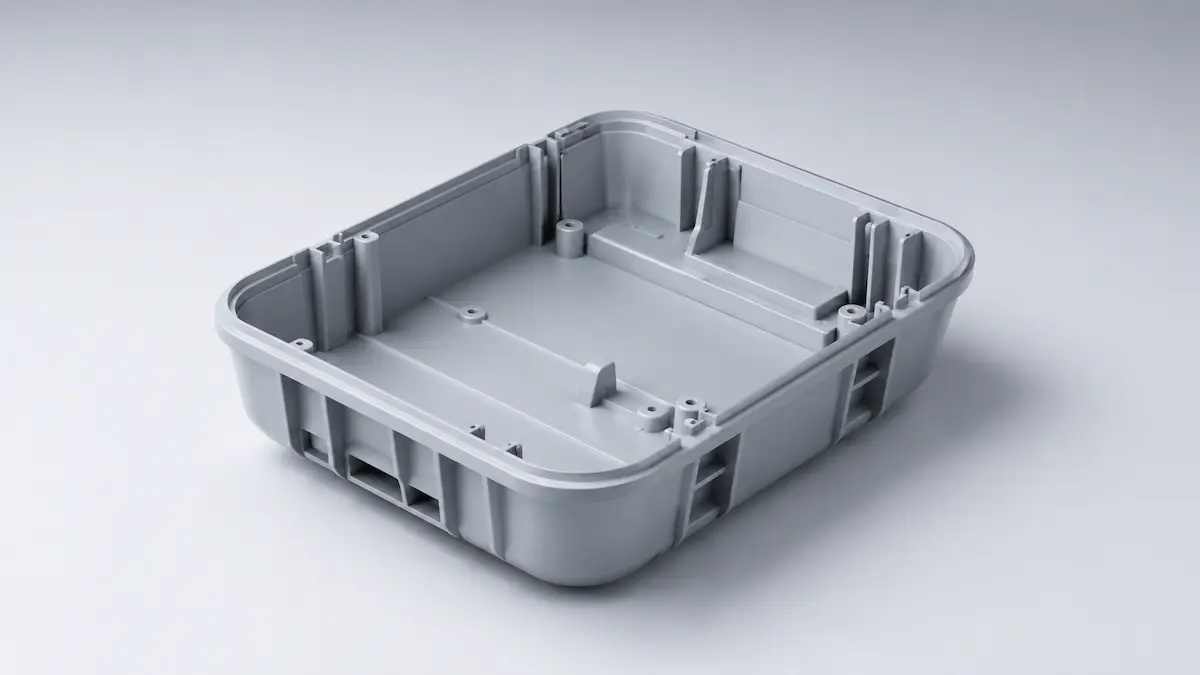
Structure and usage boundaries

For common issues such as threads, snaps, strength, temperature resistance, and weather resistance, identify in advance whether the material needs to be replaced or if another processing method should be used.

Thread Recommendation

Applicable ScopePolypropylene (PP) can be injection molded into low-strength threads or using self-tapping screws, but they are not suitable for frequent assembly and disassembly or high-locking force connections.
Risk pointStandard low-load connections can directly form threads or hole positions;
Recommended practiceFor important connection points, it is recommended to use metal inserts, hot-melt nuts, through-hole nuts, enlarged thread specifications, or flange tightening structures. When tightening screws, avoid excessive tightening to avoid thread slipping, pressure damage, creep loosening, or local deformation.

Buckle recommendation

Applicable ScopePolypropylene (PP) has good flexibility and resistance to fatigue bending, suitable for low to medium strength clasps, movable hinges, and flexible engagement structures.
Risk pointThe base of the clip should have rounded corners to control deformation and avoid creep loosening caused by prolonged stress.
Recommended practicePolypropylene (PP) integrated hinge is a common design, but it is necessary to select the appropriate grade and control the hinge thickness. It is recommended to choose high-precision strong locking clips using Acetal (POM), Nylon (PA), Polycarbonate (PC), or specialized modified Polypropylene (PP).

Strength and Environment

Mechanical strengthInjection molding Polypropylene (PP) has medium-to-low strength and rigidity, but good toughness, water resistance, and fatigue bending resistance, making it suitable for low-load structural parts, daily necessities, lids, containers, and general functional parts.
Environmental boundaryHomopolymer Polypropylene (PP) has better rigidity and better impact resistance Polypropylene (PP) copolymer.
Recommended practicePolypropylene (PP) is not suitable as a high-strength load-bearing material, nor for precision high-load transmission components. Load-bearing structures should improve reliability through thickening, reinforcing ribs, rounded corners, and reasonable support methods. Polypropylene (PP) temperature resistance is generally better than Polyethylene (PE), making it suitable for ambient and moderate temperature environments. At higher temperatures Polypropylene (PP) may still soften, deform, lose strength, or creep intensify. When used near hot water, steam, automotive interiors, inside equipment, or near heat sources, verification should be conducted based on specific temperature, load, medium, and usage time. For higher temperature resistance requirements, it is recommended to choose Nylon (PA)66, Polybutylene Terephthalate (PBT), PPS, Polyether Ether Ketone (PEEK), or metal materials. Polypropylene (PP) performs well in water resistance and most common chemical environments, but ordinary Polypropylene (PP) have average long-term outdoor weather resistance. UV exposure may cause aging, chalking, brittleness, or color changes. For outdoor or long-term exposure environments, it is recommended to choose UV-resistant modified Polypropylene (PP), black Polypropylene (PP), weather-resistant modification Polypropylene (PP) or add light-blocking protection. For harsh outdoor environments, strong corrosion, or prolonged high-temperature environments, ASA, PVDF, PTFE, stainless steel, or other more weather-resistant materials should be evaluated.

Alternative material selection and final judgment

When customer demand exceeds Polypropylene (PP) material boundaries, it is necessary to combine strength, temperature resistance, toughness, long-term stability, and mass production goals to promptly recommend alternative materials or processing technologies.

Alternative material suggestions

If higher rigidity and dimensional stability are required, Acetal (POM), Polybutylene Terephthalate (PBT), or ABS can be chosen; If higher impact resistance is required, copolymer Polypropylene (PP), modified Polypropylene (PP), ABS, or Polycarbonate (PC) can be chosen; If you need better paint finishes, you can choose ABS or Polycarbonate (PC)+ABS; If higher temperature resistance and mechanical strength are required, Nylon (PA)66, Polybutylene Terephthalate (PBT), PPS, or Polyether Ether Ketone (PEEK) can be selected; If higher wear resistance and lower friction are required, Acetal (POM), Nylon (PA), or UHMW Polyethylene (PE) can be chosen; If long-term outdoor weather resistance is needed, UV-resistant Polypropylene (PP), ASA, or modified materials can be chosen.

Material selection suggestions

If customers mainly focus on low cost, lightweight design, water resistance, chemical resistance, standard structures, and large-scale injection molding production, Polypropylene (PP) is a very suitable choice. If the product requires high-precision assembly, high rigidity, high wear resistance, high-end appearance, or long-term high-temperature use, it is not recommended to prioritize ordinary Polypropylene (PP). Instead, consider Acetal (POM), ABS, Polycarbonate (PC), Nylon (PA), Polybutylene Terephthalate (PBT), PPS or Polyether Ether Ketone (PEEK). If the product is used in scenarios involving food, drinking water, medical, or special chemical media, it is necessary to separately confirm the material grade, certification, and medium compatibility.

Already have the blueprints? Directly enter the quotation for custom parts

After uploading 3D/2D drawings and supplementing materials, quantities, tolerances, surface treatments, and delivery requirements, XPartsLab will provide next steps in 3D printing manufacturability, cost, and delivery pathways.