Material Database

Silicone Rubber

Suitable for small batches of flexible samples, sealing auxiliary parts, Soft Rubber housings, cushioning parts, buttons, protective covers, foot pads, soft-touch parts, and mold replication materials requiring elastic validation.

Material description

Silicone Rubber is a material solution for small-batch production of flexible, elastic, and soft-touch parts, suitable for producing Soft Rubber samples through Silicone Rubber molds, vacuum pouring, or low-pressure mold replication. It has good softness, resilience, heat resistance, water resistance, and tactile performance, and is commonly used for sealing rings, soft pads, buttons, protective covers, foot pads, cushioning parts, medical device appearance samples, consumer electronics Soft Rubber components, and flexible structure verification during product development.

Remold Silicone RubberVacuum Casting Silicone RubberSilicone Rubber mold partsSoft Rubber mold partsSilicone rubber composite partsSmall batch Silicone Rubber piecesElastic Silicone Rubber samplesSilicone Rubber Soft Rubber itemsSilicone Rubber type mold replication materialsSilicone Rubber Casting
The core feature of vacuum casting Silicone Rubber is softnessIt has good elasticity and tactile feelSuitable for quickly achieving near-Soft Rubber sample results during the R&D phaseIt can be selected in different hardness levels according to requirementsCommonly expressed as Shore A hardnessFor example, softer 20A-30AMedium softness and hardness, 40A-60AThe harder is around 70ASilicone Rubber is suitable for sealingBuffer
Silicone Rubber
Vacuum CastingPlastics

Material compatibility assessment

By focusing on application scenarios, boundaries of advantages, and non-recommended scenarios, it helps sales, customer service, and quoting staff quickly determine whether the material meets current part requirements.

Core advantages

Good softness, good resilience, comfortable touch, good temperature resistance, good water resistance, and aging resistance, suitable for small batch production, no need for formal Silicone Rubber molding or LSR injection molds, suitable for validating Soft Rubber structures, and suitable for sealing and buffering samples.

Suitable for the product

Silicone Rubber buttons, sealing rings, Soft Rubber pads, foot pads, anti-slip pads, cushioning pads, shock absorbers, protective covers, Soft Rubber housings, medical device soft-touch samples, consumer electronics Soft Rubber parts, wearable device watch strap samples, tool handles, Soft Rubber pieces, Silicone Rubber plugs, Silicone Rubber sets, soft components, and sealing samples with low to medium requirements.

Not suitable for the product

High-precision long-term mass production parts, high-strength load-bearing parts, high rigidity structural parts, high wear-resistant motion parts, high-frequency friction parts, high-strength threaded parts, high-gloss hard appearance parts, transparent optical parts, long-term strong acid and strong alkali environment parts, food long-term contact and uncertified parts, medical implant parts, and functional parts requiring extremely high performance in real LSR mass production.

Key parameter references

The following parameters come from product information and material knowledge fields, used for design review, quotation communication, and preliminary judgment before material selection.

Material positioningSuitable for small batches of flexible samples, sealing auxiliary parts, Soft Rubber housings, cushioning parts, buttons, protective covers, foot pads, soft-touch parts, and mold replication materials requiring elastic validation.
Precision performanceVacuum Casting Silicone Rubber is suitable for standard Soft Rubber samples and flexible assembly verification, with dimensional accuracy usually lower than CNC rigid materials and formal injection-molded parts. Because Silicone Rubber is soft and elastic, measurement results are affected by clamping force, compression amount, hardness, and ambient temperature. Thin-walled parts, large parts, elongated parts, complex hole positions, and highly elastic structures are more prone to dimensional fluctuations or local deformation.
Dimensional tolerancesThe conventional dimensional tolerances for vacuum casting Silicone Rubber can be referenced ± 0.30mm to ±0.80mm; Small sizes, higher Silicone Rubber hardness, and simpler structures are easier to control, while large parts, low hardness, thin-walled parts, elongated parts, and complex assemblies may have deviations of ±0.80mm-±1.50mm or more. This value is a standard reference range and does not guarantee absolute tolerances for all structures. Sealing positions, assembly holes, button travel, and overmolding boundaries are recommended for separate evaluation.
Minimum Wall ThicknessIt is recommended that the wall thickness be no less than 1.0mm-1.5mm. Low hardness Silicone Rubber it is not recommended to make large areas too thin, otherwise they are prone to deformation, tearing, difficult demolding, or curling after assembly. Non-stressed thin edges can be locally thinned according to the structure, but sealing, stretching, clamping, and assembly positions should be appropriately thickened.
Recommended wall thicknessStandard Silicone Rubber pads, protective covers, Soft Rubber housings, and cushioning components are recommended 1.5mm-3.0mm; sealing rings, buttons, foot pads, and compression structures are recommended 2.0mm-4.0mm; positions requiring repeated pressing, stretching, insertion, or compression should be appropriately thickened according to hardness, compression rate, rebound, and assembly space.
Minimum apertureThe recommended hole diameter should not be less than 1.5mm-2.0mm. Low hardness Silicone Rubber small holes are prone to unstable pore size due to springback, shrinkage, or demolding stretching. Deep holes, elongated holes, and sealed holes are recommended for post-processing or enlargement through structural enlargement. Assembly holes, wire punching, and positioning holes should consider material springback and long-term deformation to avoid overly tight design.
Assembly clearanceFor ordinary assembly, it is recommended to reserve 0.30mm-0.80mm on one side; Soft Rubber sleeve, sealed compression, and elastic cladding structures can be designed with appropriate interference according to hardness and compression amount. Sealing structures should focus on controlling the compression ratio; generally, excessive compression is not recommended to avoid permanent deformation or assembly difficulties. Low hardness Silicone Rubber can compensate for dimensional errors by elasticity, but long-term pressure may cause loosening or deformation.
Detailed performanceVacuum Casting Silicone Rubber can replicate the logo, shallow texture, raised ribs, grooves, button contours, and anti-slip textures on the mother mold, but the detail clarity is lower than that of hard plastic and metal. For raised text, recessed text, and anti-slip textures, it is recommended to be no less than 0.5mm-1.0mm. Low hardness Silicone Rubber details are prone to rounding, softening, or peeling and scratching; High hardness Silicone Rubber clearer detail rendering. Fine sharp edges and thin edges are not recommended for use in main load-bearing areas.
Surface effectVacuum Casting Silicone Rubber can be customized in transparent, semi-transparent, milky white, black, gray, or various other colors, with surfaces typically soft, slightly elastic, skin-friendly, or non-slip to the touch. The surface effect depends on the quality of the master mold, the condition of the Silicone Rubber, the material formulation, and the post-processing method. Matte surfaces are better suited for anti-slip and tactile parts, while high-transparency surfaces are more prone to exposing bubbles, impurities, and flow marks. Silicone Rubber surfaces easily attract dust, so dust protection is needed during packaging and storage.

Typical application scenarios

Based on material characteristics and suitable product ranges, customer needs are broken down into easier application directions to determine.

Product validation

Silicone Rubber buttons, sealing rings, Soft Rubber pads, foot pads, anti-slip pads, cushioning pads, shock absorbers, protective covers, Soft Rubber housings, medical device soft-touch samples, consumer electronics Soft Rubber parts, wearable device watch strap samples, tool handles, Soft Rubber pieces, Silicone Rubber plugs, Silicone Rubber sets, soft components, and sealing samples with low to medium requirements.

Reasons for material selection

Suitable for small batches of flexible samples, sealing auxiliary parts, Soft Rubber housings, cushioning parts, buttons, protective covers, foot pads, soft-touch parts, and mold replication materials requiring elastic validation.

Material characteristics

The core features of vacuum casting Silicone Rubber are softness, elasticity, and good tactile performance, making it suitable for quickly achieving prototype results close to Soft Rubber during the R&D phase. Different hardness levels can be selected according to requirements, commonly expressed as Shore A hardness, such as the softer 20A-30A, the medium softness 40A-60A, and the harder around 70A. Silicone Rubber parts are suitable for sealing, cushioning, anti-slip, and flexible assembly, but dimensional accuracy, surface consistency, and batch stability are usually inferior to the mass production processes Silicone Rubber formal LSR injection molding or compression molding.

Design and risk review

Based on wall thickness, hole position, assembly clearance, dimensional tolerances, and material usage risks, determine in advance whether the part structure is suitable for Silicone Rubber.

Design considerations

  • When designing vacuum casting Silicone Rubber parts
  • Hardness should be given special consideration
  • The walls are thick
  • Rounded corners
  • Release direction
  • Compression amount
  • Rebound
  • Sealing lines and assembly methods
Precision performanceVacuum Casting Silicone Rubber is suitable for standard Soft Rubber samples and flexible assembly verification, with dimensional accuracy usually lower than CNC rigid materials and formal injection-molded parts. Because Silicone Rubber is soft and elastic, measurement results are affected by clamping force, compression amount, hardness, and ambient temperature. Thin-walled parts, large parts, elongated parts, complex hole positions, and highly elastic structures are more prone to dimensional fluctuations or local deformation.
Dimensional tolerancesThe conventional dimensional tolerances for vacuum casting Silicone Rubber can be referenced ± 0.30mm to ±0.80mm; Small sizes, higher Silicone Rubber hardness, and simpler structures are easier to control, while large parts, low hardness, thin-walled parts, elongated parts, and complex assemblies may have deviations of ±0.80mm-±1.50mm or more. This value is a standard reference range and does not guarantee absolute tolerances for all structures. Sealing positions, assembly holes, button travel, and overmolding boundaries are recommended for separate evaluation.
Quality riskThe main risks in vacuum casting Silicone Rubber include bubbles, burrs, parting lines, surface dust adhesion, uneven color, hardness deviation, dimensional shrinkage, thin-wall tearing, hole deformation, and long-term compression deformation. It is suitable for small-batch verification and display, but not for long-term service testing as a complete replacement for formal mass-produced Silicone Rubber parts. When used for sealing rings, buttons, protective sleeves, and buffering components, focus should be paid to checking hardness, springback, compression permanent deformation, assembly clearance, sealing lines, and actual usage environment.
Surface effectVacuum Casting Silicone Rubber can be customized in transparent, semi-transparent, milky white, black, gray, or various other colors, with surfaces typically soft, slightly elastic, skin-friendly, or non-slip to the touch. The surface effect depends on the quality of the master mold, the condition of the Silicone Rubber, the material formulation, and the post-processing method. Matte surfaces are better suited for anti-slip and tactile parts, while high-transparency surfaces are more prone to exposing bubbles, impurities, and flow marks. Silicone Rubber surfaces easily attract dust, so dust protection is needed during packaging and storage.

Post-processing and assembly precautions

Post-processing of Silicone Rubber affects appearance, dimensions, hole position, assembly clearance, and usage validation results, and should be explained in advance during quotation, DFM review, and sample confirmation stages.

Post-processing options

Post-processing should focus on appearance display, dimensional fitting, connection assembly, and testing verification. Parts involving assembly positions need to be reserved in advance for machining, coating, and trial assembly allowances.

Remove the rough edgesDeburring is used to improve part appearance, assembly, or usage validation, requiring confirmation of dimensions, strength, and delivery impact based on material properties.
and repaired the borderEdge trimming is used to improve the appearance, assembly, or validation of parts, and must be combined with material properties to confirm dimensions, strength, and delivery impact.
PolishingImproves support marks, layer lines, and edge feel, but will slightly alter local dimensions and the shape of sharp edges.
Surface cleaningSurface cleaning is used to improve the appearance of parts, assembly or usage validation, and must be combined with material properties to confirm dimensions, strength, and delivery impact.
Screen printingSilk-screen printing is used to improve the appearance of parts, assembly, or functional verification effects, and it is necessary to confirm the dimensions, strength, and delivery impact in combination with the material characteristics.
Pad printingPad printing is used to improve the appearance of parts, assembly, or functional verification effects, and it is necessary to confirm the dimensions, strength, and delivery impact in combination with material characteristics.
Laser carvingLaser engraving is used to improve the appearance, assembly, or validation of parts, and must be combined with material properties to confirm dimensions, strength, and delivery impact.
Spray a touch oilSpraying tactile oil is used to improve the appearance, assembly, or validation of parts, and must be determined by combining material properties with dimensions, strength, and delivery impact.

Key control point

Size impactSilicone Rubber Soft materials; Edges are easily pulled during trimming; Thin edges and small hole positions require careful handling; Silicone Rubber low surface energy; Ordinary bonding; Limited adhesion between spraying and printing; Specialized treatment agents are usually required; Primer or plasma treatment
Assembly clearanceFor positions involving snapping, plugging, sliding, or enclosure closure, the clearance needs to be adjusted according to post-processing thickness, material shrinkage, and trial assembly results.
Hole Position StrengthThreading, inserting nuts, locking screws, and the areas around positioning holes need to ensure wall thickness to avoid cracks, stripped threads, or chipped edges during post-processing or assembly.
Environmental matchingWhen used in high-temperature, outdoor, humid, friction, or load-bearing scenarios, post-processing materials, adhesives, coatings, and fasteners must also meet the corresponding usage environment.

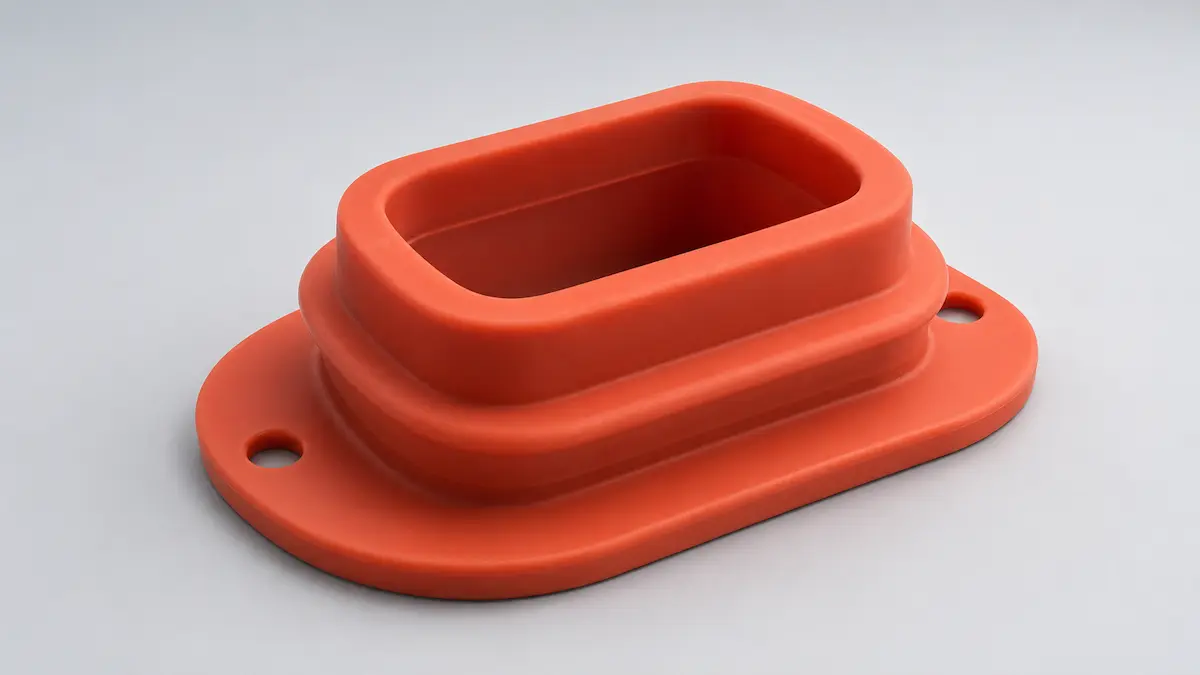
Structure and usage boundaries

For common issues such as threads, snaps, strength, temperature resistance, and weather resistance, identify in advance whether the material needs to be replaced or if another processing method should be used.

Thread Recommendation

Applicable ScopeSilicone Rubber not suitable for directly producing high-strength threads, nor for frequently disassembling and installing threads.
Risk pointLow-load positioning can be done with flexible sockets or press-in structures;
Recommended practiceIt is recommended to use metal inserts, rigid plastic frameworks, perforated screws, pressure plates, or external structural fixes for important connection points. When tightening screws, the Silicone Rubber body should not directly bear the main clamping force to avoid compression deformation, tearing, or prolonged loosening.

Buckle recommendation

Applicable ScopeSilicone Rubber can be used for flexible inserts, elastic coverings, low-strength limits, and soft anti-detachment structures, but not suitable for high-precision strong locking clasps.
Risk pointThe base of the clip should use large rounded corners to avoid tearing;
Recommended practiceThe amount of deformation should be controlled within the recoverable range. Silicone Rubber clips under prolonged stress may creep, loosen, or tear. If highly reliable mechanical clips are needed, it is recommended to use Acetal (POM), Nylon (PA), Polycarbonate (PC), ABS, or metal spring plates, allowing the Silicone Rubber to handle only wrapping, sealing, or cushioning functions.

Strength and Environment

Mechanical strengthThe strength of vacuum casting Silicone Rubber is mainly reflected in elasticity, resilience, tear resistance, and cushioning capacity, rather than rigid load-bearing capacity.
Environmental boundaryHigh hardness Silicone Rubber better support, while low hardness Silicone Rubber softer to the touch and greater deformation.
Recommended practiceSilicone Rubber is not suitable as a high-strength load-bearing structural material; under long-term pressure, attention should be paid to permanent compression deformation and rebound attenuation. The load-bearing structure should improve reliability by thickening and increasing the contact area, combined with a rigid framework. Silicone Rubber temperature resistance generally surpasses that of many common plastics and elastomers such as ABS, Polypropylene (PP), Polyethylene (PE), PU, etc., making it suitable for flexible sealing, cushioning, and tactile applications within a certain temperature range. The specific temperature resistance depends on the Silicone Rubber formula, hardness, and usage environment. Even under prolonged high temperatures, aging may occur, hardness changes, reduced rebound, or color alteration. For high-temperature sealing, food heating, or medical sterilization scenarios, official Silicone Rubber materials with corresponding certifications and temperature resistance ratings should be selected. Silicone Rubber has good water resistance, ozone resistance, aging resistance, and weather resistance, generally superior to ordinary rubber, Rubber-Like TPU, and Polyvinyl Chloride (PVC) Soft Rubber. It has good stability under long-term outdoor conditions, UV exposure, humid heat, and temperature changes, but its color, transparency, and surface texture may still change over time. For outdoor, wearable, medical, food, or long-term sealing scenarios, appropriate grades of Silicone Rubber materials should be selected and verified for weather resistance, sweat resistance, oil resistance, cleaning agent resistance, and aging resistance.

Alternative material selection and final judgment

When customer demand exceeds Silicone Rubber material boundaries, it is necessary to combine strength, temperature resistance, toughness, long-term stability, and mass production goals to promptly recommend alternative materials or processing technologies.

Alternative material suggestions

If full-scale mass production and more stable performance are needed, liquid Silicone Rubber injection LSR or solid Silicone Rubber molding can be chosen; If higher wear resistance and load-bearing capacity are required, Rubber-Like TPU or PU urethane adhesive can be chosen; If lower-cost Soft Rubber parts are needed, TPE or soft Polyvinyl Chloride (PVC) can be chosen; If rigid structural components are needed, ABS, Polycarbonate (PC), Acetal (POM), Nylon (PA), or metal materials can be chosen; If high chemical resistance and low friction are required, PTFE or fluororubber can be chosen.

Material selection suggestions

If customers need to verify Soft Rubber touch feel, sealing effect, cushioning effect, button tactile feel, or flexible assembly structure in small batches, vacuum casting Silicone Rubber is the appropriate choice. If customers require mass production consistency, food-grade certification, medical-grade certification, long-life sealing, or long-term weather reliability, it is recommended to use formal LSR injection molding, Silicone Rubber molding, or certified-grade Silicone Rubber materials. When selecting materials, first confirm hardness, color, transparency, springiness, compression amount, operating temperature, and contact medium.

Already have the blueprints? Directly enter the quotation for custom parts

After uploading 3D/2D drawings and supplementing materials, quantities, tolerances, surface treatments, and delivery requirements, XPartsLab will provide next steps in 3D printing manufacturability, cost, and delivery pathways.