Material Database

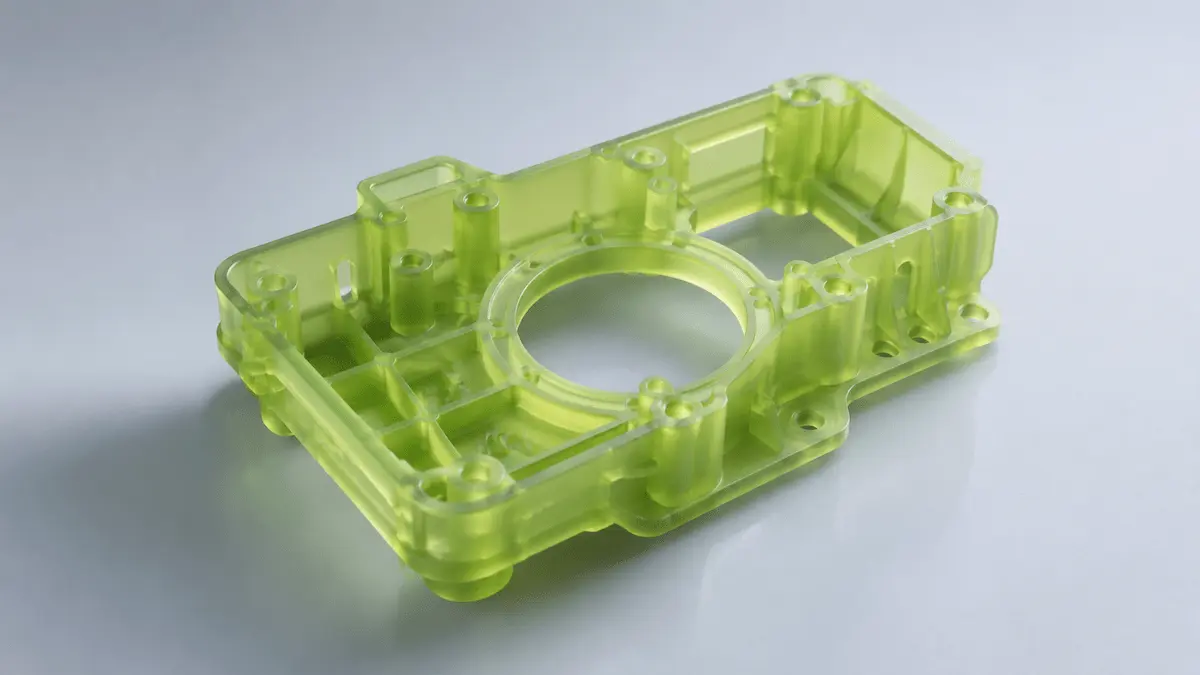
Tough Resin – Yellow-Green

A tough 3D printing material suitable for structural validation, assembly testing, low-strength functional verification, and the production of impact-resistant samples.

Material description

Tough Resin – Yellow-Green is a tough resin material used for photocuring 3D printing, offering better impact resistance, fracture resistance, and bending deformation capabilities compared to ordinary photosensitive resins. It is suitable for 3D printed parts requiring certain toughness, assembly verification, snap-fit testing, structural verification, and functional sample testing, but it is still not equivalent to engineering plastics such as nylon, ABS, or Acetal (POM).

Tough photosensitive resinYellow-green tough resinSLA tough resin3D printed tough resinTough UV-curable resinImpact resistant photosensitive resin
Tough Resin – Yellow-Green is less likely to crack compared to ordinary white or black photosensitive resinsSuitable for test assemblySnap buttonThin-walled casing and lightly functional structureIt preserves the fine surface of photocurable 3D printingThe details are quite goodThe advantage of fast forming speedAt the same time, it enhances the impact resistance and fracture resistance of the parts
Tough Resin – Yellow-Green
3D PrintingPlastics

Material compatibility assessment

By focusing on application scenarios, boundaries of advantages, and non-recommended scenarios, it helps sales, customer service, and quoting staff quickly determine whether the material meets current part requirements.

Core advantages

It has good toughness, better impact resistance than ordinary photosensitive resin, is not prone to brittle cracking, suitable for assembly verification, suitable for buckle and thin-walled structure testing, has high molding precision, and can quickly produce functional prototypes.

Suitable for the product

Structural verification parts, assembly verification parts, snap-fit test parts, thin-walled housing samples, handheld product samples, consumer electronics structural models, medical device structural samples, industrial product verification parts, small-batch functional test parts, and prototype models requiring certain drop resistance.

Not suitable for the product

Long-term load-bearing parts, high-temperature usage parts, high-strength mechanical parts, long-term outdoor use parts, long-term immersion parts, wear-resistant moving parts, high-frequency bending parts, high-frequency snap-fit parts, precision gears, and final mass-produced functional parts.

Key parameter references

The following parameters come from product information and material knowledge fields, used for design review, quotation communication, and preliminary judgment before material selection.

Material positioningA tough 3D printing material suitable for structural validation, assembly testing, low-strength functional verification, and the production of impact-resistant samples.
Precision performanceTough Resin – Yellow-Green usually has good forming accuracy, making them suitable for general structural verification and assembly testing. Because the material has certain toughness and elasticity, slender parts, thin-walled parts, and snap-on parts may experience slight rebound or deformation. The actual accuracy is affected by the part structure, printing direction, support position, post-curing, and post-processing methods.
Dimensional tolerancesStandard dimensional tolerances can refer to ± 0.10mm to ±0.30mm. This value is a reference value for conventional processes and does not guarantee the absolute tolerance of all structures. For thin-walled, slender, snap-fit parts, assembly structures, and large parts, it is recommended to assess risks at ± 0.30mm-±0.50mm, and for precision assembly positions, it is recommended to reserve margin or post-processing.
Minimum Wall ThicknessIt is recommended that the wall thickness be no less than 1.0mm. Small non-load-bearing local structures can achieve about 0.8mm thickness, but large-area use is not recommended. For clips, assemblies, or lightly stressed positions, the recommended wall thickness should not be less than 1.2mm.
Recommended wall thicknessFor standard structural verification parts, 1.2mm-2.0mm is recommended; for clips, thin shells, handheld samples, and parts requiring certain impact resistance, 1.5mm-2.5mm is recommended; for large parts, adding reinforcing ribs or locally thickening is recommended to reduce deformation.
Minimum apertureThe recommended aperture is no less than 1.0mm. It is recommended to reserve machining allowance for precision holes, screw holes, and assembly holes, and drill holes later if necessary. Because tough materials may have slight springback, small holes and deep holes require special attention to dimensional stability.
Assembly clearanceFor ordinary assemblies, it is recommended to reserve 0.20mm-0.30mm on one side; for movable fits, it is recommended to reserve 0.30mm-0.60mm on one side; the positions of snaps and elastic assembly should be evaluated separately based on deformation, wall thickness, and force direction. If painting is done later, an additional single-side gap of about 0.10mm-0.20mm should be added.
Detailed performanceRaised text, fine textures, and decorative lines are recommended to be no less than 0.4mm-0.6mm. Tough resin usually performs well in detail, but its edges may be slightly less sharp than ordinary rigid photosensitive resin. Too small details may weaken during cleaning, sanding, or painting.
Surface effectThe original surface is relatively fine, usually yellow-green or semi-transparent yellow-green, with high visual recognition, but not necessarily suitable for final appearance. After grinding and painting, the appearance can be improved, but if you have high requirements for color and surface texture, it is recommended to choose painting or switch to appearance-type resin.

Typical application scenarios

Based on material characteristics and suitable product ranges, customer needs are broken down into easier application directions to determine.

Product validation

Structural verification parts, assembly verification parts, snap-fit test parts, thin-walled housing samples, handheld product samples, consumer electronics structural models, medical device structural samples, industrial product verification parts, small-batch functional test parts, and prototype models requiring certain drop resistance.

Reasons for material selection

A tough 3D printing material suitable for structural validation, assembly testing, low-strength functional verification, and the production of impact-resistant samples.

Material characteristics

Tough Resin – Yellow-Green is less prone to cracking than ordinary white or black photosensitive resins, making it suitable for testing and assembly, snap-ons, thin-walled housings, and lightly functional structures. It retains the advantages of UV-curable 3D printing surfaces with fine texture, good detail, and fast forming speed, while also enhancing the impact resistance and fracture resistance of parts.

Design and risk review

Based on wall thickness, hole position, assembly clearance, dimensional tolerances, and material usage risks, determine in advance whether the part structure is suitable for Tough Resin – Yellow-Green.

Design considerations

  • It is recommended to avoid walls that are too thin during design
  • Sharp angle
  • Excessive cantilever and large thin planes
  • Load-bearing positions should include fillets and transition structures
  • The base of the clip should be thickened and rounded corners added
  • Sufficient clearance should be reserved at the location where assembly is needed
  • Avoid over-tightening due to material rebound or post-processing
Precision performanceTough Resin – Yellow-Green usually has good forming accuracy, making them suitable for general structural verification and assembly testing. Because the material has certain toughness and elasticity, slender parts, thin-walled parts, and snap-on parts may experience slight rebound or deformation. The actual accuracy is affected by the part structure, printing direction, support position, post-curing, and post-processing methods.
Dimensional tolerancesStandard dimensional tolerances can refer to ± 0.10mm to ±0.30mm. This value is a reference value for conventional processes and does not guarantee the absolute tolerance of all structures. For thin-walled, slender, snap-fit parts, assembly structures, and large parts, it is recommended to assess risks at ± 0.30mm-±0.50mm, and for precision assembly positions, it is recommended to reserve margin or post-processing.
Quality riskThe main risk of this material is that after toughness improvement, its rigidity and dimensional stability may not be as good as ordinary hard resin. Thin-walled parts, elongated parts, large flat parts, and assembly components may still experience deformation, dimensional deviations, or rebound issues. It is suitable for functional verification but is not recommended for direct use as long-term mass-produced functional components.
Surface effectThe original surface is relatively fine, usually yellow-green or semi-transparent yellow-green, with high visual recognition, but not necessarily suitable for final appearance. After grinding and painting, the appearance can be improved, but if you have high requirements for color and surface texture, it is recommended to choose painting or switch to appearance-type resin.

Post-processing and assembly precautions

Post-processing of Tough Resin – Yellow-Green affects appearance, dimensions, hole position, assembly clearance, and usage validation results, and should be explained in advance during quotation, DFM review, and sample confirmation stages.

Post-processing options

Post-processing should focus on appearance display, dimensional fitting, connection assembly, and testing verification. Parts involving assembly positions need to be reserved in advance for machining, coating, and trial assembly allowances.

To support itRemove the printed support structure, focus on controlling the support contact points, and avoid cracking at edges caused by hard prying.
PolishingImproves support marks, layer lines, and edge feel, but will slightly alter local dimensions and the shape of sharp edges.
SandblastingAchieve a more uniform matte surface, suitable for engineering prototype display and slight surface mark reduction.
Spray paintEnhances color and appearance consistency, but will increase coating thickness, so assembly surfaces need to allow for clearance.
ColorWhen adjusting appearance colors or display effects, confirm color penetration, color differences, and subsequent assembly effects.
attacked YaSuitable for low-strength thread verification; the hole edge must ensure wall thickness; frequent disassembly or high-torque locking is not recommended.
Embedded nutsTo improve connection reliability, it is necessary to confirm the hole diameter, embedding depth, and surrounding material thickness in advance.
BondingSuitable for disassembly and splicing or partial fixing, but it is necessary to ensure the glue matches the material, temperature, and stress environment.

Key control point

Size impactTough resin is more elastic than ordinary resin; Pressure should be controlled during sanding; Avoid local deformation or surface roughing; Before painting, surface cleaning and primer treatment are necessary; Otherwise, adhesion may be affected; The positions of tapping and embedded nuts must ensure sufficient wall thickness; Avoid localized cracking or deformation
Assembly clearanceFor positions involving snapping, plugging, sliding, or enclosure closure, the clearance needs to be adjusted according to post-processing thickness, material shrinkage, and trial assembly results.
Hole Position StrengthThreading, inserting nuts, locking screws, and the areas around positioning holes need to ensure wall thickness to avoid cracks, stripped threads, or chipped edges during post-processing or assembly.
Environmental matchingWhen used in high-temperature, outdoor, humid, friction, or load-bearing scenarios, post-processing materials, adhesives, coatings, and fasteners must also meet the corresponding usage environment.

Structure and usage boundaries

For common issues such as threads, snaps, strength, temperature resistance, and weather resistance, identify in advance whether the material needs to be replaced or if another processing method should be used.

Thread Recommendation

Applicable ScopeIt can be used for low-strength tapping and screw assembly verification, but it is not recommended to directly print high-strength threads or frequently disassemble threads.
Risk pointIf reliable connections are needed, it is recommended to use embedded copper nuts or post-processed threads.
Recommended practiceThe screw locking position should avoid being too thin or thick.

Buckle recommendation

Applicable ScopeTough Resin – Yellow-Green is more suitable for buckle verification than ordinary photosensitive resin, but it is still not recommended for long-term high-frequency buckle use.
Risk pointSnap designs should add rounded corners, thicken the base, control deformation, and avoid excessive bending.
Recommended practiceSuitable for one-time or low-frequency assembly testing.

Strength and Environment

Mechanical strengthIt has moderate strength, with toughness and impact resistance better than ordinary rigid photosensitive resins, but its rigidity may be slightly lower.
Environmental boundarySuitable for low-strength functional verification, assembly testing, and impact-resistant samples; not recommended for long-term load-bearing, high-impact, or high-frequency fatigue parts.
Recommended practiceOrdinary toughness photosensitive resin has average temperature resistance and is recommended for use in ambient temperature environments. It is not suitable for long-term exposure to high-temperature environments and is not recommended for final functional parts near heat sources. In high-temperature environments, it may soften, deform, or lose performance. Prolonged UV exposure may cause color changes, aging, brittleness, or performance degradation. The yellow-green appearance may develop yellowing, darkening, or surface aging with long-term use. If used for display pieces or with higher appearance requirements, it is recommended to apply painting or surface protection treatment.

Alternative material selection and final judgment

When customer demand exceeds Tough Resin – Yellow-Green material boundaries, it is necessary to combine strength, temperature resistance, toughness, long-term stability, and mass production goals to promptly recommend alternative materials or processing technologies.

Alternative material suggestions

If greater toughness and durability are needed, nylon Nylon (PA)12 is a good choice; If you need properties close to ABS plastics, you can choose ABS resin or CNC ABS; If wear resistance and precision mechanical performance are required, CNC Acetal (POM) can be chosen; If high strength and temperature resistance are required, CNC aluminum alloy can be chosen; If only for appearance display, you can choose ordinary white or black photosensitive resin.

Material selection suggestions

If customers need to verify the effectiveness of snap-ons, assemblies, thin-walled structures, or low-strength functionality, Tough Resin – Yellow-Green is more suitable than ordinary photosensitive resins. If customers need long-term use, repeated force resistance, wear resistance, high temperature resistance, or performance close to mass-produced plastics, priority should be given to nylon Nylon (PA)12, CNC ABS, CNC Acetal (POM), or metalworking.

Already have the blueprints? Directly enter the quotation for custom parts

After uploading 3D/2D drawings and supplementing materials, quantities, tolerances, surface treatments, and delivery requirements, XPartsLab will provide next steps in 3D printing manufacturability, cost, and delivery pathways.